
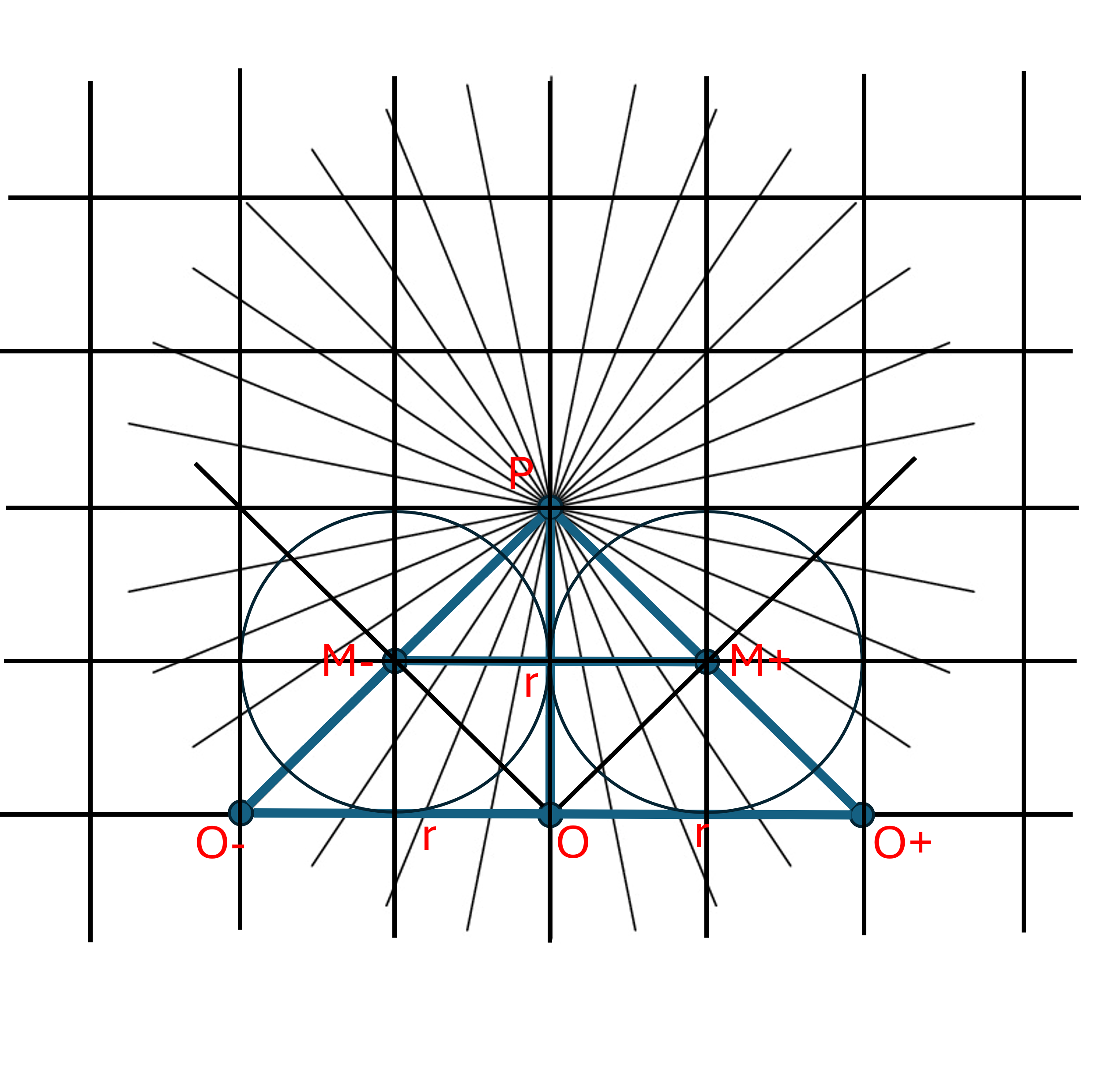
The diagram above shows what our 2-dimensional space looks like when we take the original line (through the points O- O+) and reflect it through the parallel line passing through the points M- M+ to form a reflected parallel line passing through point P. Then like parallel mirrors, we reflect these lines through each other. We can then keep on doing this, reflecting lines to get an infinite set of “horizontal” parallel lines with the same distance apart going on forever upwards and downwards.
Let’s do the same with the perpendicular lines we generate through points M- and M+ and then original line. As we discussed before, the distance between M- and the line of symmetry (O P) is the same as the distance to M+ by symmetry. So, if we generate lines from M- and M+ perpendicular to the original line, they are also parallel to each other, they have the same distance between them forever in each direction.
We can then reflect these “vertical” parallel lines through each other to get an infinite set of vertical lines the same distance away from each other. From the circles around M- and M+ we can see that the distance between these parallel vertical lines is the same as the distance between the horizontal lines. Thus, we have formed a “cartesian” grid that maps out our 2-dimensional space.
One last thing to notice before we finish this thought, the distance “r” between points P and O, could be made to be smaller than an atom, or bigger than a galaxy. Just think, we can make the distance r to be anything we want and then generate a cartesian grid that is any size, from an infinitely large grid to an infinitesimally fine grid.
 Dr. Gary Samuelson