
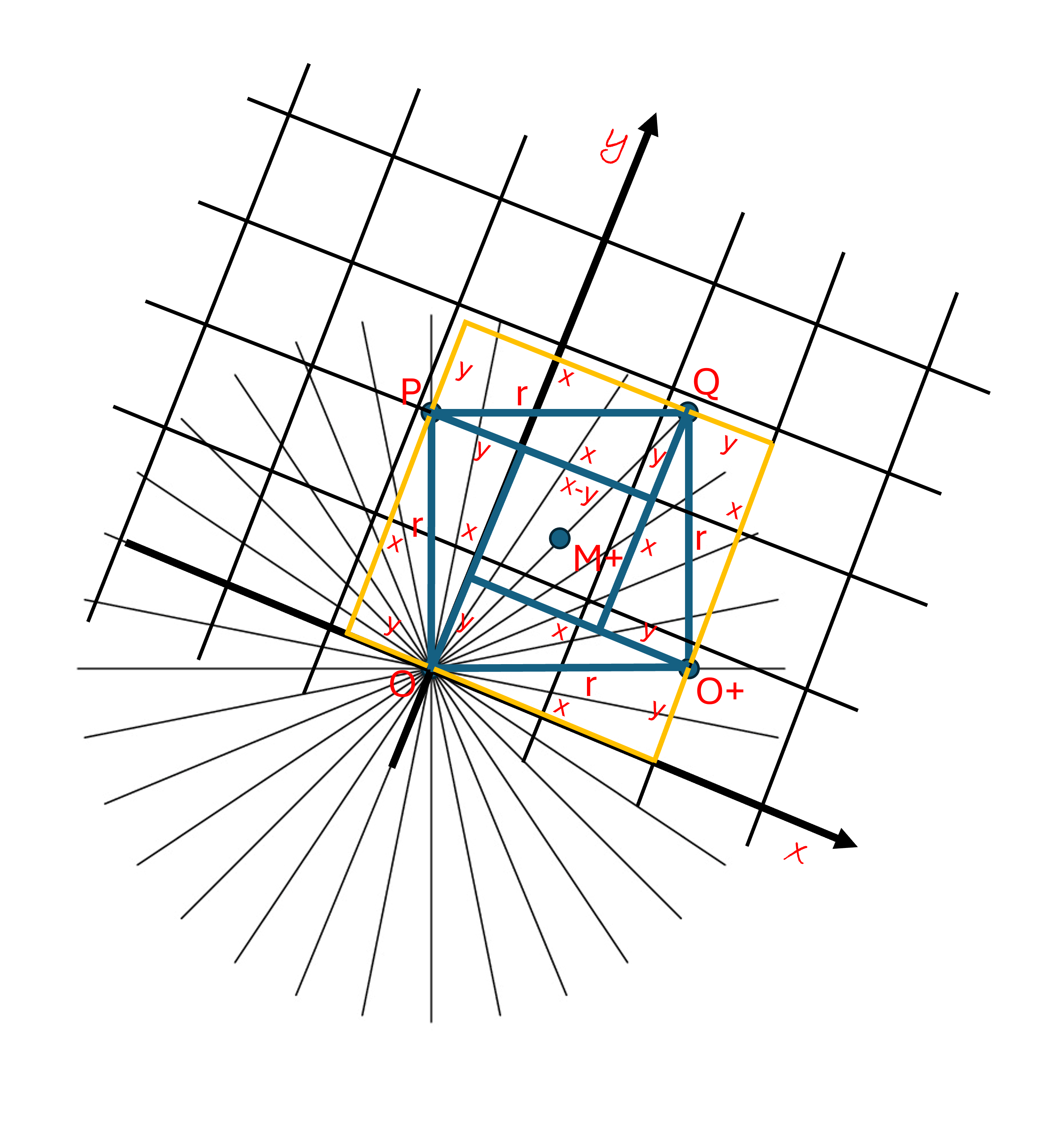
In the diagram above, we used the 4-fold symmetry squares to map the rectangle we saw in the last post onto the sides of the original square. You can rotate this diagram onto any of the sides of the yellow square (with side lengths of x+y) and see that it looks exactly the same, but with the reference points and directions rotated.
It also becomes immediately obvious that the area of the larger yellow square is (x+y)*(x+y) = x2 + 2*x*y +y2 (from the distributive property, not explained here). Since we know that all the triangles have an area ½*x*y and there are 4 of these triangles (one on each side of the large square) the total area of the 4 triangles are 4*½*x*y = 2*x*y.
By staring at the diagram, you can easily see that the area of the large square is the same as the area of the original square (r2) plus the area of the 4 exterior triangles. This is written:
(x+y)*(x+y) = r2 + 4 * ½*x*y
using the relations above, this is:
x2 + 2*x*y + y2 = r2 + 2*x*y
since the 2*x*y is the same on both sides:
x2 + y2 = r2
This proves the Pythagorean theorem and shows how we can relate any rotated frame of reference with any other one. Finally, this gives us a ruler that we can use to measure distances in any direction.


I really enjoyed this geometric approach to proving the Pythagorean Theorem. The way the areas of the large square and the four surrounding triangles are compared makes the cancellation of the 2xy terms feel very natural. I also like how the proof connects the theorem with measuring distances in different directions rather than treating it as only an algebraic formula. This explanation of the Pythagorean Theorem and its applications is also useful for reviewing the underlying idea: https://pythagorastheoremcalculation.co/what-is-the-pythagorean-theorem/