New Hope for Health Care – Value Proposition

It always amazes me that after spending over $800,000,000 USD (as required by the FDA) to approve a medication for a specific disease, and after conducting dozens of placebo-based double blind human studies, the results of these studies are rarely publicized by the pharmaceutical companies. In many cases, the study results are even hidden behind foundations or other barriers to prevent inspection by the public eye.

Even more amazing to me, after a medication has been released to be sold to the public, there are rarely follow up studies to determine the real-world safety and efficacy of such (unless a large number of people are gravely harmed by it). Any attempt to hide scientific research that is of paramount public interest has never set well with me, especially when the research has been financed by public funds. I speak from the viewpoint of a PhD level researcher.

The adverse side effects of medications, however, are required to be publicly disclosed. Evidence of this can be seen in pharmaceutical advertisements. Public advertisements often feature actors that are depicted as being happy to be free from the ravages of the disease but offer little else of substance except for occasional mild claims that it works under certain conditions. This is then followed by the long list of possible side effects.

New hope for health care simply comes with a better public disclosure of the scientific study results. Imagine if there was an official government website that published the scientific findings on treatments from all credible sources, summarized on a table that looks something like this:


Disease: Flojitis Type x (fictional)

TreatmentDescriptionLength of
Treatment
Improvements
Observed
Average %
of People
Improved
Cost
per
month
Side Effects
Blue Pill2x daily……Life……controlled…23%$2400…kidney…
Mineral xinfusion…3 weeks……reversed…81%$350…nausea…
If you had this disease, which one of these treatments would you choose?

My intuition tells me that this would probably be a VERY popular website. Especially if it was comprehensive, unbiased, and verified by independent scientists. The real evolution would come when people start to realize that they have the freedom and information to make informed decisions between various treatments.

The whole health care market would shift overnight. Verified treatments for certain diseases would become fiercely competitive. The science behind treatments would fall under strict scrutiny. Pharmaceutical companies, universities, and hospitals would hustle to find better, more cost-effective, solutions. The entity that found better methods would profit the most. Cost of health care would plummet. The quality of treatments would skyrocket. The number of options would compound.

In short, the health care system would naturally be healed, everyone would have a new hope for health care. What do you think? Please leave your opinions in the comments.

Standard

New Hope for Health Care

Walking into a modern hospital always gives me a sense of apprehension. Sometimes I experience an unsettling feeling of uncertainty, I am not sure what to expect. Other times I feel profound sadness, hopelessness, and sometimes emotional pain as I anticipate many shades of suffering. As an incurable optimist and medical researcher, I have often felt a sense of hope that some medical professional inside will know enough to fix the health problem that I am struggling with. As a realist, however, I know many of the limitations of medical science. Very seldom do I ever feel a sense of surety or freedom.

Imagine that you need to go to the hospital; how does it make you feel?

I have an entirely different experience walking into an electronics store. Before going in, I have already spent some time researching what I want to purchase. I know the expected prices. I know the quality and capabilities of the products I want. I have checked the reviews. I have purposefully chosen a store with great service. I still hope that someone inside knows enough to help me fix any problem I struggle with. Often, I feel a sense of surety and freedom. I am excited about seeing some new cool stuff. I feel I can make the best educated choice possible.

How do you feel when you walk into your favorite retail store?

Since health is so important, wouldn’t it be great to feel more confident in the health care system? Wouldn’t it be great to know what to expect before walking into the hospital or doctor’s office? What if you knew the available treatments, expected outcomes, and how much it would cost to get better? What if you could make the best educated choice beforehand? Wouldn’t it be wonderful to feel better and get your life back without the unnecessary pain or loss of freedom?

Our amazing mind is built to evaluate millions of pieces of information and to put them together. When there is a perceived benefit or danger, our feelings help guide us. We purchase things more based on feelings than rational thought. This is an amazing ability, and its effects are well known. It generally helps us to progress, to have a better future. Can this amazing ability to feel help us to find a way to make a better health care system?

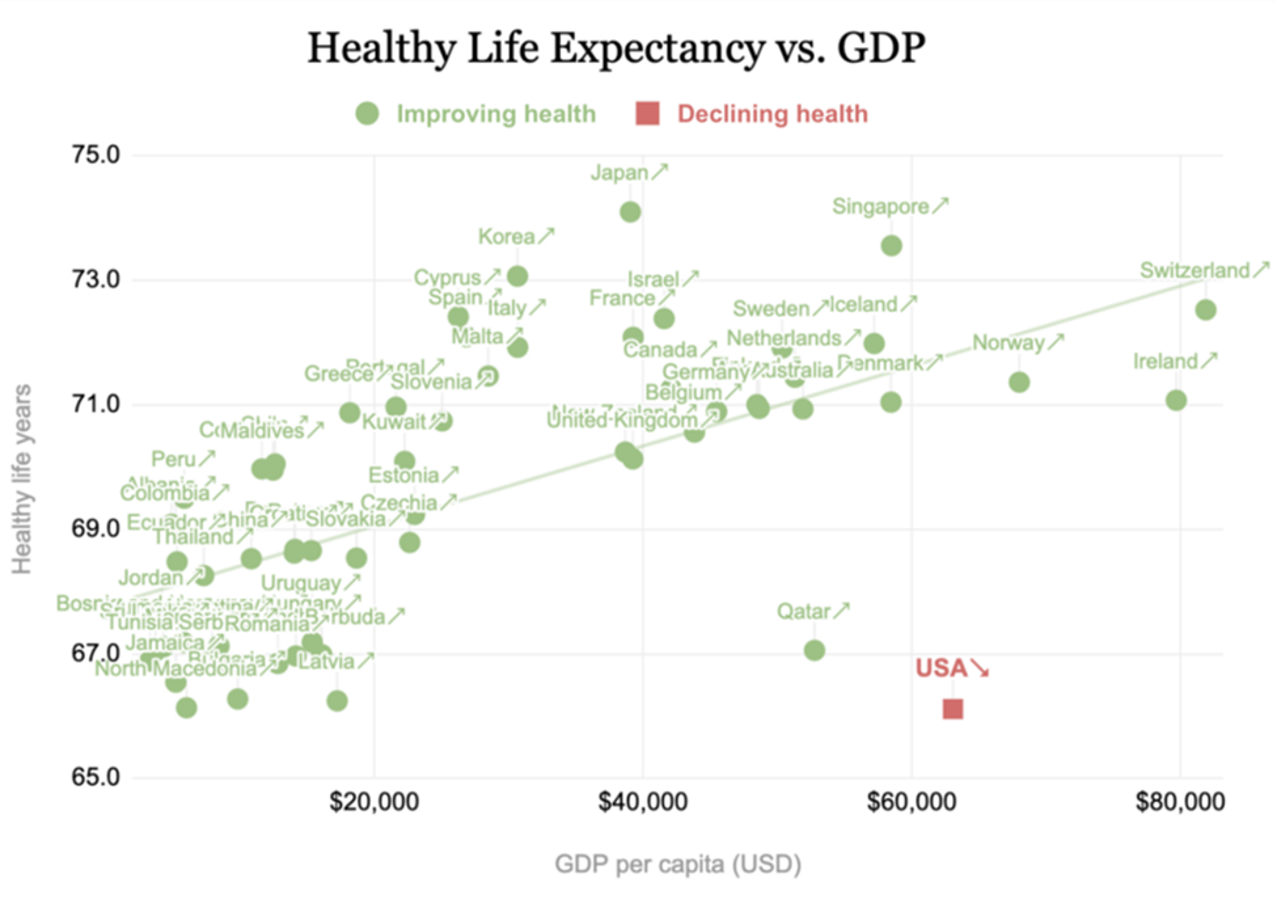
A radically better health care system is certainly needed. We all feel it. In the United States, where I live, health care costs are escalating, and benefits are decreasing. Despite spending more, up to 25% of our GDP, our healthy lifespan is going down. This is a sure indicator of an unhealthy system. The health care system profits more from sickness than it does from wellness. In contrast, with a healthy system, the prices go down and benefits increase. This is why we all love the electronics industry so much.

What if we were to build a health care system that is designed to profit more from wellness than from sickness? After many years of being a professional in the health care industry, I have found many ways to do this. It gives me a feeling of great hope and excitement. I have grown weary of standing by and watching people suffer when there are many proven solutions available.

This is a first of a series of posts that offers a view of new hope for health care.

Standard

Math Moments – Extending Spaces into New Dimensions

So far, we have been exploring a 1-dimensional “space” of points along an infinitesimally thin line. Mathematicians call this a 1-dimentional space. The concept of symmetry implies that the line looks exactly the same in both directions. Therefore, this line must extend on forever in both directions, there is no point on the line where it ends. The line looks exactly the same on both sides of every point.

The concept of point symmetry in 1-dimensional space also means that if you were to reverse the direction of the “ruler” that measures the distance between any two points in this space, you will still measure the same distance between the points. This concept of invariance of direction is one of the most important characteristics of space. Of course, we need a lot more than just one line to describe all the space around us.

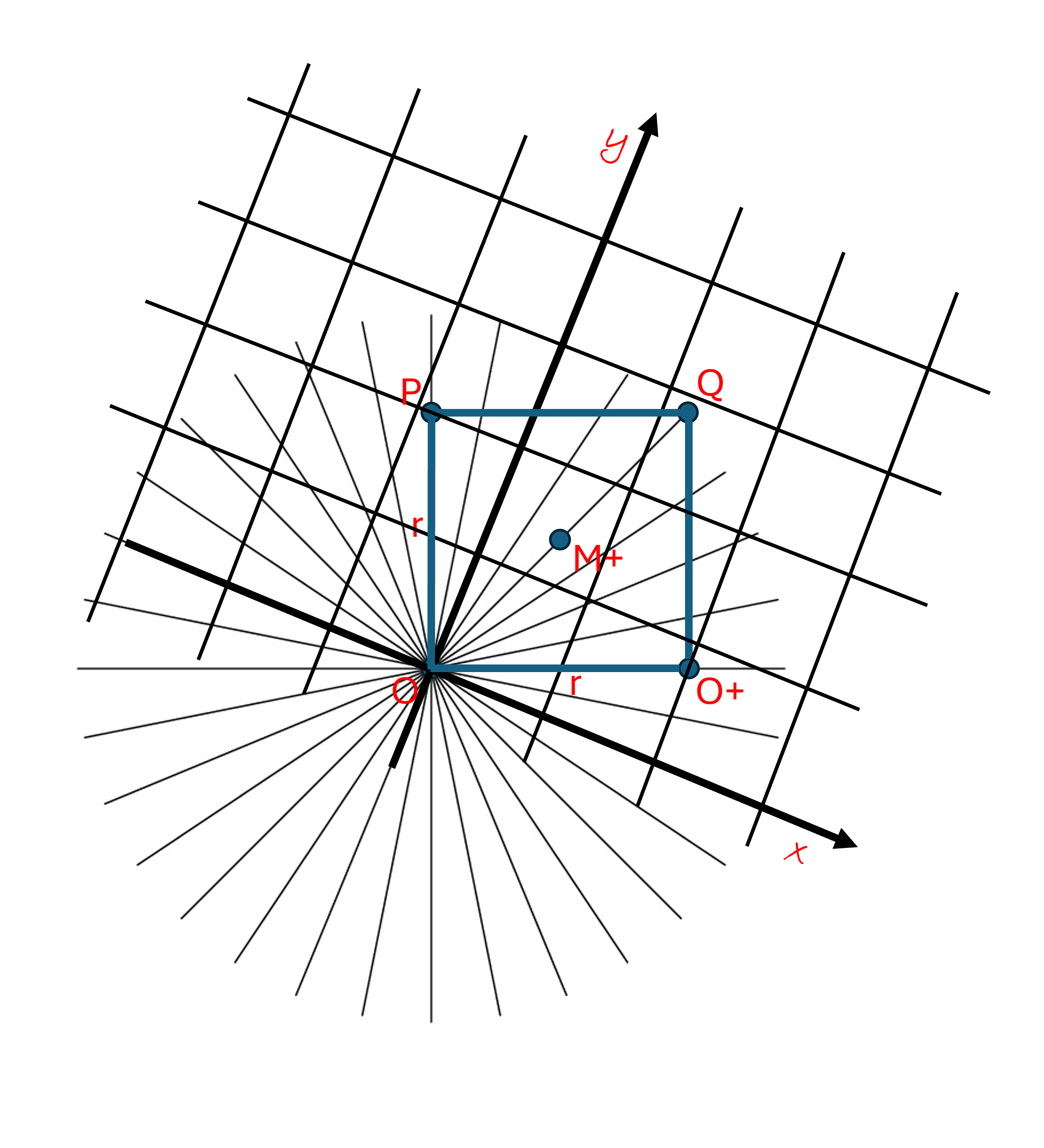
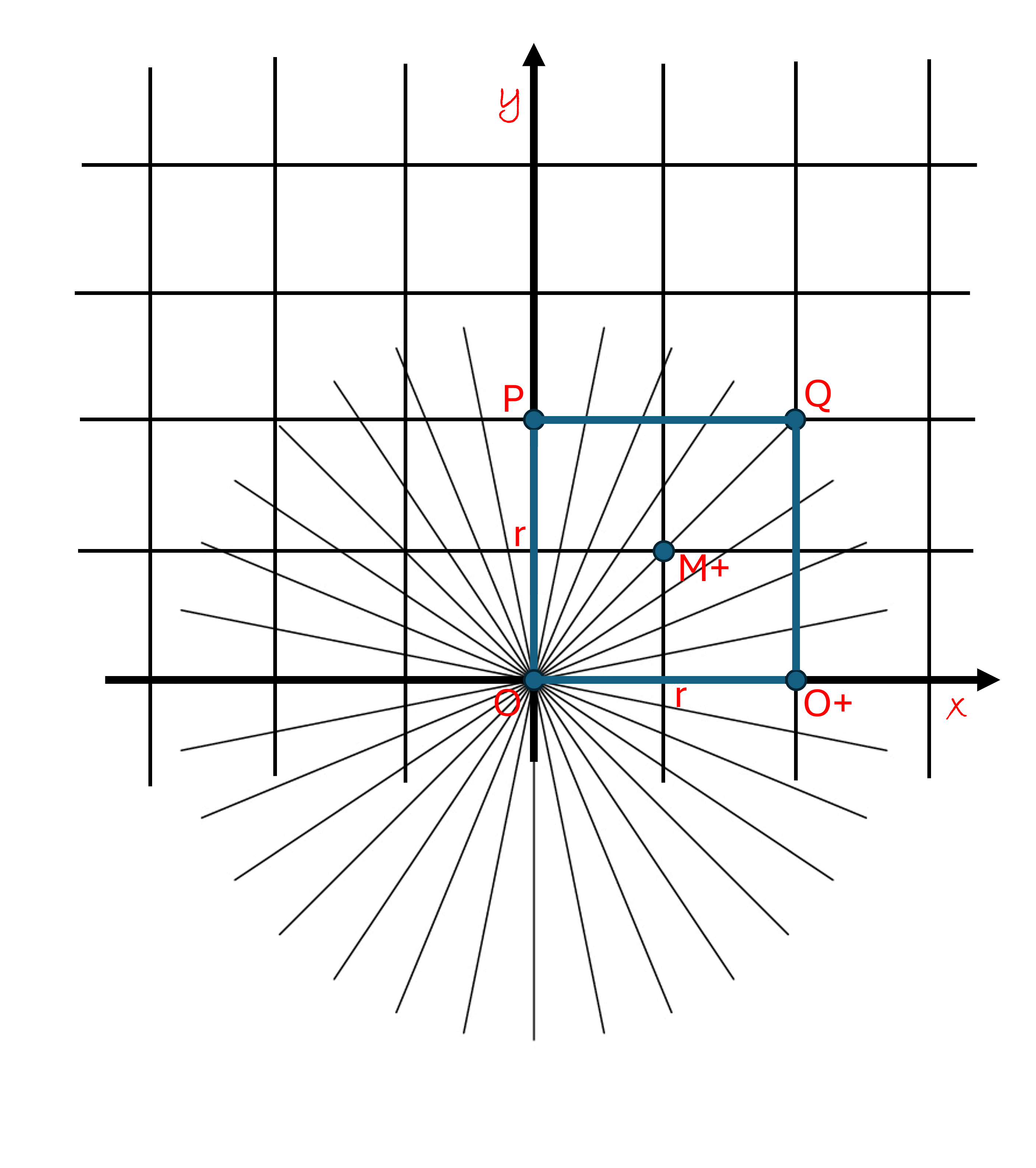
In order to expand the dimensions of space beyond this 1-dimensional space, we must assume that there is some point that is not in this space, a point that is not on the line. When we find a point that is not on the line, we can create a new line between any point on the line and the new point. This defines a new 1-dimensional space (a line) for every point on the original line, all of these new lines pass through the new point.

Since there are an infinite number of points on the original line, we see that there are an infinite number of 1-dimensional lines that can be drawn through the new point all in different directions. The space formed by this infinite number of lines is called a 2-dimensional space. It is called 2-dimensional due to the “language” necessary to describe the location of any point in this space. To locate any point, we must choose a reference point, then first (1) we need to choose one of the lines passing through the reference point, and second (2) we use the methods we have already discussed to determine the location of a point along this reference line. Thus, the location of a point thus requires 2 numbers, one (1) to locate the reference line, and the other (2) to determine the location of the point along this line.

The concept of point symmetry in 2-dimensional spaces also comes into play. It means that measuring distances is the same in every direction. This invariance of direction means that if we have a “ruler” that measures a distance along any of the lines in this space, and we change the direction of the ruler, the length of the ruler does not change.

Imagine how the world would look if measuring lengths in one direction were different than lengths in another direction. If the invariance of direction was not true, then when we changed direction, the distance between things would shorten or lengthen, depending on which direction we faced. This is not what we experience in real life.

We can use the same concepts that we used to extend 1-dimensional space to 2-dimensional space to extend into spaces into any number of dimensions. How many distinct points do you need to generate a 3-dimensional space? Think about it. We will discuss how it can be done later.

Standard

Math Moments – The power of symmetry

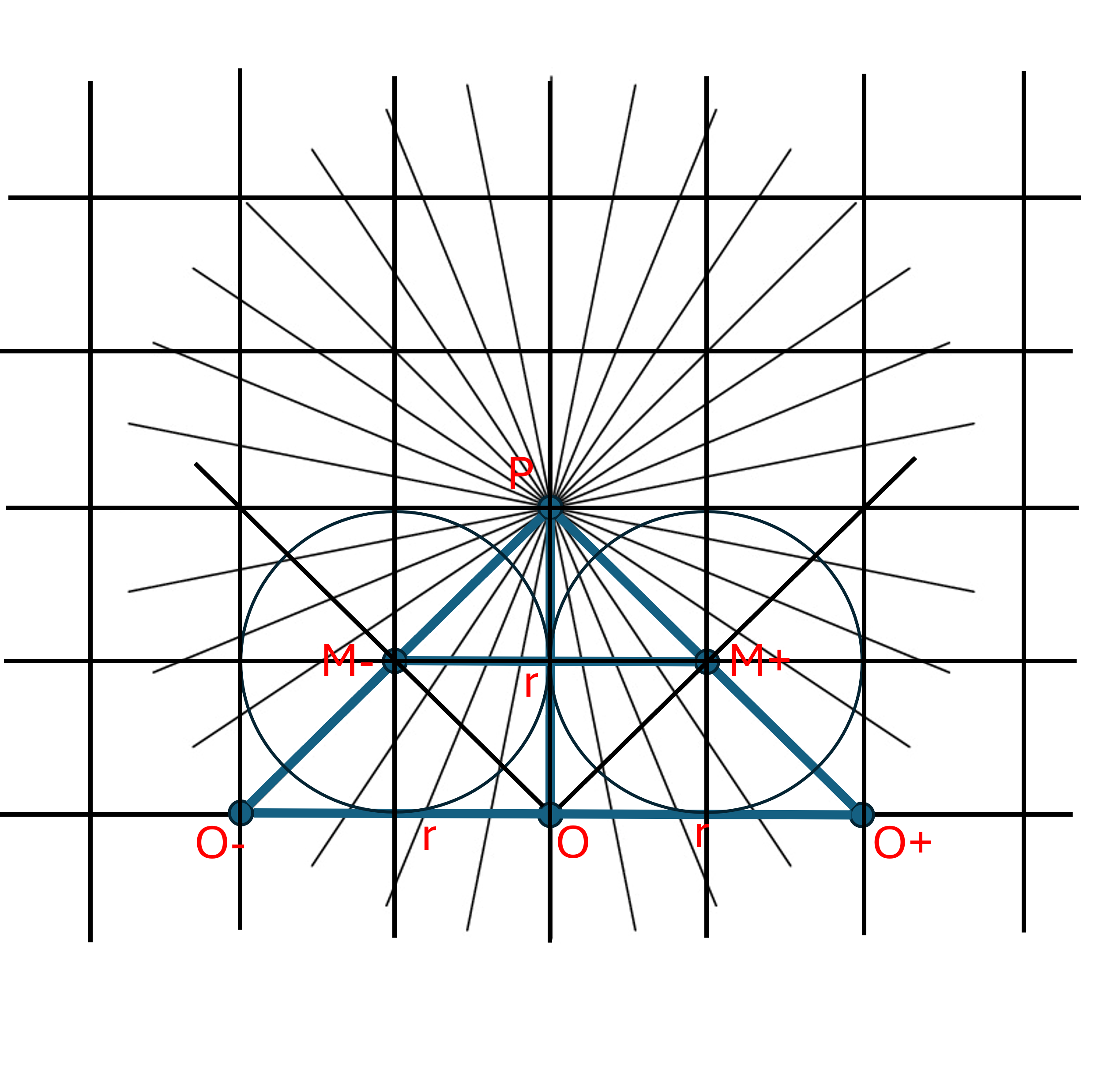
If we were to consider any two points in the universe (A and C) and draw an imaginary line segment between these two points, there would be only one singular point on that line segment that preserves symmetry (under reflection). This is the midpoint (B) on the line segment which is exactly the same distance from each of the endpoints. You can reflect (flip) either one of the endpoints through the midpoint and it would fall exactly on the other endpoint. Such symmetry applies to all points on the line segment that are the same distance from this midpoint.

If you were to pick the midpoint as the reference point and the positive direction pointing toward one of the endpoints, then from the midpoint, the line segment in the positive direction looks exactly the same as the line segment in the negative direction. You could conceptually switch the positive direction with the negative direction, and nothing would change. This is called reflection symmetry, for obvious reasons.

If you have reflection symmetry, then anything that exists at a certain distance along the positive direction, also exists at that same distance in the negative direction; just like looking at things through a mirror. We use such symmetries in atomic physics all the time to make things easier.

For example, the electric field between two identical electrons, as observed from the midpoint between them, looks exactly the same when you are facing one electron as it does when you are facing the other. From the midpoint, everything is exactly the same in both directions, you cannot tell the difference between the electrons nor any of their physical properties from this perspective. To tell the difference, you would need to “break the symmetry” by introducing something else that is not symmetric to the midpoint.

So, once you have seen what exists on one side of the “mirror” we also know what will exist on the other side. It makes the math (and the diagrams) so much easier. We always should seek out these points of symmetry when we are doing the math, it makes everything so much more…symmetric.

Standard

Crystal Clear Vision – First Step to Success

Have you ever been in a place where your life seems unresolved? Have you felt that the dreams you have had for years, those things that have inspired you, the things you really wanted to happen, always seem to be out of reach? Have you wondered why no matter how hard you try, or how much your heart desires it, or wherever you go, you don’t seem to be able to achieve it in your life? Are you sensing that your time, your health, your strength are gradually fading away?

There is really only one way to create and realize the things desired in your life. It always starts with clarity of vision and focus. How clearly can you see exactly what IT is? Your eyes focus the light bouncing off real objects in your environment to form a clear image of them on the back of your eye. There the retina transmits this image to your mind. There is only one tiny spot on the retina, called the macula, where the image is crystal clear. As you move your eyes around, your mind pieces together an image of the reality of your world. Your mind only retains the images of things that are of the greatest importance to you. Your world exists entirely in your mind.

Do you realize that this works the other way around? The images that you form in your mind are the things that you make into your reality in the world around you. Everything you see in your home was first created in the mind of someone, in all its detail. You placed such objects in your home according to the vision in your mind. The process of creation starts in the mind. To the extent that you can imagine and form your reality in your mind, will you be capable of realizing it in the world. Everything in your world starts with an image of it in your mind. The first step to achieving anything you want in your world is to form a crystal-clear image of it in your mind.

The power of imagination is the power of creation. The more real and resolute it is to you in your mind, the more likely it will become your reality, in all its glory. According to the creation story in the Bible, even the earth was created in the mind of God before it existed: “And God said, let there be light, and there was light.” This is a powerful principle. If something you desire does not exist in your life, the first step is to work to form a crystal-clear image of it in your mind, with all of its detail. Otherwise, you will find it hard to arrive at the place you want to go if you don’t know where it is, or what it is. Imagination requires real work.

I will give you an example from my own experience. I have always wanted to see a global health care system that really works, based on the verifiable truths being discovered by science. How wonderful it would be to live in such a world. I have seen technologies that drastically accelerate the speed of tissue healing, disable harmful microbes, and heal whole organs. I know how we can prevent more than 80% of the horrible diseases that we currently suffer. This vision has not been realized in my world yet.

I imagine a world where everyone would have the tools and knowledge they need to heal themselves. I have formed a Cellular Health Coaching organization that provides these tools and teaches my friends to heal themselves. I have finally come to see that the that the only way to realize this vision is to create it in my mind and share a crystal-clear vision of it to the world, complete with the necessary infrastructure. My heart is full, I am now recommitted to this vision. I hope to bring this realization to your world also.

Standard

Math Moments – How many Points are on a Line Segment?

If you have fun with the concept of being able to zoom in to a single Point forever, always getting closer and closer but never arriving, you are one step closer to understanding the concepts of advanced math and calculus.
You saw that with any two points you could always find a point that is exactly in the middle. You can then take this midpoint as a new end point and find another point that is in the middle of it. Since points have no size, you can keep on cutting these line segments in half forever.


No matter how close two points are together, you can still find a point in the middle. Thus, there are an infinite number of points in any line segment, no matter how short it is. This is an example of the concept of a countably infinite set of points. It is possible to write out list the location of these points as their distance from the reference point: 1/2, 1/4, 1/8, 1/16, … and so on forever.


You could just as well cut the segments into thirds, with the location list of points: 1/3, 1/9, 1/27, … and so on forever. Notice that this list of points does not have any of the same points as the one in the last paragraph. So, it appears like you could go on forever filling in all the gaps by dividing the segments up evenly and still never fill in all the gaps. So how many points can fit into the line segment between any two endpoints, no matter how short? Can we ever find a way to fill in all the gaps between points? To fill in all the points between any two points, we would need what is called an uncountably infinite number of points. This is a concept that mathematicians have not yet resolved.

Standard

Math Moments – The Number Line

Let’s imagine that you have a universe with only two points in it. You now draw a line segment between the two points and choose one of them to be the reference point. The location of any point along the line segment is now determined by the distance it is from the reference point. Now make a third point on the line segment that is exactly half-way between the two points. This new point is located at exactly half of the distance between the two end points.


Can you see the symmetry that is formed by these three points? The distance from the center point to either of the two end points is exactly the same. If you now were to choose the center point to be the reference point, then both end points would be the same distance away, but in opposite directions.


You would now need more than just the distance measurement alone to determine the location of points along the line. With three points, now direction becomes important. Again, using the axiom of choice and can choose which direction from the center point is positive, and which direction is negative.


We can then, finally, determine the location of every point on the line by specifying both a distance and a direction (positive or negative) from the center point. This arrangement of determining the locations of points on a line is called a “number line”. We call the distance and direction of each point on the line the Point’s coordinates. A Point’s coordinates uniquely determine its location on the line. Finally, we have a way of determining the location of a Point.


The center point is a special point of symmetry between the two endpoints. We can “rotate” the direction (exchange negative for positive directions) and the location (distance and direction) of the two identical endpoints would be exactly the same. This is called “rotational symmetry”. It means you can switch reference directions and the list of all the point coordinates will be the same. Remember that since you can’t tell the difference between points, the order of the list of points is not important.


Please believe me, taking the time to understand these concepts makes math so much more fun and easier later on. Learning these concepts is like learning the basic vocabulary of the math language.

Standard

Math Moments – 1-Dimensional Space

How can the exact location of the Point be described? This is a conceptual problem. It is also where some very advanced concepts of math (found in calculus and number theory) come to play. After some thought, it becomes obvious that if there was just one point in the universe, all by itself, it does not have an absolute location until you look at where it is relative to another point in the universe.


If there were only two points in the universe you could imagine a line segment drawn between the two points, and then there is some distance between the two points, you could pick one of the points as the reference point. Then you could describe the location of the second point as being a certain distance from the reference point. You only need one (1) distance measurement from the reference point to describe the location of the Point. This is why such a line is called 1-dimensional space.


You have now discovered quite a few interesting concepts, including the concept of the number “2”. Two identical objects in space that are distinguished by the distance between them. You have also discovered the concept of the number “1”, the concept of distance, and you are also starting to realize why Einstein’s theory is called the theory of relativity. Distances and times are only measurable relative to a reference point, and you can pick any of the points to be the reference point.


The idea that you can pick any of the points to be the reference point is called the axiom of choice. An axiom is something that is assumed to be true even though it has no definite proof. The axiom of choice forms the conceptual foundation for all mathematics.


Another concept that comes from using the distance from a reference point to describe location is the idea of symmetry. You can exchange the locations of two points, and you have not changed anything. It is impossible to tell the two points apart, and both points still have the same locations relative to every other point. This is called exchange symmetry. Symmetries makes math and physics much easier.

Standard

Math Moments – What is the Point?

The most singular concept in Math is that of a Point. In math language, a Point indicates a location in space that has no size or shape (it has no dimensions). People often represent it by a dot “.” on a piece of paper. But, the dot itself has a size and shape, and so it does not qualify as a point.


If you were to magnify the dot, you might be able to find the ink-atom that is nearest the exact center of the dot, but this is not the Point either because atoms have a size and shape. You could try to find the exact center Point inside the atom, but whatever you pick has a dimension and still would not satisfy the definition of a point. This is where you really need to start using your imagination.

Soon you would zoom in to a space around the point that is so small that everything else would be so far away in comparison that you could no longer see any of it, and the only thing inside this tiny space would be the Point itself. You could keep on zooming in for all eternity until the only thing in all space around it would be the point itself.


The Point has zero dimensions. The point itself does not even exist. In math language, it is infinitesimally small. So, what is the Point? By the definition of a Point, it has no size or shape, but it does have an exact location. Exactly how can we describe the location of the Point?

Standard

Hello My Friends — It has been a while…

I miss sharing my thoughts with you and hearing your thoughts in return. I haven’t been very verbal lately, mostly because there have been some difficult circumstances in my professional life. I have not felt the need to talk about them and yet they have weighed heavily on me.

There are so many things that I want to do to change in the world, I know many solutions of great value and have struggled to find an effective way to get cellular health solutions out to the people who need them. Through all of this and years of learning from the masters, I have found that the only way I can change the world is to change myself into the person that is able to accomplish the visions I have in my own life and then reach out to others. I am redoubling efforts on my professional pursuits also.

I would very much like to get back into contact with all of my friends throughout the world and continue to share with you things that are meaningful and powerful to me, and so I am restarting some weekly blog posts and social media posts to share my thoughts with you. And since I am passionate about atomic science and math, I also would like to post a few “fun” posts on these topics as well. If getting in touch is interesting to you, please join our community discussions, weekly. They are at present on Thursday at 9:00 am mountain time on zoom:

https://us02web.zoom.us/j/126930637

Best wishes to you all,

Gary Samuelson, PhD.

Standard