While we are here, it might be fun and instructive to work out the math for the trajectory of a falling object using the calculus tools we have developed.
Experiment has shown that if you drop an object, it starts out at 0 velocity and starts moving downward so that after 1 second it is traveling at 9.8 meters per second (m/s) downward, after 2 seconds it is traveling at 19.6 m/s downward (exactly twice as fast). And so, the velocity in the downward direction (negative y-direction) is
vy(t) = -(9.8 m/s/s) * t
where “t” is the time it has been dropping.
We often use the letter “g” to be the acceleration of gravity g=9.8m/s/s to show how fast things speed up when they are dropped. It is measured in meters per second per second.
Thus, when we drop an object, we then can calculate the speed that it will be falling at every moment “t”:
vy(t) = -g * t
We want to find the position of how far it has dropped at every moment “t”:
vy(t) = dy/dt = -g * t y(t) = ?
We can use differentials and the Integral function from the previous post to figure this out, we drop the object at some height when t=0, “y(0)”, and want to know the height at any time “t”, “y(t)”:
dy = -g * t * dt
Iy(0)y(t)(dy) = I0t(-g*t*dt)
y(t) – y(0) = I0t(-g*t*dt)
We can find this Integral if we know the Anti-Derivative of -g*t:
AD(-g*t) = -g*t2/2 + C
Which you can check by taking its derivative again. And so, we can solve the integral I0t(-g*t*dt):
y(t) – y(0) = AD(-g*t)(t) – AD(-g*t)(0)
y(t) – y(0) = (-g*t2/2 + C) – (0 + C) y(t) – y(0) = -g*t2/2 or y(t) = y(0) – g*t2/2
which gives you the y(t) coordinate of the object that you dropped from a height y(0) at all values of “t”. This is proven out by experiment.
Let us figure out Newton’s problem of finding the trajectory (x(t), y(t)) of a cannon ball that is shot in a direction (Dx, Dy) at a speed “S” at the time “t=0”. We set up the coordinate so that “y” is pointing in the upward direction and “x” is pointing horizontally in the direction the cannon is fired. We know the velocity at t=0, and the position of the cannon is (0, 0):
(vx(0), vy(0)) = (Dx, Dy)*S (x(0), y(0)) = (0, 0)
So since
(vx(t), vy(t)) = (dx/dt, dy/dt)
And the velocity in the x-direction “vx” does not change vx(t) = vx(0) and the velocity in the y-direction is always decreasing vy(t) = vy(0)-g*t:
Finally substituting in our starting values from above:
(x(t), y(t)) = (Dx*S*t, Dy*S*t – g*t2/2)
We have arrived at the trajectory of the cannon ball at every time “t”. It is a simple formula that depends only on simple math that is easy to calculate.
At this point, you might sense that we can in theory solve for the trajectory of any object if we know the acceleration that is acting on it at any point in space. This field of study is called kinematics, and it is used to figure out the trajectory of planets in orbit, or trajectories of rocket ships floating through space, or basically the path of any other object in the universe. This is also what must have been floating through Newton’s head when he realized that these principles were universal.
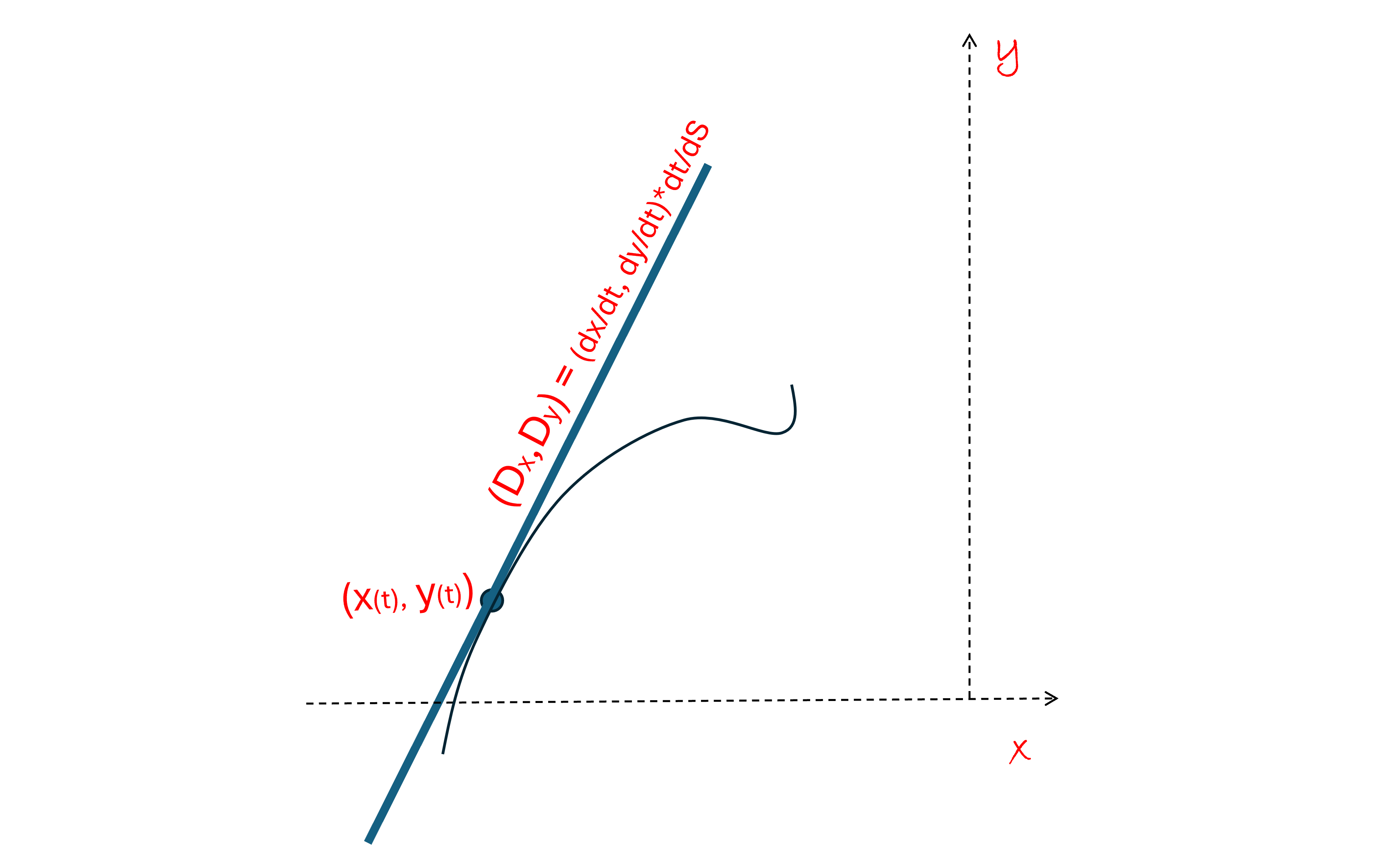
While we were drawing curves in 2-D, you might have realized that the derivative of the curve at any point (dx/dt, dy/dt), gives us the “direction” (Dx, Dy) and “speed” (S) of the point (x(t), y(t)) as it travels along the curve:
(dx/dt, dy/dt) = (Dx(t), Dy(t))*S(t)
We used the function notation to suggest that the “direction” and “speed” may also vary at every point “t” along the curve.
To illustrate this concept, let’s return to the example of a car traveling along a straight road (along the x-axis). If x(t) gives you the position of the car at any time “t”, then the distance “dx” describes the distance the car travels in short time “dt”. Thus, dx/dt gives you the velocity “vx(t)” the car is moving in the x-direction at exactly the time “t”.
dx/dt = vx(t)
Now, if I was in the car, and didn’t know exactly where I was [x(t) = ?], but I did know my speed vx(t) at every point in time “t”, then I could theoretically calculate how far I have moved by adding up all the distances “dx” that I have moved over all the short time intervals “dt”.
dx = v(t)*dt
Recall that the concept of a differential, dx = x(t+dt) – x(t), involves the length and direction of an infinitesimally small segment between two points. Even though the distance between the two points gets as small as possible, we still envision that there is an infinitesimally small line segment between two points. I can figure out how far I have traveled by adding up all of these small dx segments over time.
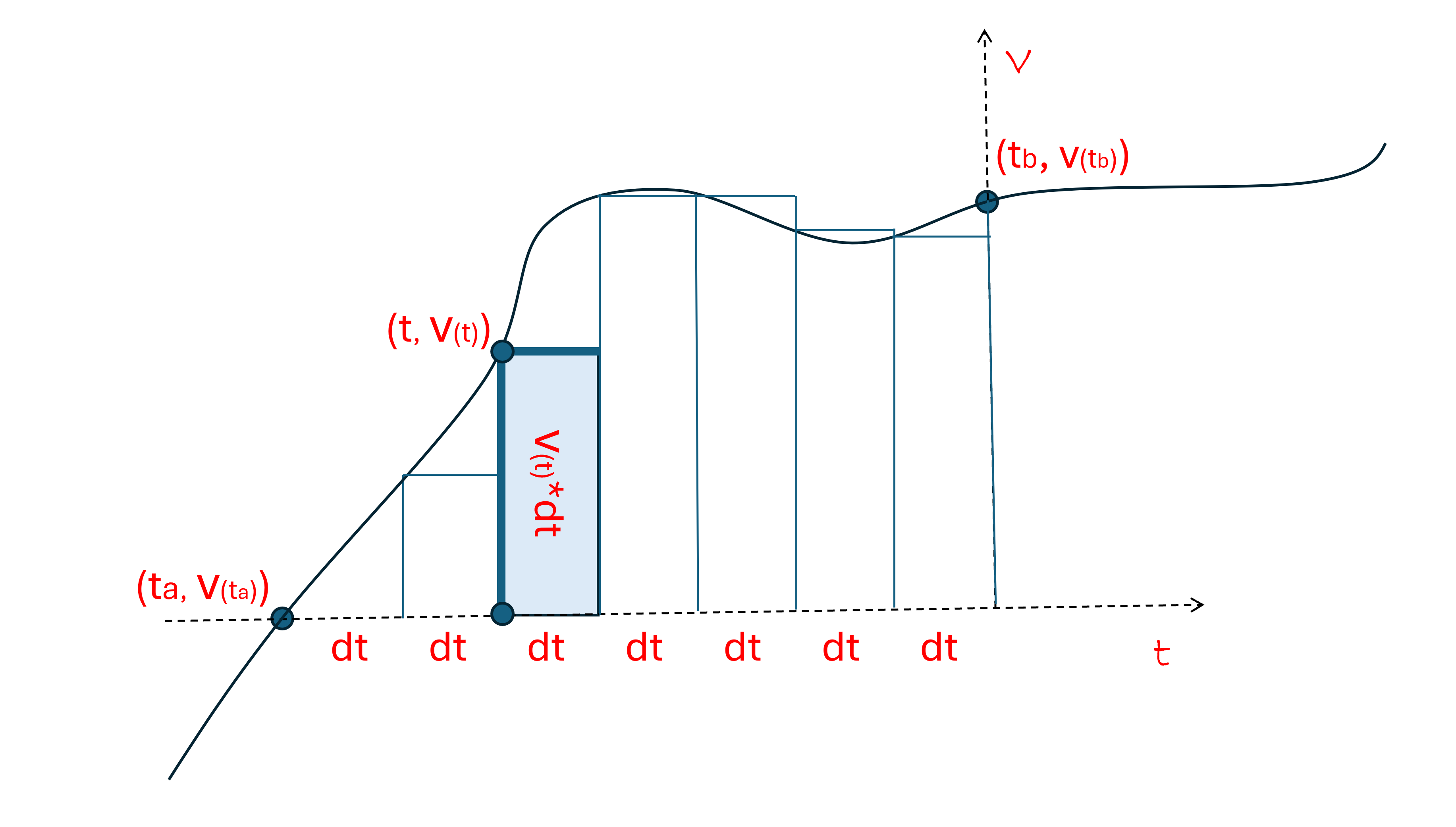
So, for instance, if I could make “dt” to be one second, and I was able to measure my starting “vx(t)” velocity at every second, I could add up the distance traveled over each of the one-second intervals and would be able to calculate the approximate distance that I moved over a certain time period. Note that this calculation would be approximate, because I could have changed velocity during any of the 1 second intervals. Please refer to the diagram below for clarity.
But remember, we make the “dt” segments infinitesimally small, and since I know the velocity “vx(t)” at every instant, I can get a much more accurate result when I shorten the time intervals. When the “dt” length approaches zero, the number of segments approaches infinity, and adding them up I should be able to calculate exactly how far I have moved from my starting point. I just have to accept the idea that I can add up an infinite number of infinitesimally small segments and still get something that makes sense.
We now look at the concept of an Integral function “I” that adds up all the infinite differential segments between a starting point “a” and ending point “b” and returns the sum of the distances between them. Since we assume that each of the “dx” segments are equal in size, we define the integral function that adds up all the differential segments between two points, x=a and x=b:
Iab[dx] = b – a (all segments “dx” are “equal” in size)
This doesn’t seem too exciting until we consider that the length of the differential “segments” might be changing in time, so that at time ta, we are at x(ta), and at time tb we are at x(tb):
Since dx = vx(t)*dt we “Integrate” both sides:
Ix(ta)x(tb)[dx] = Itatb[vx(t)*dt] so
x(tb) – x(ta) = Itatb[vx(t)*dt]
The second integral adds up all the differential elements vx(t)*dt from ta to tb (depicted by the shaded area in the diagram). At first it might seem unrealistic to solve this by adding up an infinite number of infinitesimally small segments (v(t)*dt) until a mathematician named Isacc Newton realized that the function x(t) is simply the Anti-Derivative of vx(t), and this Anti-derivative is something we might be able to determine.
So, if vx(t) = 5, then x(t) = 5*t + C (because if we take the derivative of 5*t + C we get 5), or if vx(t) = 2*t, then x(t) = t2 + C (because if we take the derivative of t2+C we get 2*t). Here we had to add on a C (meaning constant) term because when we take derivatives, all constant terms go to zero (it is easy to prove this out), so when we take Anti-Derivatives, we need to add on an unknown constant.
If we use the Anti-Derivative function “x(t) = AD[vx(t)]” then:
Since x(tb) – x(ta) = Itatb[vx(t)*dt] then AD[vx(t)](tb) – AD[vx(t)](ta) = Itatb[vx(t)*dt]
And we have solved the integral function if we can find the Anti-Derivative “AD” of the function vx(t).
Let’s check this out, suppose:
x(t) = t2 + 5 then
v(t) = dx/dt = 2*t
This means that the velocity is 2 mph after 1 second, 4 mph after 2 seconds, 6 mph after 3 seconds, etc. It is constantly increasing. Then since AD[2*t] = t2 + C, plugging in to the Integral solution gives us:
(tb2 + C) – (ta2 + C) = Itatb[v(t)*dt]
Now since we know what x(t) is we can just plug the values directly in:
Alright, I didn’t say that doing Anti-Derivatives are necessarily easy, but you can look most of them up on integral tables, and then you can use your calculator to plug in values at the endpoints to get the answers you are looking for.
Before you start to complain about this being too hard, Integrals are extremely useful in real world applications. Isacc Newton invented integral calculus because he was given the problem of how to hit castles with cannon balls. They knew the velocity when they fired the cannon balls, they knew the angle at which they shot the cannon ball (vx(t), vy(t)), and the downward acceleration of gravity g = -dvy/dt, and wanted to find (x(t), y(t)), the path of the cannon ball. Newton showed how they could figure it out on a scrap of paper, using a pencil and simple math (using Integrals, of course). Now you can too.
Finally, we have all the tools laid out and ready, we can focus on doing something constructive, or at least interesting, with the math we have learned.
Often in architecture, engineering, physics, math, chemistry, design, artwork, or any number of creative fields, we need to build paths (lines and curves) to describe motion or outline objects.
We already have drawn lines and hooked them together to make straight “angular paths”, like we did in orienteering, going in straight lines from point to point.
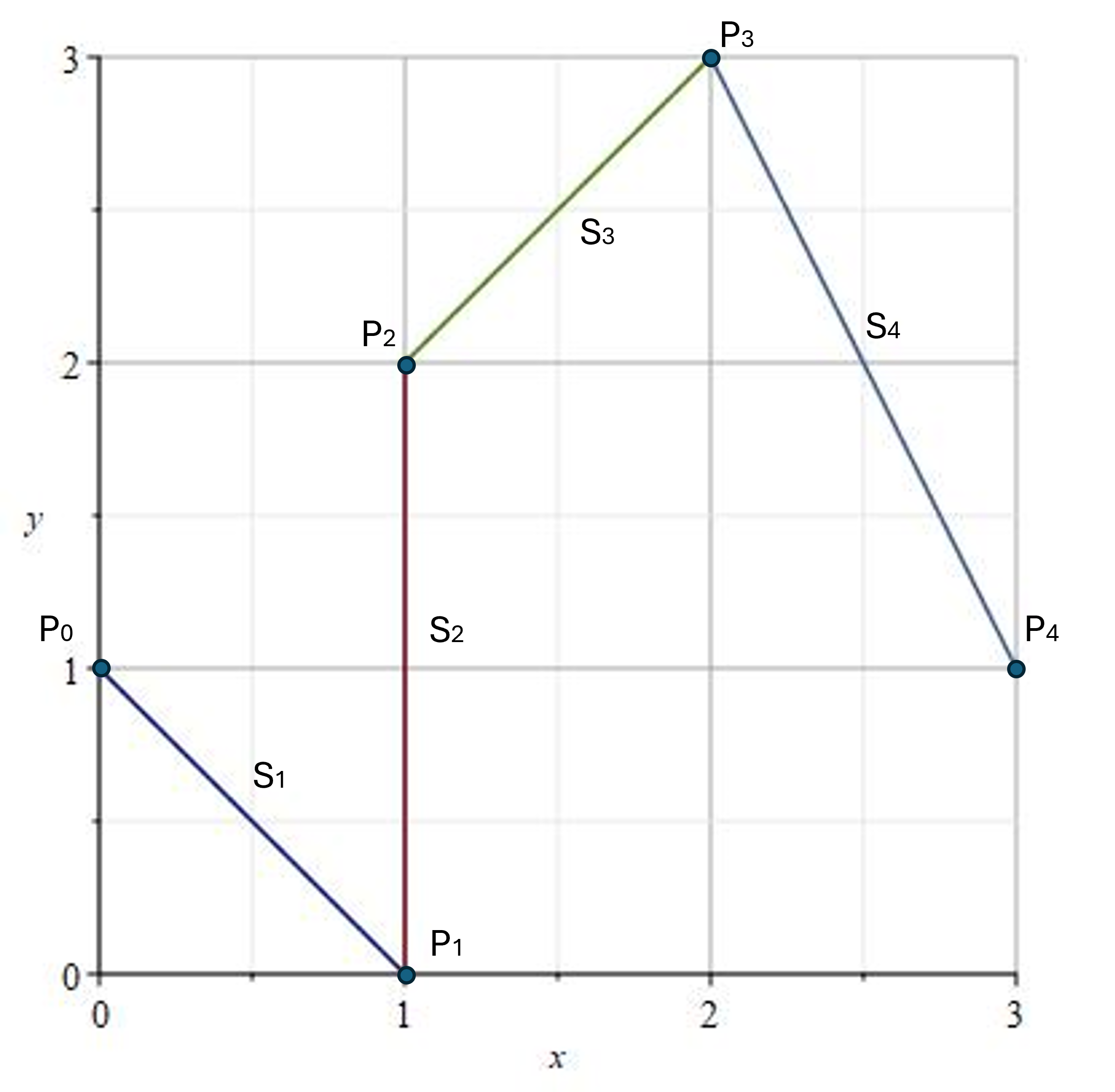
We start with a bunch of points placed in the order that we want our path to go through, P0, P1, P2, P3, P4. We listed 5 here, but there could be any number of points on our path. We will also start by looking at just the “x” coordinate of the first segment between the first two points, P0 and P1. As we have seen, we can expand this into more dimensions (x, y, z) later.
Let’s look at the, now familiar, equation for the x coordinate of a line between the first two points P0:(x0, y0) and P1:(x1, y1):
x(S) = x0 + Dx0*S
The independent variable “S” marks the distance traveled along this segment from P0, and the Dx0 is the x-direction of this segment between P0 and P1. “S” starts at S=0 (at P0) and goes to S=S1 (at P1), where “S1“ is the distance of the line segment between P0 and P1.
Since this first segment of the path stops when the line reaches the end point (x1, y1) after traveling the distance between them, S1:
x1 = x(S1) = x0 + Dx0*S1
thus
x1 – x0 = Dx0*S1 and Dx0 = (x1 – x0)/S1
Substituting this expression for Dx0 into the equation of the line we get:
x(S) = x0 + (x1 – x0)*S/S1
Notice that the ratio S/S1 can be thought of as a percentage and ranges from 0 to 1 as S goes from 0 to S1. To avoid calculating lengths of the segments, we can use the substitution:
t = S/S1
into the equation for a line and we get:
x(t) = x0 + (x1 – x0)*t where t goes from 0 to 1.
This turns out to be a very convenient way to write the equation of a line between two points. With this equation, x(0) = x0 and x(1) = x1, and “t” marks the “percentage” traveled along the line segment, from 0% (t=0) to 100% (t=1).
Expanding this into two dimensions we get the equations for all 4 segments between the 5 points:
In each case, “t” goes from 0 to 1. This is written out in full detail to make sure that you can see the pattern. In two dimensions you can find the length of Segment 1 by S12 = (x1-x0)2 + (y1-y0)2. The others are not written out, the pattern should be obvious.
Alright, we can draw lines between the points. Now let’s look at drawing curves between the points. This becomes a bit harder to pin down because there literally are an infinite number of curves that could be drawn between these same 5 points. We will have to specify the kind of curves we want.
We will learn how to draw curve segments between the points and put them together smoothly to form any continuous path we desire. We could even use this math to find an equation that describes the path of a fly walking around on the ceiling.
One common way of doing this is to use a method called “cubic splines”. With this method the coordinates of each curve are written as a “cubic” equation in t:
x(t) = c0 + c1*t + c2*t2 + c3*t3
where we can pick any numbers we want for c0, c1, c2, and c3. The numbers we pick determine the shape and position of the curve. We can also write this expression using the “dot” product we have discussed before:
x(t) = (c0, c1, c2, c3).(1, t, t2, t3)
The “c”s are called the coefficients and the powers of “t” are called the basis functions. We can now take the derivative of the x-coordinate as we learned in the last post.
dx/dt = (c0, c1, c2, c3).(0, 1, 2*t, 3*t2)
as you recall, we can use these derivatives to find the direction of the tangent line at any point “t” along the curve. As it turns out, we now have all the tools necessary to draw a “cubic spline” curve between the points.
We can pick “t” to be a “percentage of the curve” where “t” starts at t=0, the beginning of the curve, and goes to t=1 at the end of the curve (similar to how we drew lines). And so:
x(0) = (c0, c1, c2, c3).(1, 0, 0, 0) = x0 (Substitute t=0 into the equations above) x(1) = (c0, c1, c2, c3).(1, 1, 1, 1) = x1 (Substitute t=1 into the equations above)
written out this means:
c0 + 0 + 0 + 0 = x0 and c0 + c1 + c2 + c3 = x1
and we have found that the coefficient c0 = x0 (the x-coordinate of the starting point) and the sum of the coefficients must add to x1 (the x-coordinate of the ending point). This meets the conditions that the curve will start at the beginning point and end at the ending point. We still need some more conditions to determine what the other c’s will be.
It is natural to also place conditions on the direction that the curve leaves the starting point and the direction it arrives at the ending point. This is determined by the tangent direction (derivatives) at these points:
We can set S0, S1 and the directions Dx0 and Dx1 to be whatever we want and we can immediately see:
c1 = S0*Dx0 c1 + 2*c2 + 3*c3 = S1*Dx1
We have determined c0 and c1 from the starting point and the direction of the tangent at that point. We can use substitutions to find the rest. We have 4 equations and 4 unknowns and so we do this:
3*c0 + 3*c1 + 3*c2 + 3*c3 = 3*x1 (multiply the sum by 3) c1 + 2*c2 + 3*c3 = S1*Dx1 (from above)
Subtracting the second equation from the first and making substitutions for c0 and c1:
We can now draw the curves between the points if we know the starting point (x0, y0), the ending point (x1, y1), the starting direction (Dx0,Dy0) and the ending direction (Dx1, Dy1). The S0 and S1 variables are arbitrary and can be varied to taste. We now plug all of these coefficients into our original curve:
the y(t) equation follows exactly the same pattern (just substitute “y” for “x” in all the equations). Voila, we have found a “cubic” curve that passes through these points and has these tangent directions.
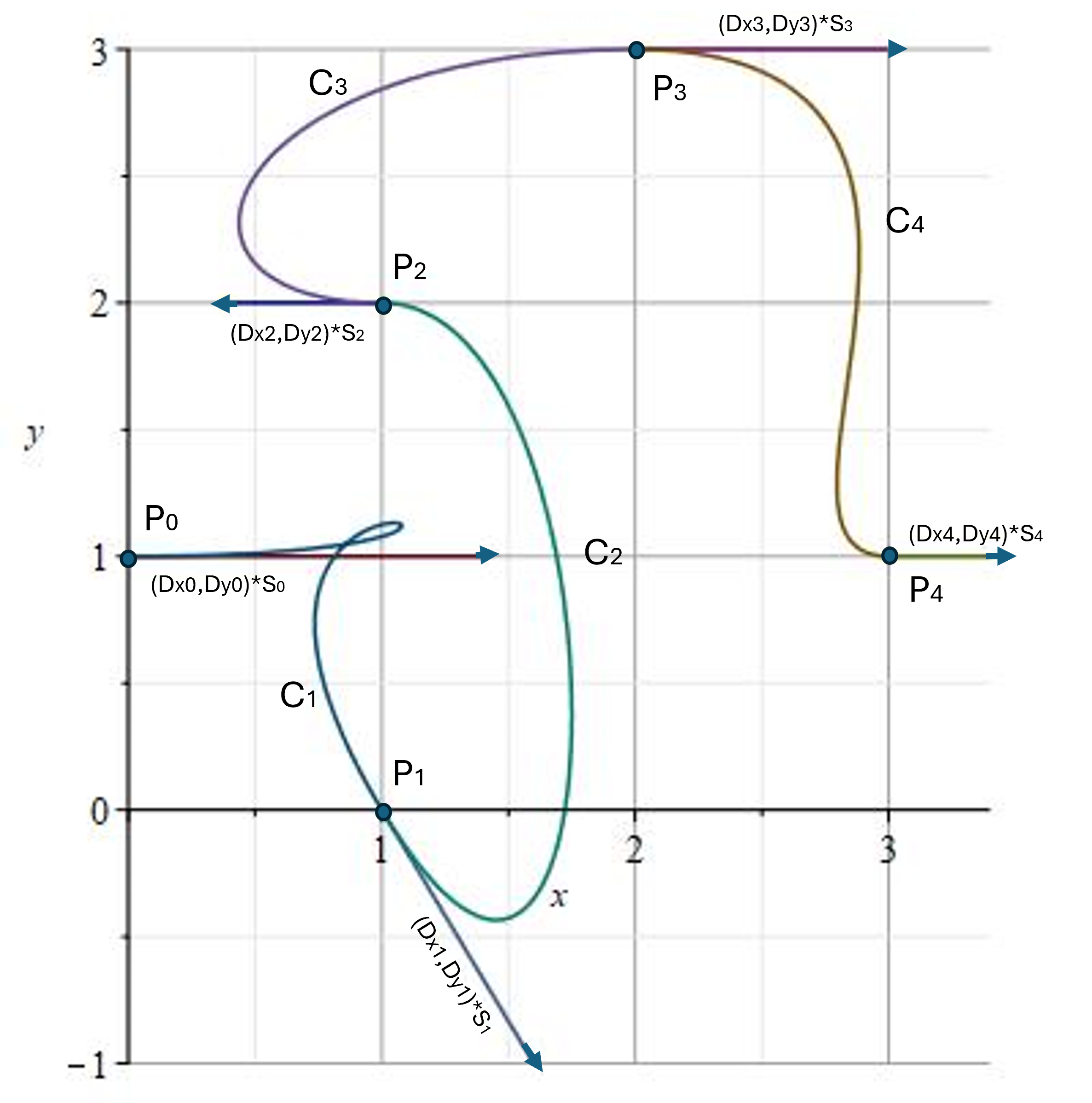
We can now do the same for all of the curves between each pair of points, drawing curves through all of the points. There is a little bit of wiggle room in these curve equations. The S0, S1, … and direction parameters for the tangents at the points can be set at will. Since the direction vectors are the same at the points, the curve will smoothly pass through the points in the same direction. These direction vectors show the “nose” direction (Dx,Dy) and “speed” (S) that a fly would be traveling if it were walking along the curve. It is fun to program these equations into a computer that draws them and watch the curves change as you change the location of the points and the directions and magnitudes of the tangents at the points. This is how most modern, curve-fitting software works.
Of course, you can use another set of “basis functions” rather than just the powers of “t”, if you wish, to possibly get a better fit on your curves. You might also want to impose other conditions, such as minimum curvature. Just remember, if you use more basis functions, you will have more equations to solve for, you will need more conditions, and you might need some experience in “linear algebra” to solve for the coefficients. Happy curving!
We covered the concept of differential calculus in just the last post. It is time to slow down just a bit, catch our breath, and explore more in depth what this all means.
First, we started out with the concept of a function. We used the example of a curve in space where the x-coordinate (and all of the others) depend on an index “t” that indicates where each point is along this curve in space.
x(t) = x-coordinate of a point at the index t
If you specify a “t” value, the function x(t) will give the x-coordinate of a point along the curve that corresponds to “t”.
It might not have been perfectly clear, but we assumed that the curve is made out of points that are infinitely close to each other (same as a line). There are no gaps or kinks in the curve, such that when you increase “t” by an infinitesimally small amount “dt” it will return the coordinates of a point that is infinitesimally close along the curve. This is the concept of a “smooth” or “continuous” function.
An example of this is a car traveling down a straight road. Suppose the function x(t) shows how far the car has gone down the road at a time “t”. At each time, “t”, the function x(t) will tell you the exact position of the car. Now since a car can’t instantaneously disappear from one point and appear in a new point, it always takes time to travel continuously between any two points, which means that if you look at the position of the car a billionth of a second later, the position will be very close to where it was before.
As we discussed, “dt” is much smaller than a billionth of a second, it is the smallest amount possible without being zero. If “t” has increased by a small amount, “t+dt”, then the x-coordinate also will have changed by a very small amount “dx”. This is what we mean by the expression:
dx = x(t+dt) – x(t)
The derivative dx/dt is defined to be:
dx/dt = [x(t+dt) – x(t)]/dt
which indicates how fast “x” is changing in relation to a change in “t” at the point “t”. We can now hopefully see why differential calculus is the mathematics of motion. In the example of the car above, dx/dt is velocity of the car at any instant “t” along its path – it moves a distance dx in the time dt.
When we learn the “algebra” of differentials, we can find derivatives for a vast array of smooth functions.
As we have seen, when we know the derivatives of a curve, we can find the direction of the tangent line at any point along the curve. Recall from the last post in 2-D:
(Dx, Dy) = (dx/dt, dy/dt)/((dx/dt)2+(dy/dt)2)1/2
The nice thing about this notation is that it is easy to go to 3-D, 4-D, and as many -D’s that you want just by continuing the pattern.
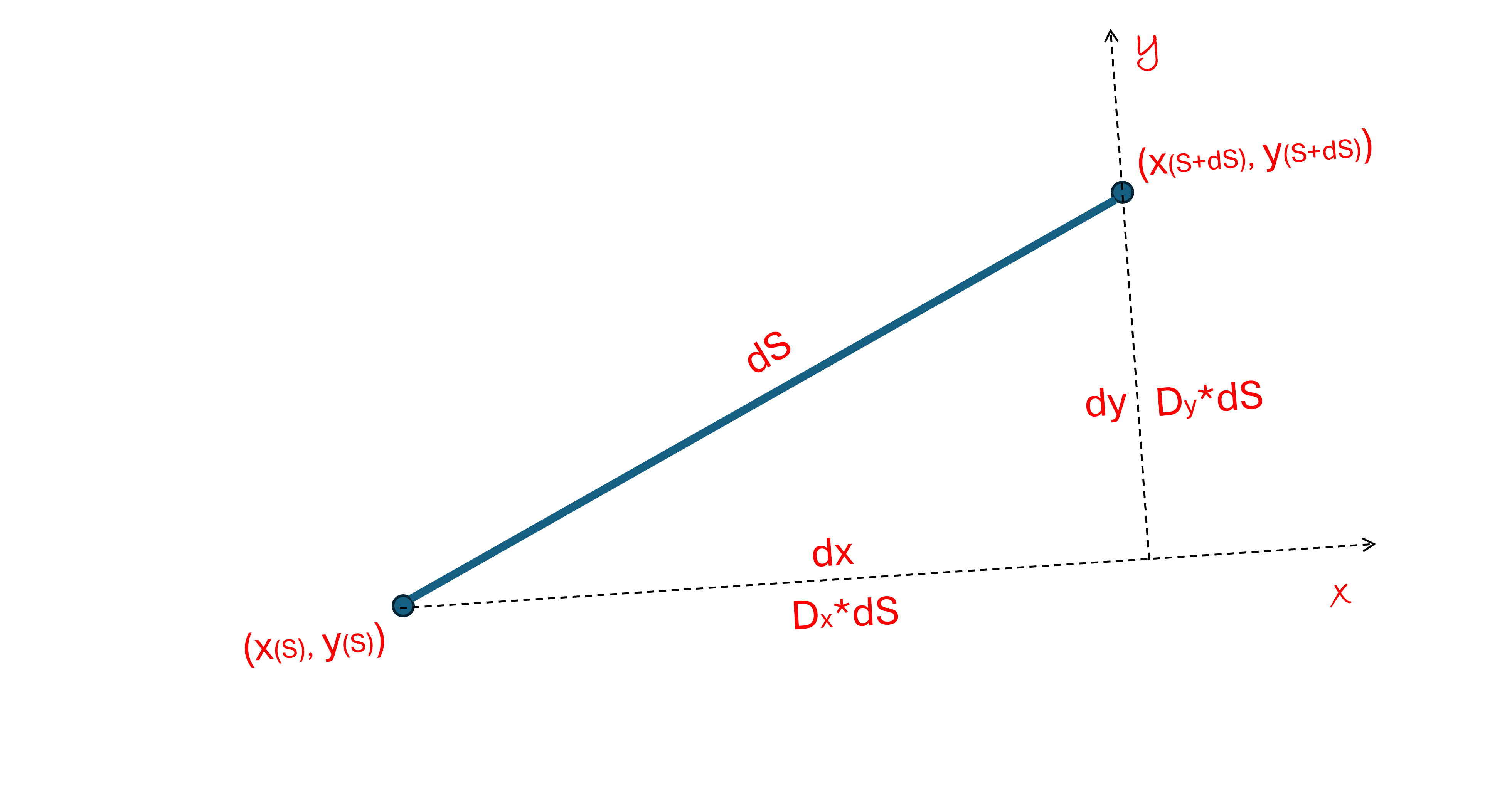
Calculus deals with the mathematics of movement. In order to move from a starting point (x(S), y(S)), in 2-D, to the point next to it, you need to know how to move a tiny distance “dS” in some direction (Dx, Dy). If we are moving along a line, then we already have a way to express this. If (x(S+dS), y(S+dS)) is the function notation for the adjacent point along the line
(x(S), y(S)) = (x0, y0) + (Dx, Dy)*S
(we are writing this in function notation) then the line segment that connects them can be written (it works out):
(x(S+dS), y(S+dS)) = (x(S), y(S)) + (Dx, Dy)*dS
Looking at just the x-coordinate this means:
x(S+dS) = x(S) + Dx*dS or
x(S+dS) – x(S) = Dx*dS
Now it is pretty easy to see that when dS goes to zero, the distance between the x-coordinate of the ending point and the starting point “x(S+dS) – x(S)” also goes to zero. We can use our differential notation to express this:
dx = x(S+dS) – x(S)
where “dx” is defined as the difference between the x-coordinates. We now can write the differential expression:
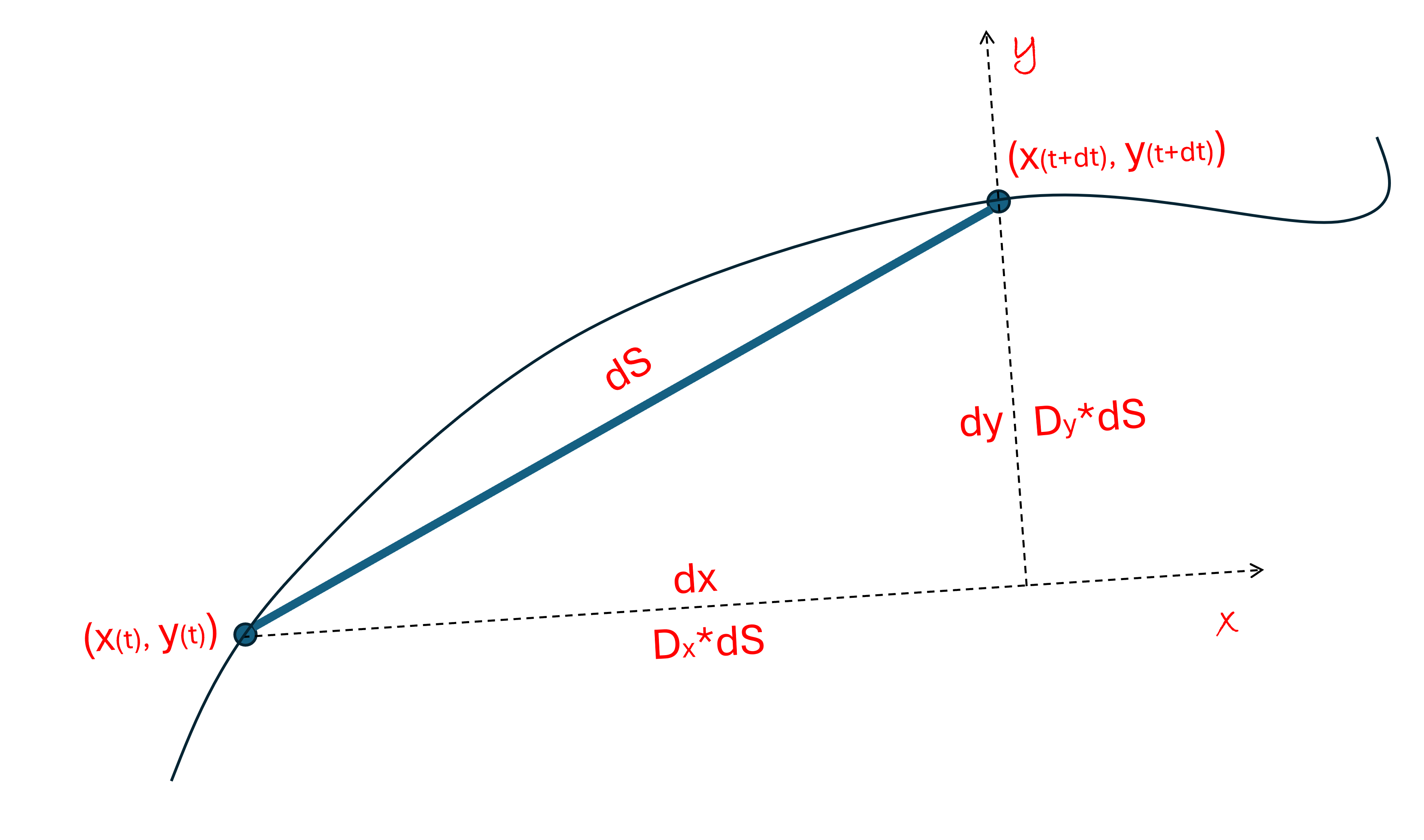
dx = Dx*dS
Recall that the small “dx” means differential (the infinitesimal distance moved, and the large “Dx” means the direction it moves. See the diagram above.
Now we are ready to make the leap. Even though dx and dS get as close as possible to zero, their ratio in this example is fixed:
dx/dS = Dx
This is because the Direction of the line segment is fixed and does not depend on the distance between points, no matter how small.
The concept of calculus is used to travel a tiny distance “dS” to arrive at an adjoining point. No matter how small dS is, you can always cut it in half (dS/2) to find a point that is closer. Recall that this concept allows us to “zoom in” to a single point throughout all eternity and never get to the point. In calculus “dS” is called a “differential” and it is “infinitesimally” small (as close as possible to zero, without being zero). This is the concept that makes Calculus a bit strange but also makes it interesting.
We can use the same concepts to describe what happens along a smooth non-linear curve (x(t), y(t)). If we then move along the curve by increasing “t” by “dt”, an infinitesimal amount to the point (x(t+dt), y(t+dt)) then these two points on the curve are infinitesimally close to one another. We define the differentials:
(dx, dy) = (x(t+dt)-x(t), y(t+dt)-y(t)) or
dx = x(t+dt) – x(t)
dy = y(t+dt) – y(t)
Note that the variable “t” no longer denotes a distance, it is just an “index” that determines the position of the point on the curve.
Let’s consider an example, with just the x-coordinate. Suppose
x(t) = 1+ t2 then
x(t+dt) = 1+ (t+dt)2 = 1+ t2 +2*t*dt + dt2
dx = x(t+dt) – x(t) = 2*t*dt + dt2
dx/dt = 2*t + dt
as dt goes to zero, we can ignore the “dt” term.
dx/dt = 2*t
The line between these two points can be written as:
(x(t+dt), y(t+dt)) = (x(t), y(t)) + (Dx, Dy)*dS
(x(t+dt)-x(t), y(t+dt)-y(t)) = (Dx, Dy)*dS
Or (dx(t), dy(t)) = (Dx, Dy)*dS
now dS2 = dx(t)2 + dy(t)2 or
dS2 = [(dx(t)/dt)2 + (dy(t)/dt)2]*dt2
which shows that “dS” also scales with “dt”.
Once we know these relationships then we can solve for the direction (Dx(t), Dy(t)) of the line that connects two infinitesimally close points on the curve (x(t), y(t)) at the index “t”. We use the function notation for the direction parameters to indicate that the direction of this “tangent” line depends on where it is along the curve.
Just as in the case of a line, even if dS, dt, dx, and dy go to zero, as the points get closer together, they could have ratios between them that do not go to zero. Everything depends on the shape of the curve. Certainly, we expect that the direction of the line will not necessarily change as the points converge. Such a curve is called “differentiable”.
And so, the direction of the line is well defined when “dt” goes to zero, and we add function notation:
(Dx(t), Dy(t)) = (1, 2*t)/ [1+(2*t)2]1/2
This line direction is called the tangent to the curve at the point (x(t), y(t)). At this point, this line will only touch the curve at this one singular point.
Also
dS/dt = [1+(2*t)2]1/2
and all is solved for every location “t” on the curve. Perhaps there are many questions remaining. One of them being, for example, how to calculate the distance along the curve “S” from one point to another. These questions will be left for other posts.
So far, we have only described lines where the distance between any two points on the line is well defined by a “metric”. Before we look at how to draw curves, let’s remind ourselves what a line looks like in math language:
(x, y) = (x0, y0) + (Dx, Dy)*S
The starting point on the line is (x0, y0) and the direction the line takes (Dx, Dy) in a cartesian coordinate system, and “S” is the distance from the starting point. Note that “S” serves as an index or indicator for every point on the line. In math language, “S” is known as the “independent variable”. It determines the exact point on a line a distance “S” from the starting point. Of course, we assume we already know the starting point (x0, y0) and direction (Dx, Dy) of the line.
In “function notation” we put the independent variable (S) next to the “dependent variables” (x and y) in parenthesis to remind ourselves that if we pick a number for “S”, it will give us an exact point (x(S), y(S)) on the line:
(x(S), y(S)) = (x0, y0) + (Dx, Dy)*S
This “function” notation is extremely helpful. We can use this notation to replace the variable “S” with any number or symbol we wish. For example, let us replace the variable “S” with “t” (like a “cut-paste” of “S” with “t”):
(x(t), y(t)) = (x0, y0) + (Dx, Dy)*t
We can even replace “S” with a mathematical statement:
(x(S+3), y(S+3)) = (x0, y0) + (Dx, Dy)*(S+3)
The rule is that whatever goes in the parenthesis in function notation it is substituted into the “function” at the appropriate place.
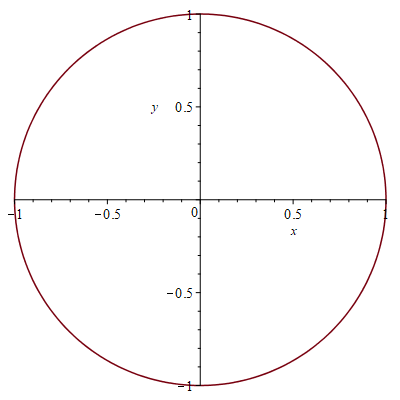
Now we can start drawing curves by considering functions that are “non-linear” (they don’t draw a line). We have already looked at how to draw a circle. You may recall that we use the same equation for a line, but instead of varying the distance “S” we varied the direction (Dx, Dy) = (Cos(t), Sin(t)), where “t” is the angle off the x-axis. So, the equation for a circle of radius S=1, centered at (x0, y0) = (0, 0) would be written:
(x(t), y(t)) = (Cos(t), Sin(t))
where “t” goes from 0 to 360 degrees. We could also draw just any arc of the circle by determining the range that the angle “t” spans, for example, a quarter circle is drawn when t goes from 0 to 90 degrees. You get the idea.
We should mention at this point that we chose “t” as the “index” that indicates where any point is on the curve. It doesn’t tell us how much distance traveled along the curve, or even the time that it takes for a point to travel along the curve. It is just taken as a general parameter. In the case of the circle of radius 1, we know that the circumference is 2*Pi over 360 degrees and so the distance traveled along the circle from 0 to the angle “t” is S = 2*Pi * (t/360).
Now we can have fun drawing a bunch of curves, using this function notation.
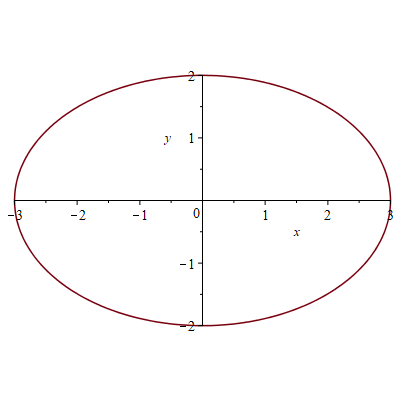
An oval that has major axis 3 and minor axis 2 has this equation:
(x(t), y(t)) = (3*Cos(t), 2*Sin(t))
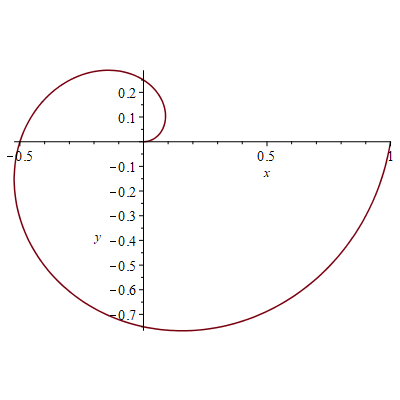
A spiral that starts at (0, 0) and goes to (1, 0) is drawn by this equation:
(x(t), y(t)) = ((t/360)*Cos(t), (t/360)*Sin(t))
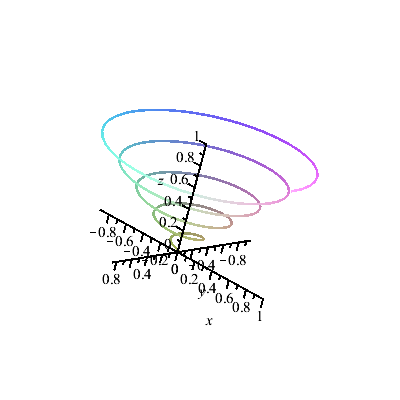
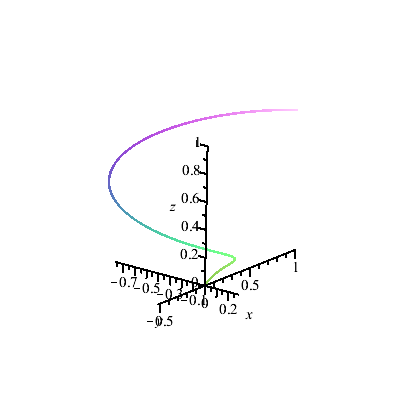
We can also draw curves in 3-dimensions just as easily; here is a spiral around a cone:
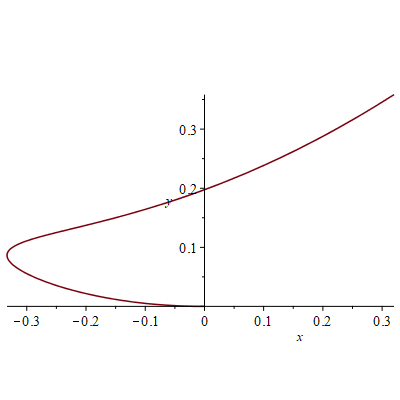
We can use any non-linear equation to draw a curve, like:
(x(t), y(t)) = (-2*t+3*t2, 2*t2-5*t3+4*t4)
We could keep going all day, curves are always visually interesting.
Later we will see how we can hook curves together to form any shape we want, but first we need another tool to analyze curves, differential calculus. It really is not as difficult as you might think, so keep tuned.
This diagram is here as a reminder to read and understand the previous post.
It is obvious that because the speed of light is constant in every possible reference frame, then it requires distances and times to be different between events relative to the reference frame in which we measure them. So, if distances change from one reference frame to another, then how exactly do we make sense of the concept of distance in Space-Time?
We have seen in 3-D space, when a point (x, y, z) is not moving in time, we simply change our reference frame by “moving our head”. We can set our Nose direction to point directly toward the point (x, y, z), in the direction (Dx, Dy, Dz). Recall that the point:
(x, y, z) = (Dx, Dy, Dz) * S
where S is the distance from our nose (0, 0, 0) to the point (x, y, z). We assume that rotating our head does not change the distance to the point. This is what is called a “spherical metric”.
It is easier to picture this in 2-dimensions (when z = 0), so we will use only the ‘x’ and ‘y’ dimensions for our illustration. Recall:
(x, y) = (Dx, Dy) * S
meaning
x = Dx * S y = Dy * S
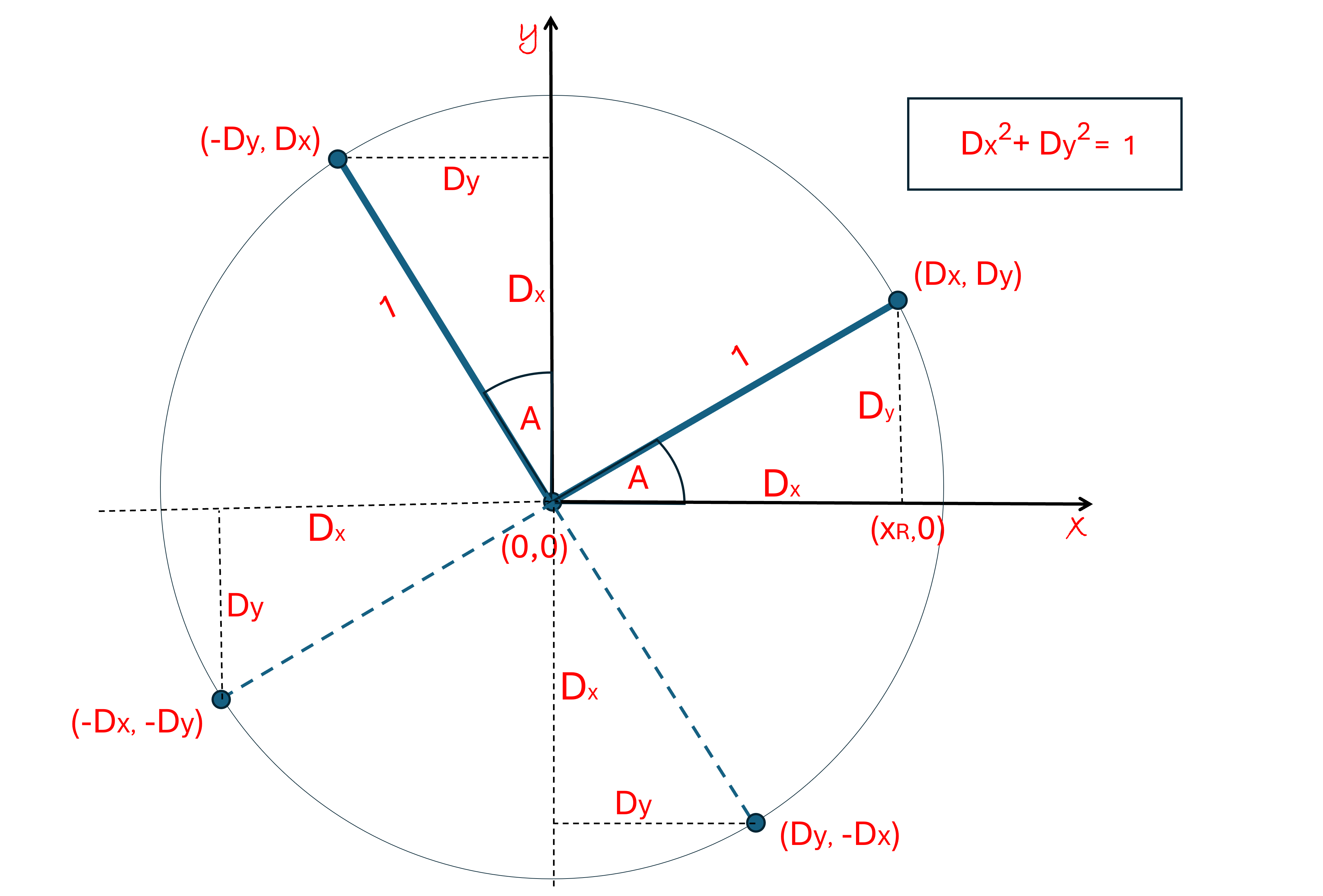
Where the (Dx, Dy) direction is shown in the following diagram:
Recall that if we “dot” (x, y) with the direction (Dx, Dy):
(Dx, Dy).(x, y) = (Dx, Dy).(Dx, Dy) * S = (Dx*Dx + Dy*Dy) * S = (Dx2 + Dy2) * S
If the metric (Dx2 + Dy2) = 1, then the Distance (S) is just this dot product. We have looked at this in detail before. This is called a “spherical” metric, because distances are the same in all directions, like the radius of a sphere. With this metric, the distance is the same regardless of the orientation (angle) of the reference frame. Nothing new here.
Yet if the point (x, y, z, C*t) in Space-Time is moving, then the situation is different. We cannot set a fixed “Nose direction” to look at a moving point. We first must start moving with the same speed in the same direction as the point. Now in this moving reference frame, the point is stationary, not moving, and then the “Nose Direction” can be set.
In space-time, the speed at which a point is moving is determined by the angle (At) it is off the C*t-axis. Going into another frame of reference means finding the “angle” of a line that will match the point’s speed. The angle At is often called the “boost” parameter and is directly related to the speed of the point traveling along this line. We will look at how to change the speeds (At) of reference frames relative to each other in space-time.
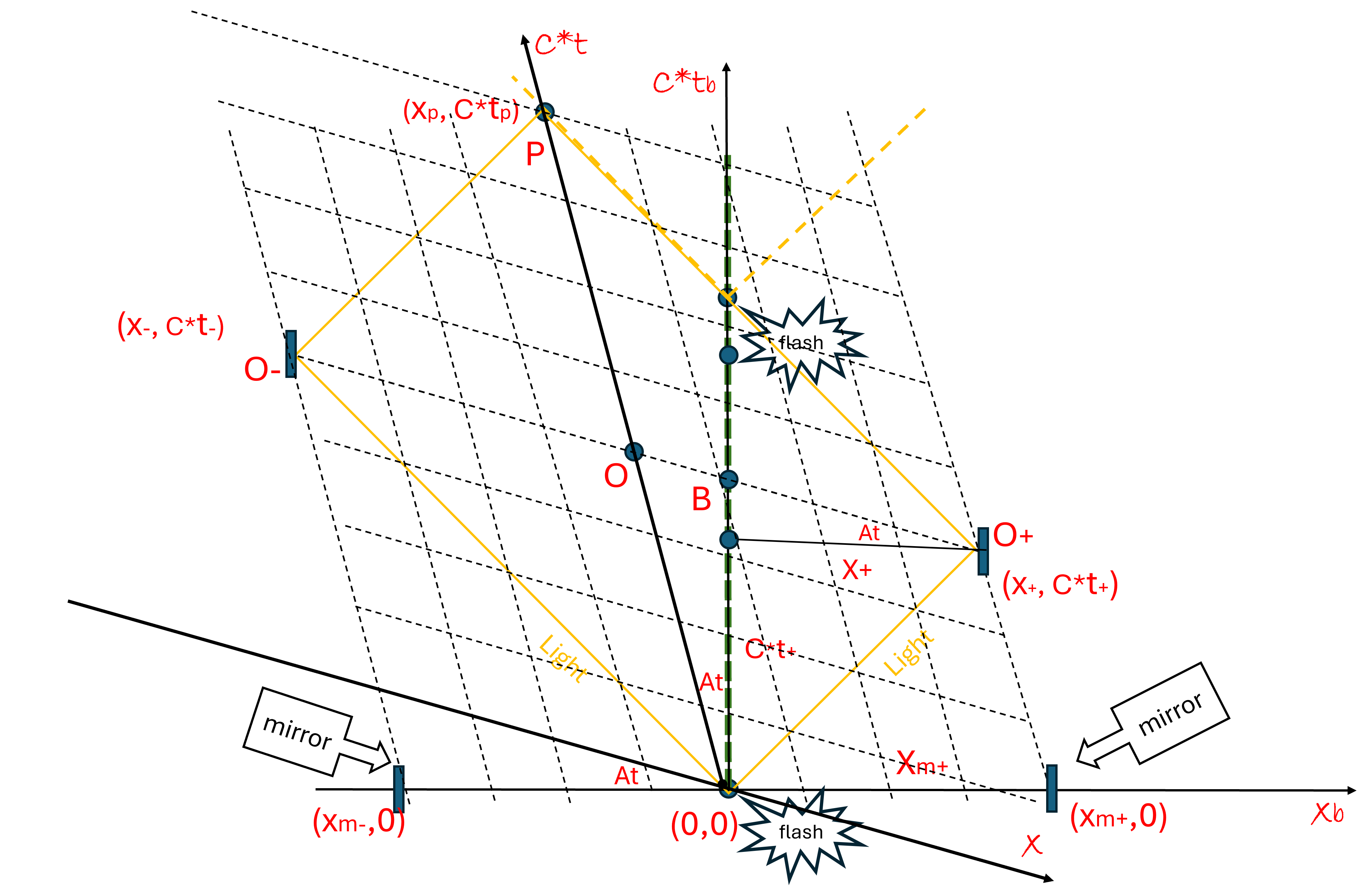
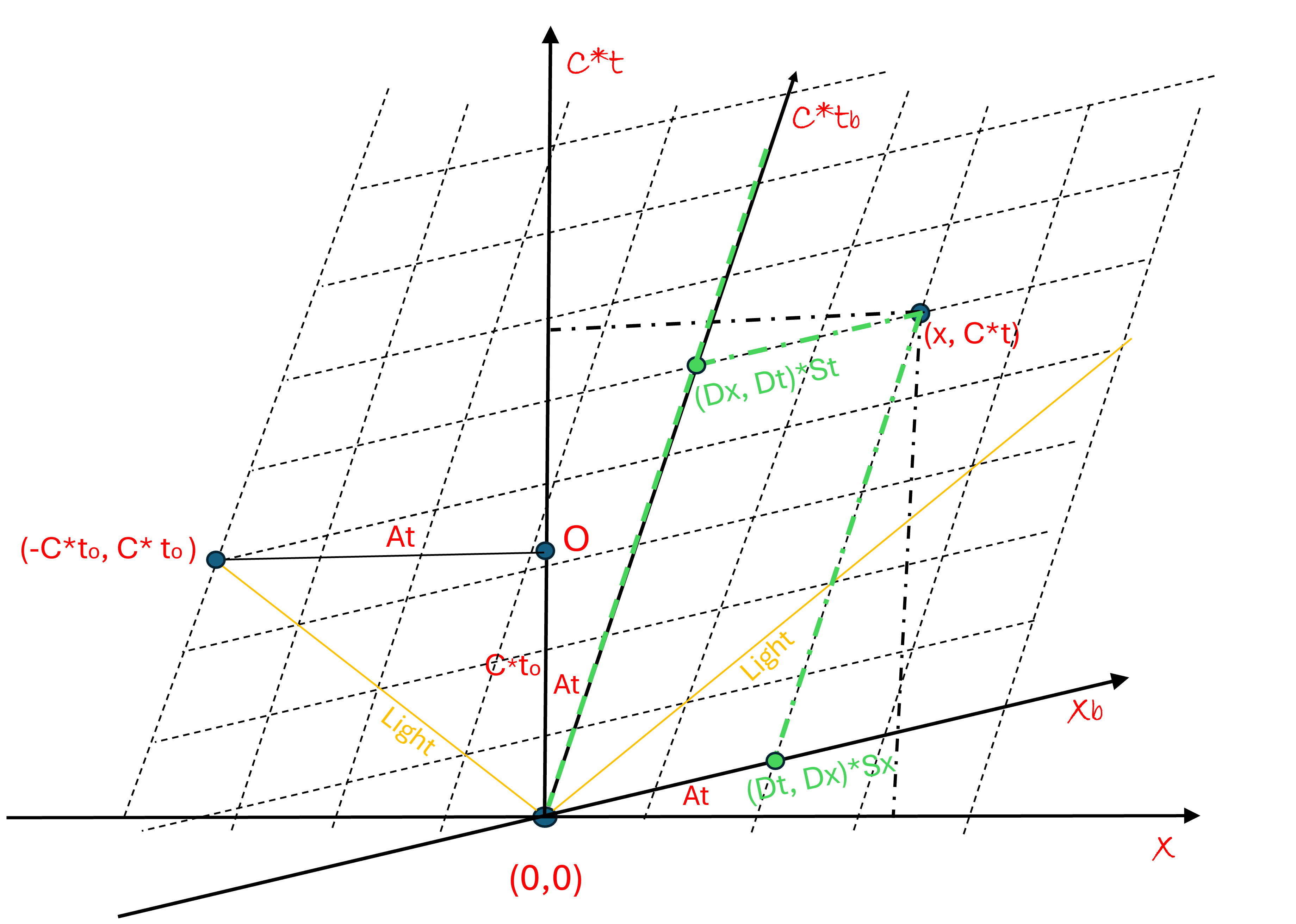
We can use the same concepts to find the meaning of Distance in Space-Time. Consider the example of a moving flash bulb (bulb frame) between two stationary mirrors (mirror frame) that we examined in the last post. For simplicity and clarity, we are only looking at the ‘x’ and ‘C*t’ dimensions and have put in grid lines parallel to the “x-axis” and “C*t-axis”. Here the x-axis points in the same direction that the bulb is moving.
This does not restrict us because we always can rotate our frame of reference so that the ‘x’ direction is pointing in the same direction that the point is moving, we are ignoring the y = 0 and z = 0 coordinates. Now as before, let’s look at the same events in the perspective of the “bulb frame”, with the “xb-axis” and “C*tb-axis” defining this frame. In the following diagram we mark in the same “grid lines” parallel to the x-axis and C*t-axis, but now in the viewpoint of the “bulb” frame.
As we mentioned before, the grid lines in the mirror frame are not mutually perpendicular when seen in the bulb frame, they are stretched out “diamonds”. Note however that the “light lines” (yellow) in both frames of reference fall along the same points (they are 45 degree lines in both frames of reference). Another thing to note is that the angle (At) of the bulb from the C*t-axis to the C*tb-axis is the same as the angle (At) between the negative-x-axis and the negative-xb-axis, but unlike the spherical rotations, they are now rotating in opposite directions and squeezing closer together.
As the angle (At) is increased, the two “mirror” axes, as seen from the “bulb” frame of reference, would come closer together, squeezing the “mirror” reference grid together like one of those fold-out books, until they get to 45 degrees (the speed of light), where the mirror frame axii are completely squeezed together and the grid lines disappear completely. Stare at the diagram above and you might be able to imagine it. This might seem really weird at first, but it is a consequence of the speed of light being the same (at 45 degrees) in both frames.
What do you think the “bulb” frame of reference would look like in the “mirror” frame of reference? See the diagram below:
Let’s now see if the math works out. Let us look at a specific point (x, C*t) in the mirror frame and ask how it would look in the bulb frame. First let’s write the equation for the “C*tb” axis as seen in the mirror frame. Let’s say it is in the direction (Dx, Dt). Recall that this is the same direction as the “bulb” world line is in the above world diagram. Then any point (xtb, C*ttb) at a distance St along the C*tb-axis can be written:
(xtb, C*ttb) = (Dx, Dt)*St
Where (Dx, Dt) marks the direction of the bulb world line in the mirror frame, and St is a distance marked along the C*tb-axis, and is yet to be determined. We can also find the equation of a point along the xb-axis in the mirror frame.
(xxb, C*txb) = (Dt, Dx)*Sx
Note that (Dt, Dx) is the direction of the xb-axis which is at the same angle, At, above the x-axis (as required by the space-time geometry) and Sx is the (yet undetermined) distance marked along the xb-axis.
From our orienteering days, we have seen that we can arrive at the point (x, C*t) by “moving” along the C*tb-axis a distance St, and then turning right to “move” in the direction parallel to the xb-axis a distance Sx (as seen by the green lines in the diagram). Note that the Sx and St are the coordinates in the “bulb frame” of reference. And so:
(x, C*t) = (Dx, Dt)*St + (Dt, Dx)*Sx
We can now “dot” both sides with a direction that is perpendicular to the C*tb-axis (Dt, -Dx) to eliminate the St term and thus find Sx:
(called a hyperbolic metric) then the “magic” matrix that transforms the event (x, C*t) into the (Sx, St) event coordinates in the “bulb frame” is found by combining the three equations above in a matrix equation, as usual:
[(Dt, -Dx), (-Dx, Dt)].(x, C*t) = (Sx, St)
And there we have it, the way to convert between the two frames of reference, this is also referred to as the “Lorentz Transform”.
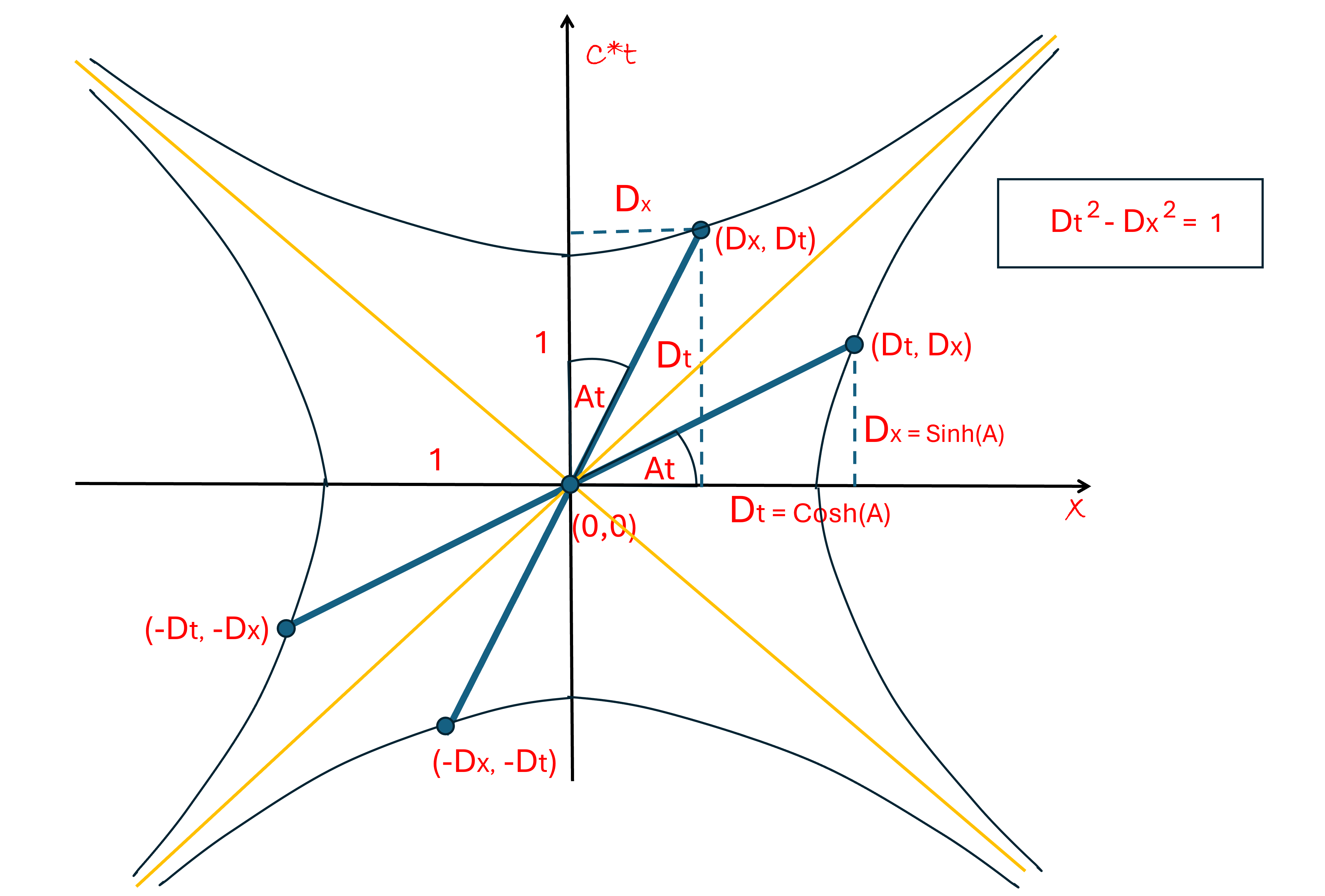
We should say a few words about the meaning of the hyperbolic metric Dt2 – Dx2 = 1. If we draw a plot of this metric, we can see that Dx, and Dt are defined by coordinates of points on the unit hyperbola as shown:
There are special functions, the hyperbolic sine (Sinh) and cosine (Cosh), that are defined to find (Dx, Dt) from the angle At:
(Dx, Dt) = (Sinh(At), Cosh(At))
We see that this is a new way of defining distances in Space-Time. If the point (x, C*t), is in the direction (Dsx, Dst):
(x, C*t) = (Dsx, Dst)*S (where S is the spacetime distance) then 1 = Dst2 – Dsx2 S2 = S2*(Dst2 – Dsx2) S2 = (S*Dst)2 – (S*Dsx)2 S2 = (C*t)2 – (x)2
And we have found a way to define distance in space-time.
Returning to our moving bulb example, we finish off by finding the direction (Dx, Dt) of the bulb, moving with a speed “v” in the“positive-x-direction” in space-time (which is also the direction of the “C*tb” axis in the mirror frame). After a time ‘tb’, the bulb has traveled a distance of xb = v*tb thus:
(v*tb, C*tb) = (Dx, Dt) * St
Where St is the space-time distance traveled by the bulb, which we now know to be:
St2 = (C*tb)2 – (v*tb)2 = (C2 – v2)*tb2
And so
St = Sqrt(C2 – v2)*tb
And thus we have found:
Dx = v/Sqrt(C2 – v2) Dt = C/Sqrt(C2 – v2)
Finally we have come full circle and filled in the unknowns. Don’t worry if you are having trouble understanding it all. It still takes me a bit of time to completely wrap my mind around these concepts. Just for reference, in science literature, Dt is often called the Greek letter “gamma” and the ratio ‘v/c’ is often called “beta”, thus Dx = gamma*beta and Dt = gamma.
I believe that that is sufficient for now. You might have many questions, but if you read and study this post a few times, you will be able to get the gist of how Special Relativity works to transform between Space-Time reference frames.
So far, we have been thinking of the time (C*t) dimension to be just another dimension in space, completely symmetric with the other three directions (x, y, z), yet we have already seen a problem with this concept. The reasonable concept of time requires that a point cannot travel everywhere with infinite speed and be everywhere at the same time. Einstein postulated that the speed of light is the speed limit that prevents everything from happening all at once. This concept creates limitations on the “time direction” (Dt) and even affects the “symmetric” geometry of space-time.
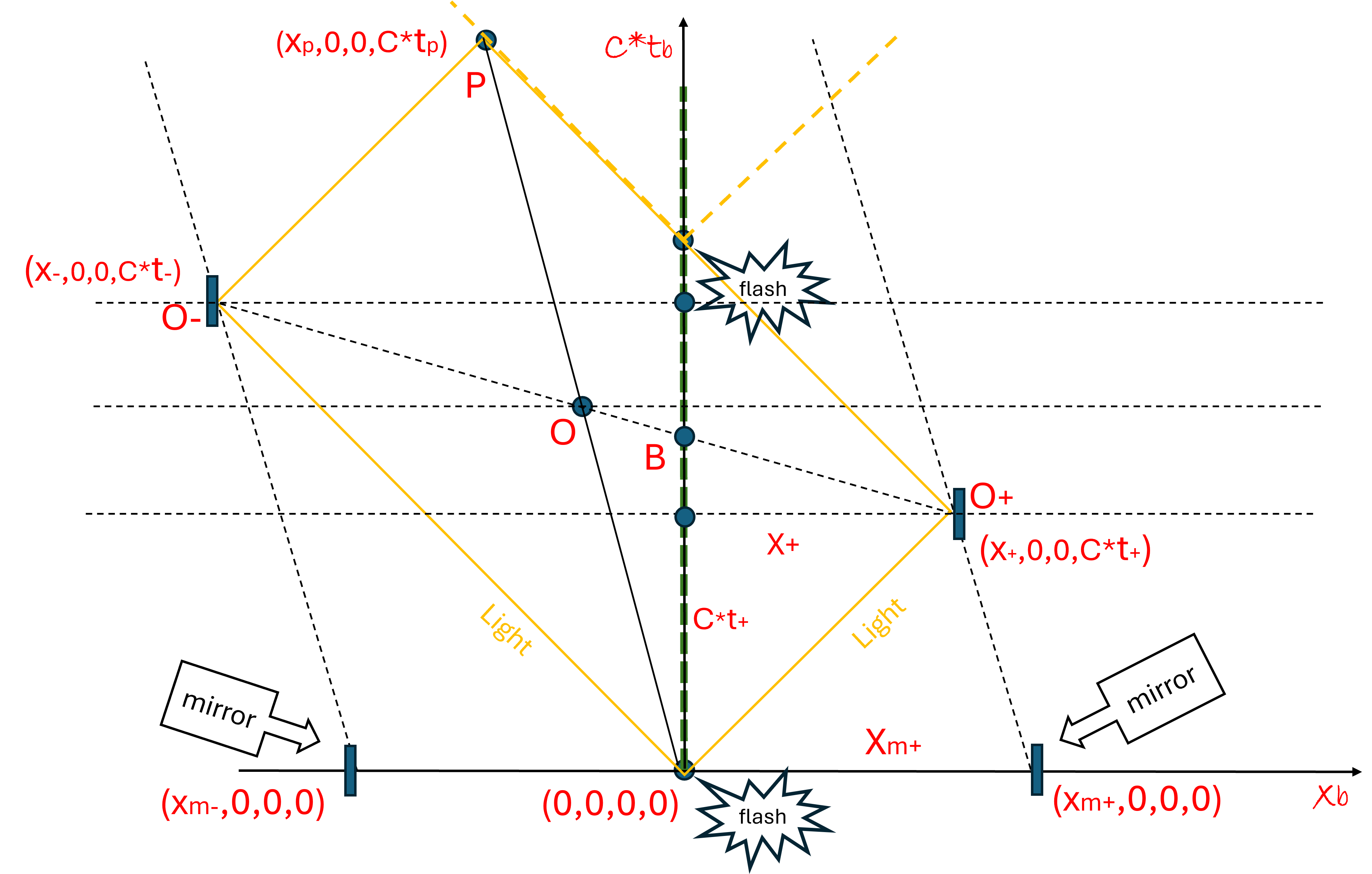
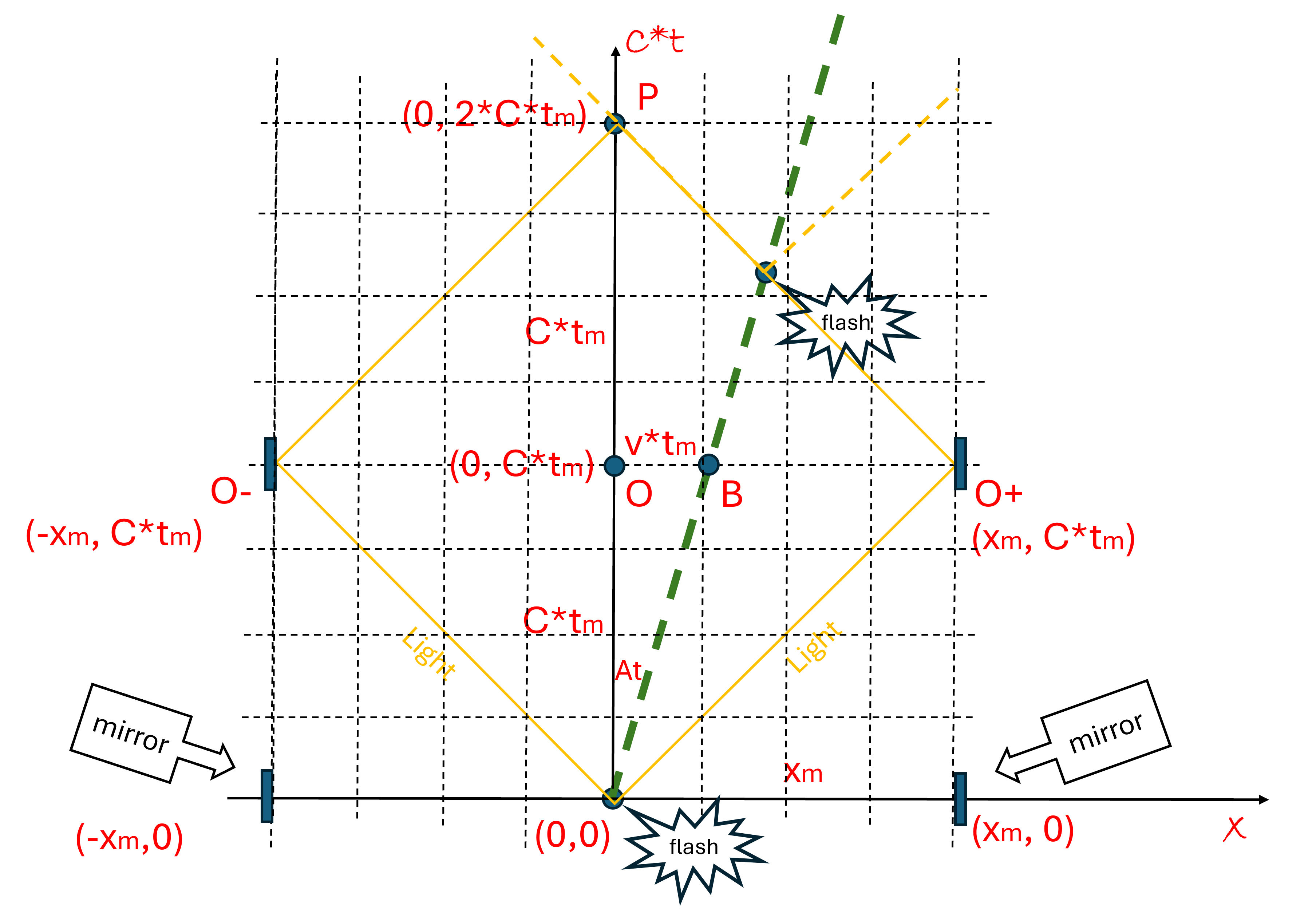
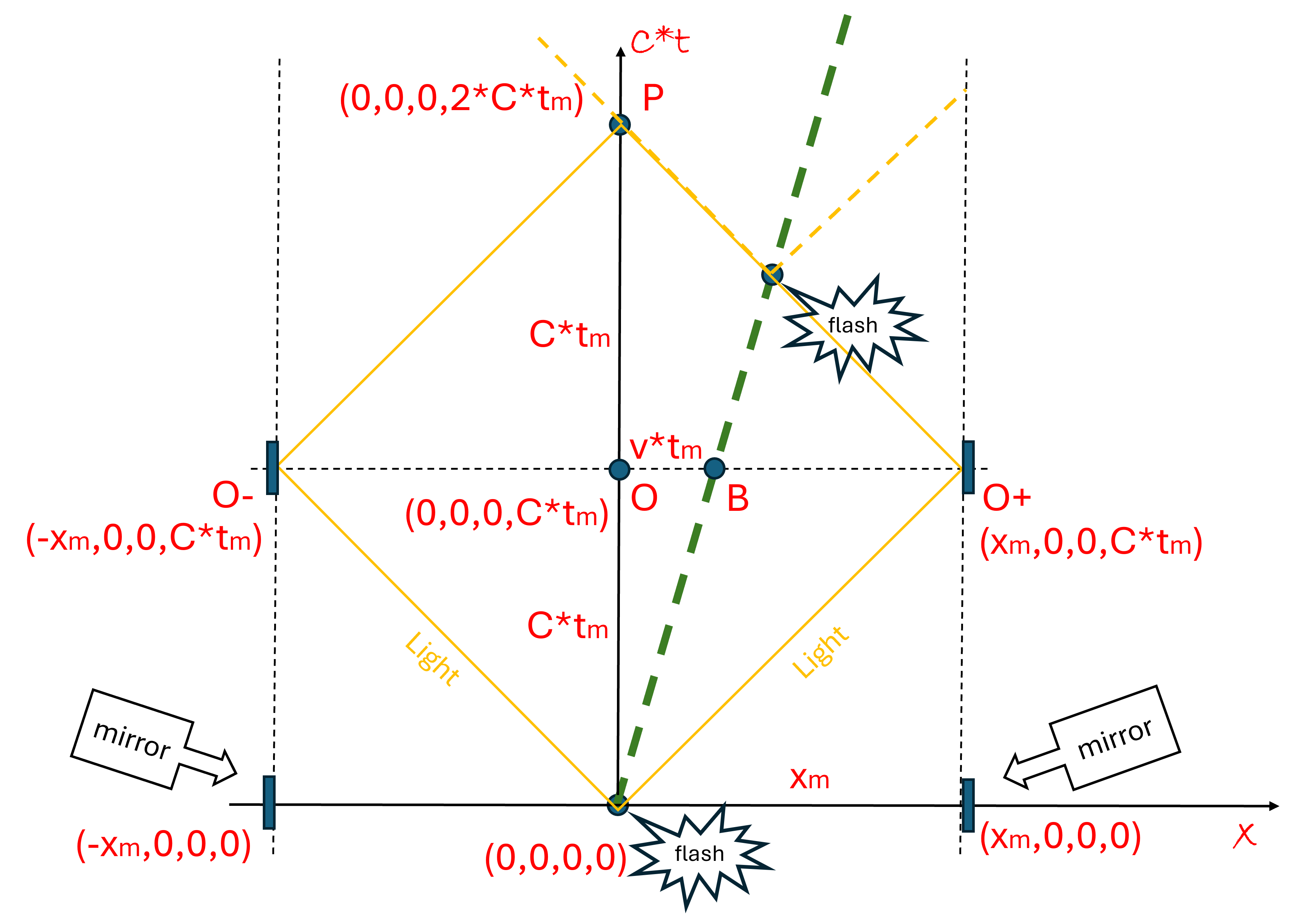
Let us look at a simple example that illustrates this concept. In space-time, every point (x, y, z, C*t) is called an “event” with a position in space and in time. Let us consider a flash bulb traveling in the positive ‘x’ direction with speed “v”. When the bulb is exactly between two mirrors, it flashes. We can call this flash our reference event, (0, 0, 0, 0). Let us suppose that the two stationary mirrors are on both sides of the flash bulb, so that when the bulb flashes, the space-time coordinates of the two mirrors are (-xm, 0, 0, 0) and (xm, 0, 0, 0) respectively, where xm is the distance to each of the mirrors. See the diagram below. It is assumed that the light from the flash will propagate out in all directions (in a perfect sphere) at the speed of light.
It is simple to predict what will happen as time passes, the light from the flash will travel at the speed of light toward both mirrors. Since we assume by symmetry that the speed of light traveling in the positive ‘x’ direction is the same speed that it travels in the negative ‘x’ we imagine that it will arrive at both mirrors at the same time, tm, and then reflect back toward the center. The diagram below is called the “world diagram” in the reference frame of the mirrors, it maps out what will happen at any time “t” in the future. In this diagram we only show the ‘x’ axis, for simplicity, describing only what happens in the ‘x-direction’, which is plotted against the ‘C*t’ axis that shows what will happen in time.
In this diagram, the flash of light follows the yellow “light line” (where x = C*t in the ‘positive-x-direction’ and x = -C*t in the ‘negative-x-direction’). In this diagram, then, Light lines always travel at a 45-degree angle off the ‘C*t’ axis. Anything that is traveling at a speed slower than light (everything else) travels at an angle less than 45 degrees off the ‘C*t’ axis. For example, the flash bulb that is traveling with a speed ‘v’ in the positive x-direction on this diagram travels along its green world line (x = v*t) and, of course, ‘v’ is less than ‘C’. In this diagram, the lines tell you where everything will be at any time ‘t’ in the future.
The world line for the mirrors, for example, go ‘straight up’, the mirrors do not move in space, they start at -xm and xm and just travel through time along the ‘C*t’ axis. From the above diagram, can you see everything that will happen? The light will hit both mirrors at the same time ‘tm’ and bounce back. The flash bulb will just keep moving off in the x-direction, and the mirrors will just stay where they are. Staring at the diagram you can see it all. You might even see that the flash bulb will flash again, when the light bouncing back off the mirror hits it.
The events are labeled on the diagram, the flash is at the origin, light bounces off the mirror in the positive direction at ‘O+’ and simultaneously bounces of the mirror in the negative direction at ‘O–‘, ‘O’ is the midpoint between O+ and O–, and ‘P’ is when the light comes back to center.
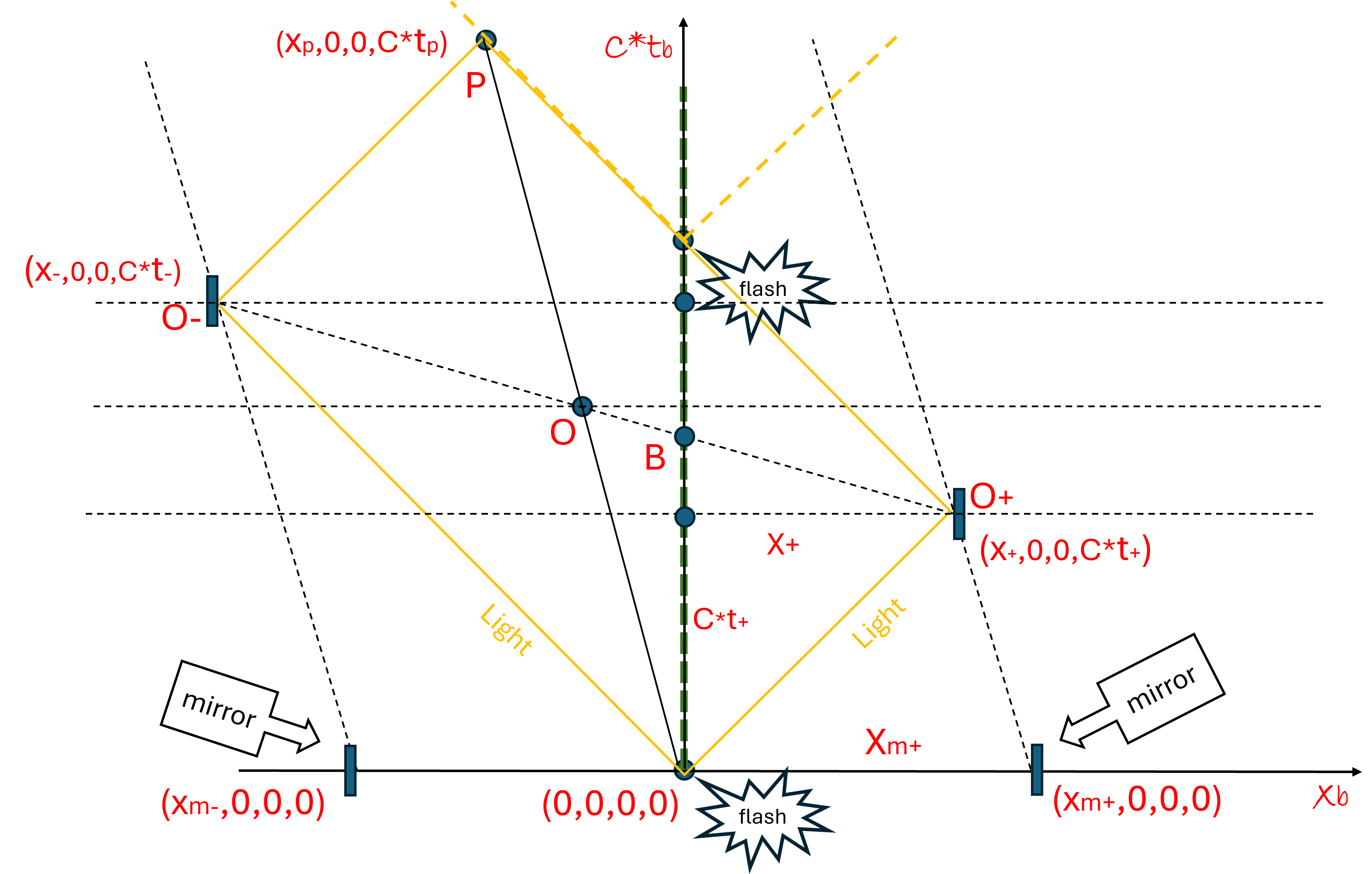
Things start getting a bit weird, however, if you are looking at the world in the reference frame of the flash bulb. In this frame of reference (you are traveling along with the bulb), the flash bulb is not moving, yet the two mirrors are moving at a relative speed ‘v’ in the negative-x-direction. As before, the flash is triggered when the bulb is exactly in the mid-point between the mirrors.
In this reference frame, the moving mirrors are certainly not going to change the velocity of light, you will still see the light propagating outward in a perfect sphere at a 45 degree angle in your world diagram. There is an obvious difference, however. You observe the light bouncing off the mirror that is traveling toward you (O+) before it bounces off the mirror that is traveling away from you (O–), the distances are different. Please refer to the diagram above. In the frame of the flash bulb, the events O+ and O– do not happen at the same time.
How can this be? In the first case, the reference frame of the mirrors, the light bounces off both mirrors at exactly the same time, but in the frame of reference of the flash bulb, the light bounces off the approaching mirror first before it bounces off the receding one. Which observation is right? Looking at the two world diagrams of each case, it is obvious that one diagram is not a simple rotation of the other. Distances and directions have changed when the relative velocities change. Lines between events that are perpendicular in one frame of reference are not perpendicular in the other.
So, we see that if there does exist a uniform speed limit ‘C’ in all frames of reference, that is the same regardless of direction or speed of the observer, then events that are simultaneous in one frame, must happen at different times in another, and the angles and distances observed between events in the space-time diagram must change from one reference frame to another. This concept is what was going through the mind of Albert Einstein when he formulated the theory of Special Relativity.
In order for the math to work, to predict what will be observed in one reference frame from the perspective of the other, we find that the symmetry or “geometry” of space-time cannot be spherical and distances are not preserved between different “rotations” or frames of reference. For spherical symmetry and geometry, Dx2 + Dy2 + Dz2 + Dt2 = 1 is true for all directions and times.
We now are starting to see that this doesn’t work in real space-time, where the speed of light is constant in all frames of reference and rotations of world lines cannot exceed 45 degrees off the ‘C*t’ axis. There is a geometry that does allow this all to happen, it is called “hyperbolic” geometry where distances are measured as Dx2 + Dy2 + Dz2 – Dt2 and vary by the velocity of one frame of reference relative to another. Mathematically, this is the true working version of space-time and is called Minkowski Space. The math has been meticulously worked out. We will cover some of the details later. The interesting thing is that through more than a century of observations, the Theory of Special Relativity has been proven time and time again. Scientists have still not been able to find an exception. It is used in everything from GPS, to positioning of satellites, to radioactive decay of cosmic particles. It works! But it takes a bit of getting used to. Space and time are inextricably connected.
As we enter dimensions beyond our physical experience, it might help our understanding to look back and see patterns in smaller dimensions that still apply in larger dimensions. Is there such a pattern when finding directions (Dx, Dy, Dz, Dt) in 4 dimensions or larger. One obvious pattern, as dimensions increase, is the way we measure distance:
The pattern for higher dimensions is obvious. We expect this pattern to continue to any number of dimensions; we just keep adding on perpendicular triangles. See the diagram above.
There is one problem with setting directions in higher dimensions that is not so obvious. For example, in 1-D, Dx2 = 1 means that Dx = 1 or Dx = -1, this defines the directions to be along the positive or negative x-axis. So far so good. In 2-D, however, when Dy2 = 1, it forces Dx2 = 0, which does not indicate either a positive or negative direction along the x-axis. This ambiguity is due to the rotational symmetry of perpendicular lines, as we have mentioned before, you can “flip” negative and positive directions around a perpendicular direction, and nothing changes.
This ambiguity of direction exists whenever we add a new dimension. In 3-D, for example, when Dz2 = 1, it forces Dx2 + Dy2 = 0 and there are ambiguities as to where to place the direction of both the x-axis and y-axis. To a man standing exactly on the north pole, for example, every direction is south, there is no east and west. I have also heard it said that no matter how you comb the fuzz flat on a tennis ball, there will always be a part (singularity).
To deal with these ambiguities when any of our direction parameters is zero, it is helpful to fix the angles of the x-axis, y-axis, z-axis, etc. so that directions will not be ambiguous when you pass through the “singularities” where one or more of the direction parameters are forced to be zero. So a man standing on the north pole, where every direction is south, still knows which angle to face if he wants to point to Paris, France. This makes defining directions consistent.
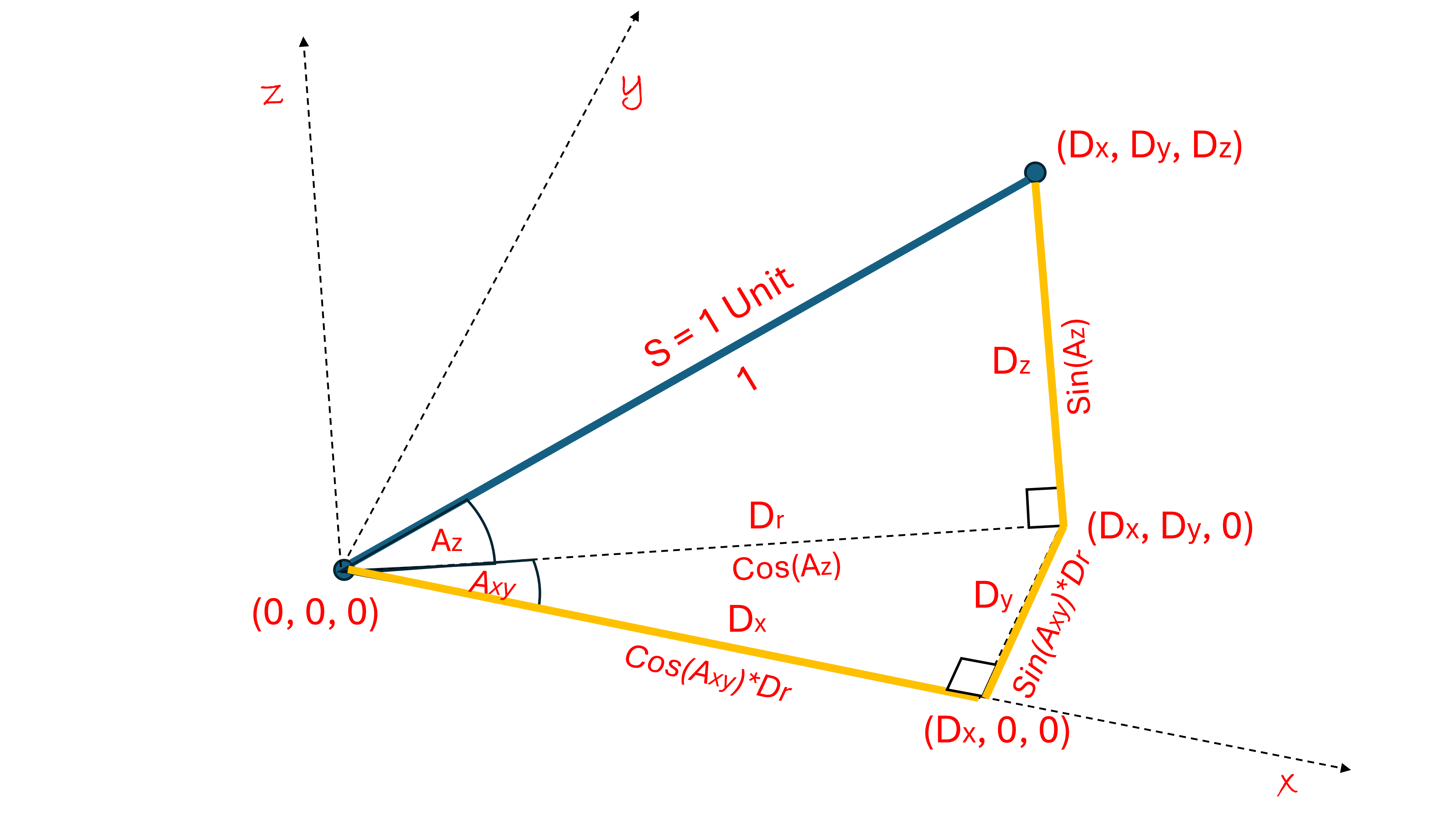
Let us look at a way to define directions as we are increasing dimensions. We defined the angle Axy to be the angle from the x-axis in the x-y plane. Then we defined the angle Az to be the angle off of the x-y plane in the z direction. Listing the direction parameters for the dimensions we know:
We added the “2” and “3” subscripts to indicate the dimension.
It might take you a few minutes to see the pattern. Expanding into 4-D, we define the angle At to be the angle off the x-y-z space toward the t-axis, then continuing the pattern, the direction in 4-D is:
And we have found the Direction parameters in 4-D, and hopefully we can see the pattern that will allow us to use the same scheme to find directions in any dimension. An interesting side note: The angle in the t-direction, At, determines how close the 4-D direction is to the t-axis. When it gets close to 90 degrees, the direction is close to the t-axis and Cos(At) is close to zero, and D4x, D4y and D4z are close to zero, this restricts motion in the x-y-z space. The faster time is moving, the more restricted the motion is in 3-D space. How strange. We will see just how strange in the following post.
We are now ready to expand our 3-D space into 4 Dimensions. My ability to draw diagrams in 4-D is very limited, so we will not have any this time.
We need to pick a point in 4 dimensions that does not exist anywhere in our 3-D world. At the start, we might be tempted to think that such a world is simply unphysical and impossible until we consider that the 4th dimension might be related to time. Consider a point (x, y, z, t), where ‘t’ represents the time (watch) that is associated with the point (x, y, z). Does this even make sense, points running around with timer watches?
It might be easier to believe if we consider a single point that is able to move around in 3-D space. When we track the same point (x, y, z) over time, we can imagine that it doesn’t have to be in the same position all the time relative to where it is right now. If we want to track the movement of a point through time, then its associated timer watch (t) comes in handy. We can think of the path of the point walking through time as walking through a path in 4-D “space-time”, where the point (x, y, z, t) describes the position of the point (x, y, z) at the time ‘t’.
Suppose that we choose the origin (0, 0, 0, 0) to be the position of the point when we set the timer to zero. Then a “new point” in 4-D space-time could be (0, 0, 0, 1) which describes the same point in the same place 1 second later. We are getting closer to constructing our new 4-D space. Now we need to draw line segments from every point in 3-D space to this new point in 4-D space-time and then need to locate the shortest of these line segments (like we did when expanding 2 dimensions to 3 dimensions).
A problem arises, however, because the time ‘t’ is not a distance, so it is confusing to find a measure for distance in this 4-D space. What is x2 + y2 + z2 + t2? One way to solve this problem is to somehow convert the time ‘t’ into a measure of distance:
(Distance/Time)*Time = Distance
By choosing a constant speed ‘C’ (with units of Distance/Time) that is the same for every point in this 4-D space, we have a way to convert any time into a distance:
C*t = the distance traveled in time ‘t’
So, if C is truly a constant speed for all points in space-time, then ‘C*t’ is the distance that any point with this constant speed ‘C’ would travel in a time ‘t’. So let us redefine a point in 4-D space time to be described by:
(x, y, z, C*t)
And we have a 4-D space of distances. Then distance ‘S’ between the origin (0, 0, 0, 0) and any point (x, y, z, C*t) is found to be:
S2 = x2 + y2 + z2 + (C*t)2
And, as usual, the direction ‘D’ of a line from the origin to any point can be expressed as the vector:
D = (Dx, Dy, Dz, Dt)
where
D.D = Dx2 + Dy2 + Dz2 + Dt2 = 1
Here Dt expresses how fast time is changing as you travel a 4-D distance ‘S’ along the line. As usual, lines from the origin in 4-D spacetime can be expressed as:
(x, y, z, C*t) = (Dx, Dy, Dz, Dt)*S
or
(x, y, z, C*t) = (Dx*S, Dy*S, Dz*S, Dt*S)
‘Dx*S’ expresses how far the point has traveled in the x-direction, as usual, and the other 3-D coordinates have similar meanings. The new one is ‘Dt*S’ that describes how much time has elapsed after we have traveled a distance ‘S’ along this 4-D line. Dt determines the speed of the timer. Notice that the 4-D distance ‘S’ is not the same as the 3-D distance we will now call ‘S3’:
Since 1 – Dt2 = Dx2 + Dy2 + Dz2, we see a more interesting expression for S3:
S32 = (1 – Dt2)*S2
This is interesting, and maybe a bit surprising, because it says that the distance that the point (x, y, z, C*t) travels in 3-D space is completely determined by the Dt direction parameter of the 4-D line. If you look at it a bit closer, however, it starts to make sense. Since 1 – Dt2 = Dx2 + Dy2 + Dz2 then when Dt = 1, the other direction parameters, Dx2, Dy2, and Dz2 must add to zero. Thus (Dx, Dy, Dz, Dt) must be (0, 0, 0, 1), and the point is only moving in the ‘time’ direction, but not moving in any of the 3-D directions. This 4-D direction describes a point that is not moving in 3-D space, S32 = 0.
If Dt is less than 1 then the point has room to move in 3-D space. A more perplexing situation happens when Dt = 0. Then in this direction, time stands still, no time is elapsing, but the point can go any distance it wants in the 3-D space. Physically this makes very little sense. The point could be everywhere all at once. Let’s look at what this means in terms of the speed ‘V’ of the point. Speed is the 3-D distance it travels per the time elapsed ‘t’ (recall C*t = Dt*S):
And we see that the speed of the point is constant everywhere on the 4-D line and it is completely determined by how fast the point is traveling in the ‘time’ direction, Dt. Things also start to be more understandable. However, if Dt goes to zero, then the speed is infinitely fast (you can’t divide by zero). Having things that can go at infinite speed is very problematic. The point could literally be everywhere at once. One fun definition of time is: “Time is something that keeps everything from happening all at once”. It makes sense to have some sort of a speed limit for our points.
Einstein, a brilliant physicist, made the argument that the speed ‘C’ (a constant speed for all points in space-time) should be that speed limit. If we assume this (C2 >= V2), then we can find restrictions on the direction parameter Dt:
This puts some serious restrictions on the directions of lines that are possible to traverse in space-time:
½ <= Dt2 <= 1
Dt is between the square root of ½ and 1. Another restriction that we see is that we cannot go backwards in time, Dt cannot cross over to become negative unless the point violates the speed limit and can go infinitely fast.
So, a 4-D space-time can exist mathematically, but for it to make sense physically, certain restrictions must be placed on the directions of lines we can draw in this space-time. Next time, we will look at how to find (Dx, Dy, Dz, Dt) in space-time and their associated angles. We will introduce a new angle, At, that describes the angle of the “time” direction. We will find that Dt = Sin(At). At the speed limit ‘C’, Dt is the square root of ½. From trig this means that At = 45 degrees. The restrictions require that At is between 45 degrees and 90 degrees. This “cone” of 4-D space-time is the only place where anything can exist when it comes from the origin. It is commonly called the “light cone”. And the speed of light is the speed limit ‘C’.