Math Moments – Finding Directions in 4-D

As we enter dimensions beyond our physical experience, it might help our understanding to look back and see patterns in smaller dimensions that still apply in larger dimensions.  Is there such a pattern when finding directions (Dx, Dy, Dz, Dt) in 4 dimensions or larger.  One obvious pattern, as dimensions increase, is the way we measure distance:

   1-D:         Dx2 = 1
   2-D:         Dx2 + Dy2 = 1
   3-D:          Dx2 + Dy2 + Dz2 = 1
   4-D:          Dx2 + Dy2 + Dz2 + Dt2 = 1

The pattern for higher dimensions is obvious. We expect this pattern to continue to any number of dimensions; we just keep adding on perpendicular triangles.  See the diagram above.

There is one problem with setting directions in higher dimensions that is not so obvious. For example, in 1-D, Dx2 = 1 means that Dx = 1 or Dx = -1, this defines the directions to be along the positive or negative x-axis.  So far so good. In 2-D, however, when Dy2 = 1, it forces Dx2 = 0, which does not indicate either a positive or negative direction along the x-axis.  This ambiguity is due to the rotational symmetry of perpendicular lines, as we have mentioned before, you can “flip” negative and positive directions around a perpendicular direction, and nothing changes.

This ambiguity of direction exists whenever we add a new dimension.  In 3-D, for example, when Dz2 = 1, it forces Dx2 + Dy2 = 0 and there are ambiguities as to where to place the direction of both the x-axis and y-axis.  To a man standing exactly on the north pole, for example, every direction is south, there is no east and west.  I have also heard it said that no matter how you comb the fuzz flat on a tennis ball, there will always be a part (singularity).

To deal with these ambiguities when any of our direction parameters is zero, it is helpful to fix the angles of the x-axis, y-axis, z-axis, etc. so that directions will not be ambiguous when you pass through the “singularities” where one or more of the direction parameters are forced to be zero.  So a man standing on the north pole, where every direction is south, still knows which angle to face if he wants to point to Paris, France.  This makes defining directions consistent.

Let us look at a way to define directions as we are increasing dimensions. We defined the angle Axy to be the angle from the x-axis in the x-y plane.  Then we defined the angle Az to be the angle off of the x-y plane in the z direction.  Listing the direction parameters for the dimensions we know:

   2D: D2 = (D2x, D2y) = (Cos(Axy), Sin(Axy))
   3D: D3 = (D3x, D3y, D3z) = (D2x*Cos(Az), D2y*Cos(Az), Sin(Az))
                 = (D2x, D2y, 0)*Cos(Az) + (0, 0, 1)*Sin(Az)

We added the “2” and “3” subscripts to indicate the dimension.

It might take you a few minutes to see the pattern.  Expanding into 4-D, we define the angle At to be the angle off the x-y-z space toward the t-axis, then continuing the pattern, the direction in 4-D is:

    D4 = (D4x, D4y, D4z, D4t) = (D3x, D3y, D3z, 0)*Cos(At) + (0, 0, 0, 1)*Sin(At)

    So putting them together and stacking them we get:

         D4x = Cos(Axy)*Cos(Az)*Cos(At)
         D4y = Sin(Axy)*Cos(Az)*Cos(At)
         D4z =                   Sin(Az)*Cos(At)
         D4t =                                   Sin(At)

And we have found the Direction parameters in 4-D, and hopefully we can see the pattern that will allow us to use the same scheme to find directions in any dimension. An interesting side note: The angle in the t-direction, At, determines how close the 4-D direction is to the t-axis. When it gets close to 90 degrees, the direction is close to the t-axis and Cos(At) is close to zero, and D4x, D4y and D4z are close to zero, this restricts motion in the x-y-z space. The faster time is moving, the more restricted the motion is in 3-D space. How strange. We will see just how strange in the following post.

Standard

Math Moments – Does Space-Time Exist?

We are now ready to expand our 3-D space into 4 Dimensions.  My ability to draw diagrams in 4-D is very limited, so we will not have any this time.

We need to pick a point in 4 dimensions that does not exist anywhere in our 3-D world.  At the start, we might be tempted to think that such a world is simply unphysical and impossible until we consider that the 4th dimension might be related to time.  Consider a point (x, y, z, t), where ‘t’ represents the time (watch) that is associated with the point (x, y, z).  Does this even make sense, points running around with timer watches?

     It might be easier to believe if we consider a single point that is able to move around in 3-D space.  When we track the same point (x, y, z) over time, we can imagine that it doesn’t have to be in the same position all the time relative to where it is right now.  If we want to track the movement of a point through time, then its associated timer watch (t) comes in handy.  We can think of the path of the point walking through time as walking through a path in 4-D “space-time”, where the point (x, y, z, t) describes the position of the point (x, y, z) at the time ‘t’.

Suppose that we choose the origin (0, 0, 0, 0) to be the position of the point when we set the timer to zero.  Then a “new point” in 4-D space-time could be (0, 0, 0, 1) which describes the same point in the same place 1 second later. We are getting closer to constructing our new 4-D space.  Now we need to draw line segments from every point in 3-D space to this new point in 4-D space-time and then need to locate the shortest of these line segments (like we did when expanding 2 dimensions to 3 dimensions).

A problem arises, however, because the time ‘t’ is not a distance, so it is confusing to find a measure for distance in this 4-D space.  What is x2 + y2 + z2 + t2?  One way to solve this problem is to somehow convert the time ‘t’ into a measure of distance:

    (Distance/Time)*Time = Distance

By choosing a constant speed ‘C’  (with units of Distance/Time) that is the same for every point in this 4-D space, we have a way to convert any time into a distance:

      C*t = the distance traveled in time ‘t’

So, if C is truly a constant speed for all points in space-time, then ‘C*t’ is the distance that any point with this constant speed ‘C’ would travel in a time ‘t’.  So let us redefine a point in 4-D space time to be described by:

   (x, y, z, C*t)

And we have a 4-D space of distances.  Then distance ‘S’ between the origin (0, 0, 0, 0) and any point (x, y, z, C*t) is found to be:

   S2 = x2 + y2 + z2 + (C*t)2

And, as usual, the direction ‘D’ of a line from the origin to any point can be expressed as the vector:

    D = (Dx, Dy, Dz, Dt)

      where

    D.D = Dx2 + Dy2 + Dz2 + Dt2 = 1

Here Dt expresses how fast time is changing as you travel a 4-D distance ‘S’ along the line.  As usual, lines from the origin in 4-D spacetime can be expressed as:

     (x, y, z, C*t) = (Dx, Dy, Dz, Dt)*S

                        or

     (x, y, z, C*t) = (Dx*S, Dy*S, Dz*S, Dt*S)

‘Dx*S’ expresses how far the point has traveled in the x-direction, as usual, and the other 3-D coordinates have similar meanings.  The new one is ‘Dt*S’ that describes how much time has elapsed after we have traveled a distance ‘S’ along this 4-D line.  Dt determines the speed of the timer.  Notice that the 4-D distance ‘S’ is not the same as the 3-D distance we will now call ‘S3’:

     S32 = (Dx*S)2 + (Dy*S)2 + (Dz*S)2
         = (Dx2 + Dy2 + Dz2)*S2

Since 1 – Dt2 = Dx2 + Dy2 + Dz2, we see a more interesting expression for S3:

   S32 = (1 – Dt2)*S2

This is interesting, and maybe a bit surprising, because it says that the distance that the point (x, y, z, C*t) travels in 3-D space is completely determined by the Dt direction parameter of the 4-D line.  If you look at it a bit closer, however, it starts to make sense.  Since 1 – Dt2 = Dx2 + Dy2 + Dz2 then when Dt = 1, the other direction parameters, Dx2, Dy2, and Dz2 must add to zero.  Thus (Dx, Dy, Dz, Dt) must be (0, 0, 0, 1), and the point is only moving in the ‘time’ direction, but not moving in any of the 3-D directions.  This 4-D direction describes a point that is not moving in 3-D space, S32 = 0.

If Dt is less than 1 then the point has room to move in 3-D space.  A more perplexing situation happens when Dt = 0.  Then in this direction, time stands still, no time is elapsing, but the point can go any distance it wants in the 3-D space.  Physically this makes very little sense.  The point could be everywhere all at once. Let’s look at what this means in terms of the speed ‘V’ of the point.  Speed is the 3-D distance it travels per the time elapsed ‘t’ (recall C*t = Dt*S):

    V = S3/t
    V = C*S3/(Dt*S)

    V2 = C2*S32/(Dt*S)2
         = C2*(1 – Dt2)*S2/(Dt2*S2)
         = C2*(1 – Dt2)/Dt2

And we see that the speed of the point is constant everywhere on the 4-D line and it is completely determined by how fast the point is traveling in the ‘time’ direction, Dt.  Things also start to be more understandable.  However, if Dt goes to zero, then the speed is infinitely fast (you can’t divide by zero).  Having things that can go at infinite speed is very problematic.  The point could literally be everywhere at once.  One fun definition of time is: “Time is something that keeps everything from happening all at once”.  It makes sense to have some sort of a speed limit for our points.

Einstein, a brilliant physicist, made the argument that the speed ‘C’ (a constant speed for all points in space-time) should be that speed limit.  If we assume this (C2 >= V2), then we can find restrictions on the direction parameter Dt:

     C2 >= C2*(1 – Dt2)/Dt2
      1 >= (1 – Dt2)/Dt2
      Dt2 >= ½

This puts some serious restrictions on the directions of lines that are possible to traverse in space-time:

    ½ <= Dt2 <= 1

Dt is between the square root of ½ and 1.  Another restriction that we see is that we cannot go backwards in time, Dt cannot cross over to become negative unless the point violates the speed limit and can go infinitely fast.

So, a 4-D space-time can exist mathematically, but for it to make sense physically, certain restrictions must be placed on the directions of lines we can draw in this space-time. Next time, we will look at how to find (Dx, Dy, Dz, Dt) in space-time and their associated angles.  We will introduce a new angle, At, that describes the angle of the “time” direction.  We will find that Dt = Sin(At).  At the speed limit ‘C’, Dt is the square root of ½.  From trig this means that At = 45 degrees.  The restrictions require that At is between 45 degrees and 90 degrees.  This “cone” of 4-D space-time is the only place where anything can exist when it comes from the origin.  It is commonly called the “light cone”. And the speed of light is the speed limit ‘C’.

Standard

Math Moments – What do Dot Products Mean?

We have seen the power of the dot products between two direction vectors.  We have shown that the dot product between two perpendicular directions is zero.  We will review this in two dimensions, because it is easier to see. Using our head reference the nose direction in 2-D is N:(Dx, Dy) and the Left ear direction is L: (-Dy, Dx):

   N.N = (Dx, Dy).(Dx, Dy) = Dx2 + Dy2 = 1
   N.L = (Dx, Dy).(-Dy, Dx) = -Dx*Dy + Dy*Dx = 0

We have also seen that we can travel to any point in 2-D (x, y) by traveling in the N direction a distance SN and then turning left and traveling in the perpendicular L direction another distance SL:

    (x, y) = N*SN + L*SL

And then we used the power of the direction dot products to see what happens when we dot these direction vectors with any point (x, y) in the 2-D space:

   N.(x, y) = N.(N*SN + L*SL) = N.N*SN + N.L*SL = 1*SN + 0*SL
                  = SN

    L.(x, y) = L.(N*SN + L*SL) = L.N*SN + L.L*SL = 0*SN + 1*SL
                 = SL

Written in concise dot product notation:

      [N, L].(x, y) = (SN, SL)

This means that dotting these “head direction vectors” (N, L) with any point gives you back the coordinates of the point in the “head frame of reference” (SN, SL), the distance traveled in the Nose direction and the distance traveled in the Left direction to arrive at the point.  From the last post, in 3-D, we saw that SN is the distance from the Nose to the perpendicular View Plane where the point lives.

We can conclude that in any dimension, if we dot the Nose direction (N) with any point we get back the “nose coordinate” in the “nose frame of reference” (SN):

     N.(any point) = SN

It might take a few moments of thought for this to sink in, but when it does, we start to realize that we can convert any point into the “nose frame of reference” no matter where our nose is pointing.  It is like rotating the reference frame into any direction we want and converting the coordinates into this “nose frame of reference”.

We might ask what happens when we dot two direction vectors together that are not perpendicular.  Suppose we have two Nose directions (N1 and N2) in 2-D:

   N1 = (Dx1, Dy1)
   N2 = (Dx2, Dy2)

Since any point (x, y) can be expressed in the N1 frame of reference, (Dx2, Dy2) can also be written in the N1 frame:

  (x, y) = N1*SN + L1*SL
  N2 = (Dx2, Dy2) = N1*SN + L1*SL

Refer to the diagram above for clarification.  Now we can easily see what happens when we dot N1.N2:

    N1.N2 = N1.(N1*SN + L1*SL) = N1.N1*SN + N1.L1*SL
               = SN

Now from the diagram we also can see that SN is just the Cos(A) because the length of N2 is 1, where A is the angle between the two directions:

   N1.N2 = Cos(A)

So, when we dot two direction vectors together, we get the Cosine of the angle between them.  This is consistent with what we have seen, because when the two directions are the same, A = 0 degrees, and when they are perpendicular, A = 90 degrees. Cos(o) = 1 and Cos(90) = 0 this is consistent with what we have shown when dotting direction vectors together so far.

   I have earned some good money from knowing this.  On one occasion, a ship captain wanted me to find the distance between two points in the ocean given the longitude and latitude of each point.  Recall that the longitude and latitude is the same as the “head direction” as seen from the center of the earth. (Axy1, Az1 and Axy2, Az2).

I realized that if I could find the angle between these two “head” directions (A), I could find the distance between the two points along the surface of the earth.  Since I know that the circumference of the earth (CE), the distance between the points is CE*(A/360).  I found N1 (the direction vector to the first point) and N2 the direction to the second point, dotted them together to find the angle: N1.N2 = Cos(A), and took home a large check (he still uses it to navigate).  Could you fill in the details?

Standard

Math Moments – How to Project 3-D on a 2-D Flatscreen

No matter where we turn our head in our 3-D world, we see the world projected on the 2-D “screen” in the back of our eyes.  These days, flat screens and cell phones are everywhere, they can display 2-D images on a flat surface that our brain interprets as being projections into a 3-D world.  From the last post, we are now equipped with math language to describe how this projection works.

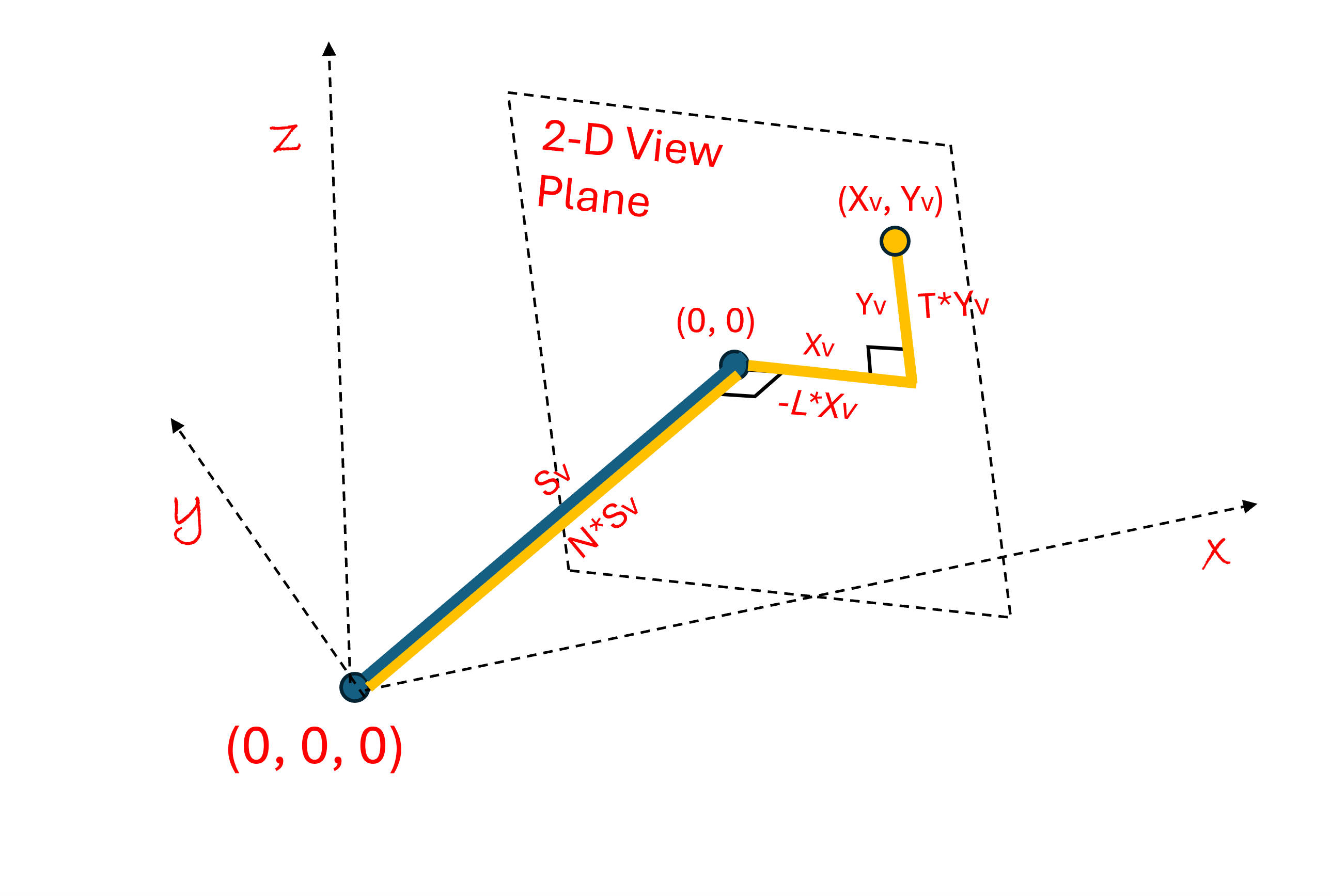
We can imagine that everything we see in front of our face is displayed on a big flat screen that is always a certain fixed distance in front of our nose and moves around with our head (it could be transparent).  Let’s call this screen the “View Plane” and say that it is always placed a fixed distance (SV) perpendicular to our Nose direction (N).  This is not hard to imagine, I see lots of people carrying their cell phones around like this in front of their face all the time.

Your personal reference point (0, 0, 0), the origin, is always between your ears, the Nose direction (N), always points straight out in front of your face, the Left Ear direction (L) always points in the direction of your left ear, and the Top of head direction (T) always points through the top of your head.  This personal reference frame moves as you change the orientation of your head.

Since the View Plane in front of you is 2-D, every point on this screen can be located on a 2-D “xv-yv plane”.  Let’s draw such Cartesian coordinates on our View Plane. We choose the origin of the View Plane (0, 0) to be where our Nose direction (N) passes through the plane. We can choose the xv-axis on the plane to point to the right (opposite the L direction), and then the yv-axis would point in the Top of Head direction (T).

A single point (pixel) on this 2-D view screen (xv, yv), with a color (cv), can also be located in the 3-D world.  Start at the origin (0, 0, 0), the middle of your head, then travel a distance Sv in the N direction to arrive at the origin of the View Plane (0, 0), then from there travel along the xv-axis (in the negative L direction) a distance xv, and then along the yv-axis (in the T direction) a distance yv.  From our orienteering days, we already know how find this 3-D point in math language:

    (x, y, z) = N*Sv + (-L)*xv + T*yv
                   = [N, L, T].(Sv,-xv,yv)

And so, we can find the 3-D coordinates for any point on the 2-D View screen (xv, yv) when we know the distance to the view screen (Sv) and the orientation of the head (N).  In review, the middle of the head is always at the origin (0, 0, 0) and you are looking in the Nose direction N:(Dx, Dy, Dz) in the 3-D world, the direction vectors of the head reference frame are:

         N = (Dx, Dy, Dz)
         L = (-Dy/Dr, Dx/Dr, 0)
         T = (-Dx*Dz/Dr, -Dy*Dz/Dr, Dr)

         Dr2 = Dx2 + Dy2

In the Cartesian frame of the 3-D world around us the orientation of our head can be determined by two angles (Axy and Az).  As you remember, Axy is the angle we have rotated our head left or right in the x-axis in the x-y plane, and Az is the angle that we have tilted our head up or down off the x-y plane.  In review, the direction vector of the head is found from the following:

       Dx = Cos(Axy)*Cos(Az)
       Dy = Sin(Axy)*Cos(Az)
       Dz = Sin(Az)

The dot products of the [N, L, T] head reference vectors are:

   N.N = L.L = T.T = 1
   N.L = N.T = L.T = 0

since they are all perpendicular to each other.
We also find that:

     N.(x, y, z) = N.( N*Sv + L*(-xv) + T*yv )
                        = N.N*Sv + N.L*(-xv) + N.T*yv
                        = 1*Sv + 0*(-xv) + 0*yv
                        = Sv

     L.(x, y, z) = L.( N*Sv + L*(-xv) + T*yv )
                        = L.N*Sv + L.L*(-xv) + L.T*yv
                        = 0*Sv + 1*(-xv) + 0*yv
                        = -xv

     T.(x, y, z) = T.( N*Sv + L*(-xv) + T*yv )
                        = T.N*Sv + T.L*(-xv) + T.T*yv
                        = 0*Sv + 0*(-xv) + 1*yv
                        = yv

Another way of writing these stacked equations with dot products is simply:

      [N, L, T].(x, y, z) = (Sv, -xv, yv)

So, we can see that with this miracle matrix [N, L, T] can map a point in 3-D space onto a point (xv, yv) on a View Plane that is a distance Sv away.

Let’s finish this idea off.  Suppose we have any point in 3-D space (x, y, z), then

[N, L, T].(x, y, z) = (SN, -xN, yN)

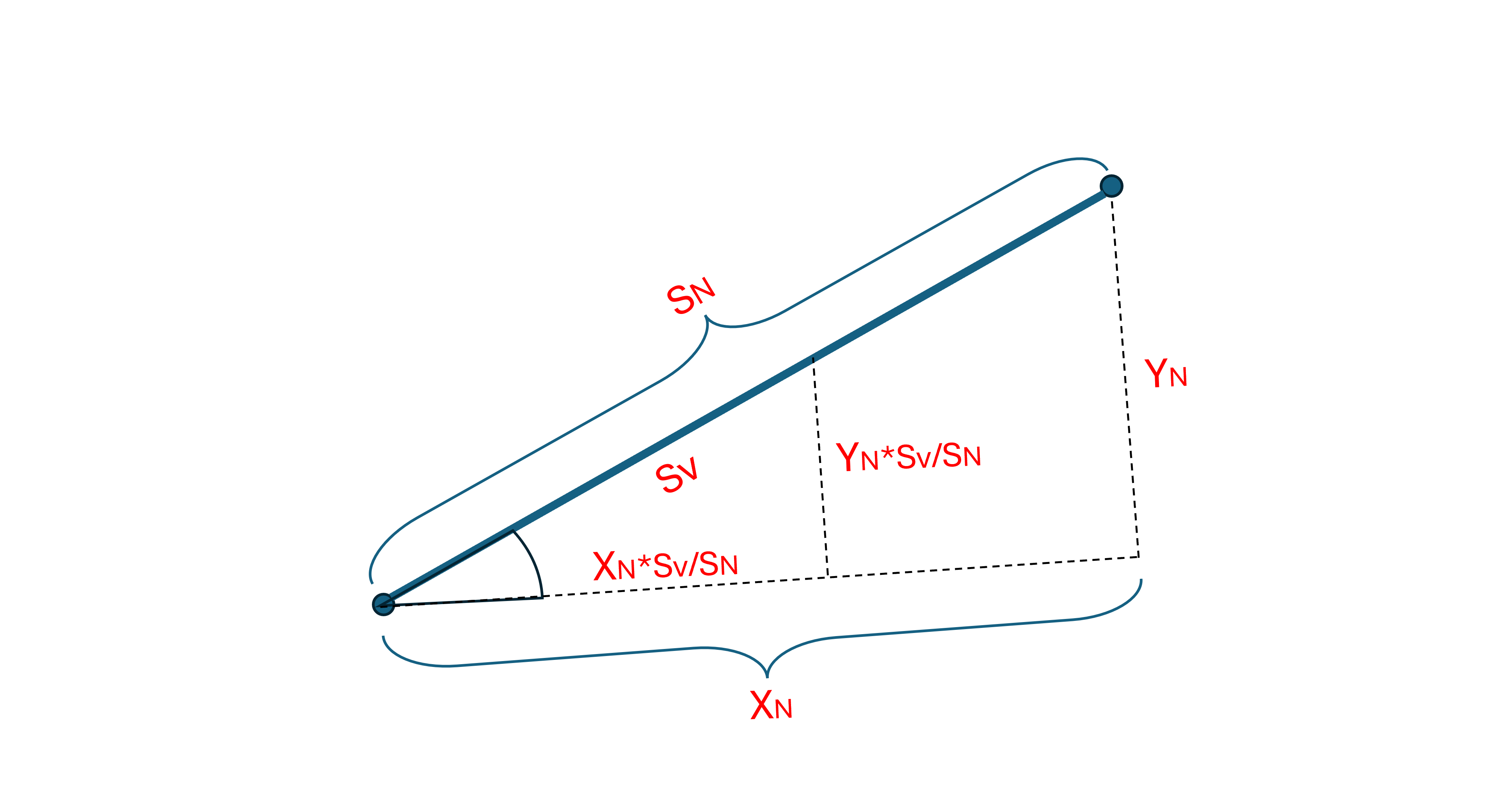
maps (x, y, z) onto a point (xN, yN) on 2-D view plane that is a distance SN away from your nose.  Using simple geometry, this point can be mapped onto a point (xv, yv) in any parallel View Plane that is a distance Sv away by using:

    (xv, yv) = (xN, yN)*Sv/SN

And so, we can map a 3-D world onto a 2-D view plane.  Our brain perceives these 2-D images from colored points (pixels) from our flat screens as 3-D images.

Standard

Math Moments – Navigating in 3-D Space

We can navigate in 3-D to any point (xR, yR, zR), in Cartesian Coordinates, by starting at the origin (0, 0, 0) and in the 2-D, x-y plane, walking in the x-direction (1, 0, 0) a distance xR, then turning left 90 degrees and walking a distance yR in the y-direction (0, 1, 0), still on the x-y plane.  This is the same as we did in 2-D except we put an extra ‘0’ in the third ‘z’ direction.  At this point we are still on the x-y plane at the point (xR, yR, 0).  The z-direction is straight up, so we would now need a ladder to climb up or a shovel to dig down, it is helpful to pretend we can fly (or dig).  From this point (xR, yR, 0) on the x-y “ground” plane, we fly straight up in the z-direction (0, 0, 1) a distance zR, and we successfully arrive at the point (xR, yR, zR).

We can express this journey with vectors, as we did in 2-D, by connecting (adding) lines together to form the path:

   (xR, yR, zR) = (1, 0, 0)*xR + (0, 1, 0)*yR + (0, 0, 1)*zR
                        = (xR, 0, 0) + (0, yR, 0) + (0, 0, zR)
                        = (xR, yR, zR)

        And using dot product notation, this can be written:

   (xR, yR, zR) = (1, 0, 0)*xR + (0, 1, 0)*yR + (0, 0, 1)*zR
                        = [(1, 0, 0), (0, 1, 0), (0, 0, 1)].(xR, yR, zR)

The [(1, 0, 0), (0, 1, 0), (0, 0, 1)] matrix is called the identity matrix.

We could also arrive faster by flying along a straight line connecting the two. Fly along a direction (Dx, Dy, Dz), from the origin directly to this point, (xR, yR, zR) a distance “R” away:

   (xR, yR, zR) = (Dx, Dy, Dz)*R

        Where the distance ‘R’ is found by:

    R2 = xR2 + yR2 + zR2

From the equation above for this line, we can easily find the direction vector from the origin to any point (xR, yR, zR), similar to what we did in 2-D.

      (Dx, Dy, Dz) = (xR/R, yR/R, zR/R)

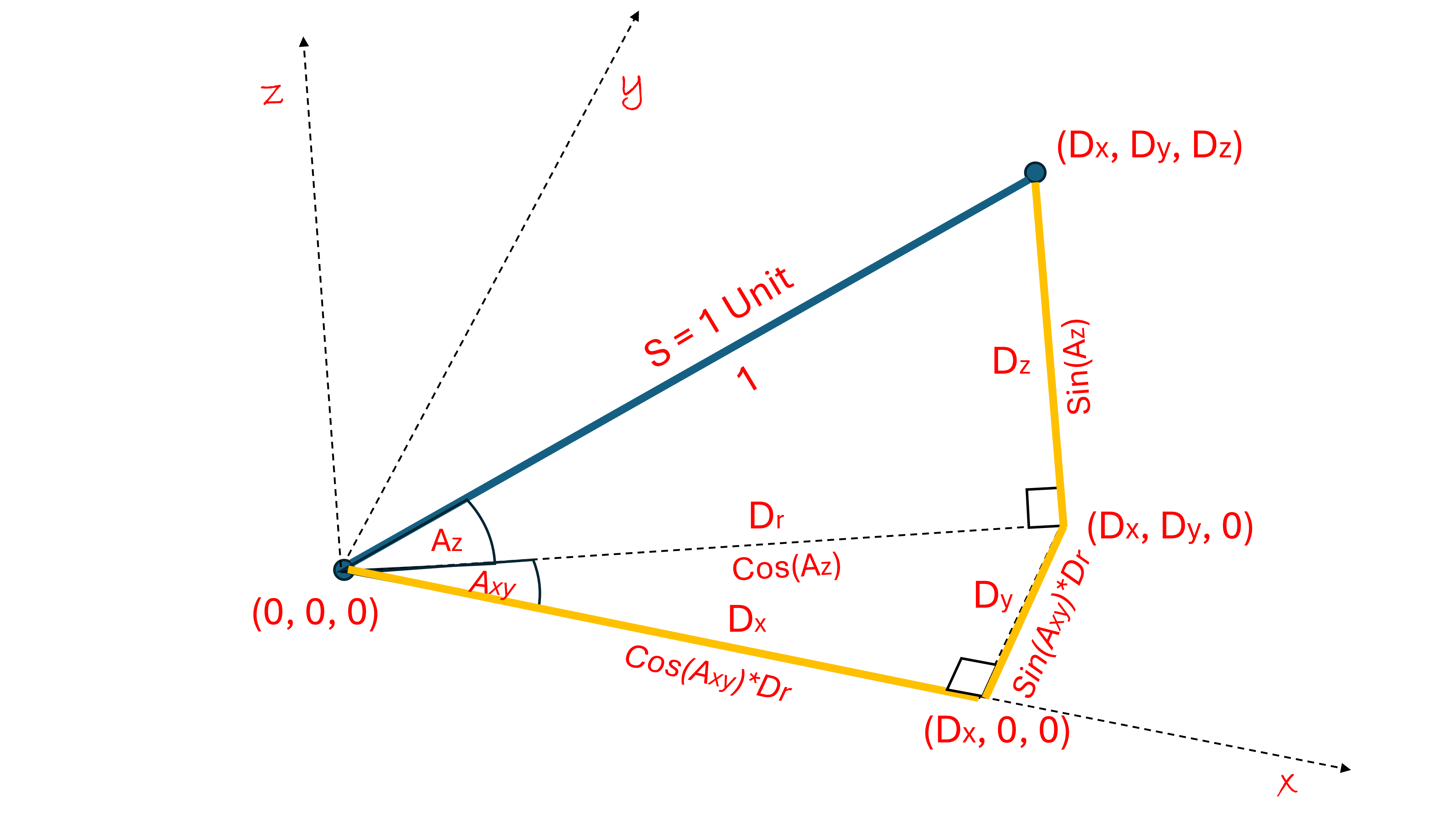
Recall that the direction vector always has a distance of 1 unit, as seen in the diagram above.  In the diagram, we have attempted to show a 3-D path on a 2-D piece of paper.  Note that in the diagram, Dr is the distance from the origin to the point (Dx, Dy, 0) in the x-y plane. From the Pythagorean theorem, we find that the length:

      Dr2 = Dx2 + Dy2    and
      Dr2 + Dz2 = 1        thus combining these
      Dx2 + Dy2 + Dz2 = 1.

The total length of the distance vector is 1 unit, as required.  Everything is consistent.  Now we use the definition of the ‘Sin’ and ‘Cos’ and can see, from the diagram above, that:

     Cos(Axy) = Dx/Dr
     Sin(Axy) = Dy/Dr

      Cos(Az) = Dr/1
      Sin(Az) = Dz/1

    Thus

       Dx = Cos(Axy)*Dr = Cos(Axy)*Cos(Az)
       Dy = Sin(Axy)*Dr = Sin(Axy)*Cos(Az)
       Dz = Sin(Az)

And so, if we stand at the origin facing in the x-direction, and rotate our “head” an angle Axy to the left, and then tilt our head an angle Az off the x-y plane to look directly at the point (xR, yR, zR), we can find the direction vector pointing to this point using these angles:

   (Dx, Dy, Dz) = (Cos(Axy)*Cos(Az), Sin(Axy)*Cos(Az), Sin(Az))

       And then draw the line to this point:

    (xR, yR, zR) = (Dx, Dy, Dz)*R

Now that we are staring at a point in the sky, with our nose pointed directly at the point, we can ask about “reference frame” of our head.  What direction is our left ear pointing, for example.  Our left ear is pointing in the direction, still in the x-y plane, that is 90 to the left of the Axy angle we rotated our head (-Dy/Dr, Dx/Dr, 0). We divide by Dr because in 3-D we must make the length of the direction vector equal to 1.  If this seems vague, look back and review how to find 90 degree directions in the 2-D plane in the top diagram taken from previous posts.

When we tilt our head, we can ask what is the direction that the top of our head points, 90 degrees up from the angle Az. It perhaps takes a bit more imagination to see this, since we are facing in the x-y plane (Dx/Dr, Dy/Dr, 0) and have tilted our head up to look at Dz, we find that the “shadow” of our head is pointed behind us, in the x-y plane (-Dx/Dr, -Dy/Dr, 0), then looking at the elevation Dr (when rotated 90 degrees) we find that (-Dx*Dz/Dr, -Dy*Dz/Dr, Dr) is the direction of the top of our head.  So, in the reference frame of our head:

     Direction of our Nose:     (Dx, Dy, Dz)
     Direction of Left ear:         (-Dy/Dr, Dx/Dr, 0)
     Direction of Top of head:  (-Dx*Dz/Dr, -Dy*Dz/Dr, Dr)

Let us verify that these direction vectors all have a length of 1.  The Nose direction we have verified.  For the Left ear direction:

    L.L = (-Dy/Dr)2 + (Dx/Dr)2 + 02 = (Dy2 + Dx2)/Dr2 = 1

For the Top of head direction:

    T.T = (-Dx*Dz/Dr)2 + (-Dy*Dz/Dr)2 + Dr2 = (Dy2 + Dx2)*Dz2/Dr2 + Dr2
                                                                    = Dz2 + Dr2 = 1

Now let’s find what happens when we find the dot product of these direction vectors, we will call them the N, L, and T directions respectively.

N.N = (Dx, Dy, Dz).(Dx, Dy, Dz) = Dx2 + Dy2 + Dz2 = 1

N.L = (Dx, Dy, Dz).(-Dy/Dr, Dx/Dr, 0) = -Dx*Dy/Dr + Dy*Dx/Dr + 0
                                                                  = 0

N.T = (Dx, Dy, Dz).(-Dx*Dz/Dr, -Dy*Dz/Dr, Dr)
        = -Dx2*Dz/Dr + -Dy2*Dz/Dr + Dz*Dr
        = -(Dx2 + Dy2)*Dz/Dr + Dz*Dr
        = -Dr2*Dz/Dr + Dz*Dr
        = 0

L.T = (-Dy/Dr, Dx/Dr, 0).( -Dx*Dz/Dr, -Dy*Dz/Dr, Dr)
       = Dy*Dx*Dz/Dr2 + -Dx*Dy*Dz/Dr2 + 0
       = 0

We also verified that L.L = 1 and T.T = 1 above.  So, in general, if we dot any of these N, L, T direction vectors with themselves, we get ‘1’, but if we dot any of them with each other, we get ‘0’.  It turns out that this is a requirement for any three perpendicular direction vectors in a 3-D Cartesian reference frame.  I find the “head” reference frame to be more natural because we can relate to it better, so I use this reference frame for whatever direction I am looking.  It is also a great reference frame for video games.

We have already seen from perpendicular 2-D paths how we can convert between a reference frame to our “ground” x-y-z reference frame.  To understand this, let’s take a journey: Fly in the Nose direction a distance SN, then fly in the Left ear direction a distance SL, and then in the Top of head direction a distance ST.  Then we will arrive at the point:

    (x, y, z) = N*SN + L*SL + T*ST

       or in dot product notation:

     (x, y, z) = [N, L, T].(SN, SL, ST)

This amazing equation lets you convert any point in your “head frame” of reference (SN, SL, ST), when your Nose is pointing in a direction N:(Dx, Dy, Dz), to a point in the “ground” frame (x, y, z).  You might also want to do this the other way around.  Review how we did this in 2-D, by “dotting” each side by each of the direction vectors, we get:

    (SN, SL, ST) = [N, L, T].(x, y, z)

This is how video games convert a 3-D world, stored in “ground” (x, y, z) coordinates, into the perspective of the viewer’s head (SN, SL, ST) coordinates.  The details need to be worked out but using this equation we can map a 3-D world onto a 2-D screen in the viewer’s perspective, no matter the relative direction of the viewer’s head.  We will stop here, there is a lot to take in.

Standard

Math Moments – Review and 3-Dimensional Expansion

All the concepts that we have discussed so far can be expanded into new dimensions.  We have only been looking at two dimensions so far, and yet we live in a world of 3 physical dimensions.  Although mathematically we don’t have to stop at 3 dimensions, we could expand the same concepts to work in as many dimensions as we want. First, let’s start by generating a 3-dimensional space from the 2-dimensional space we have been working in.

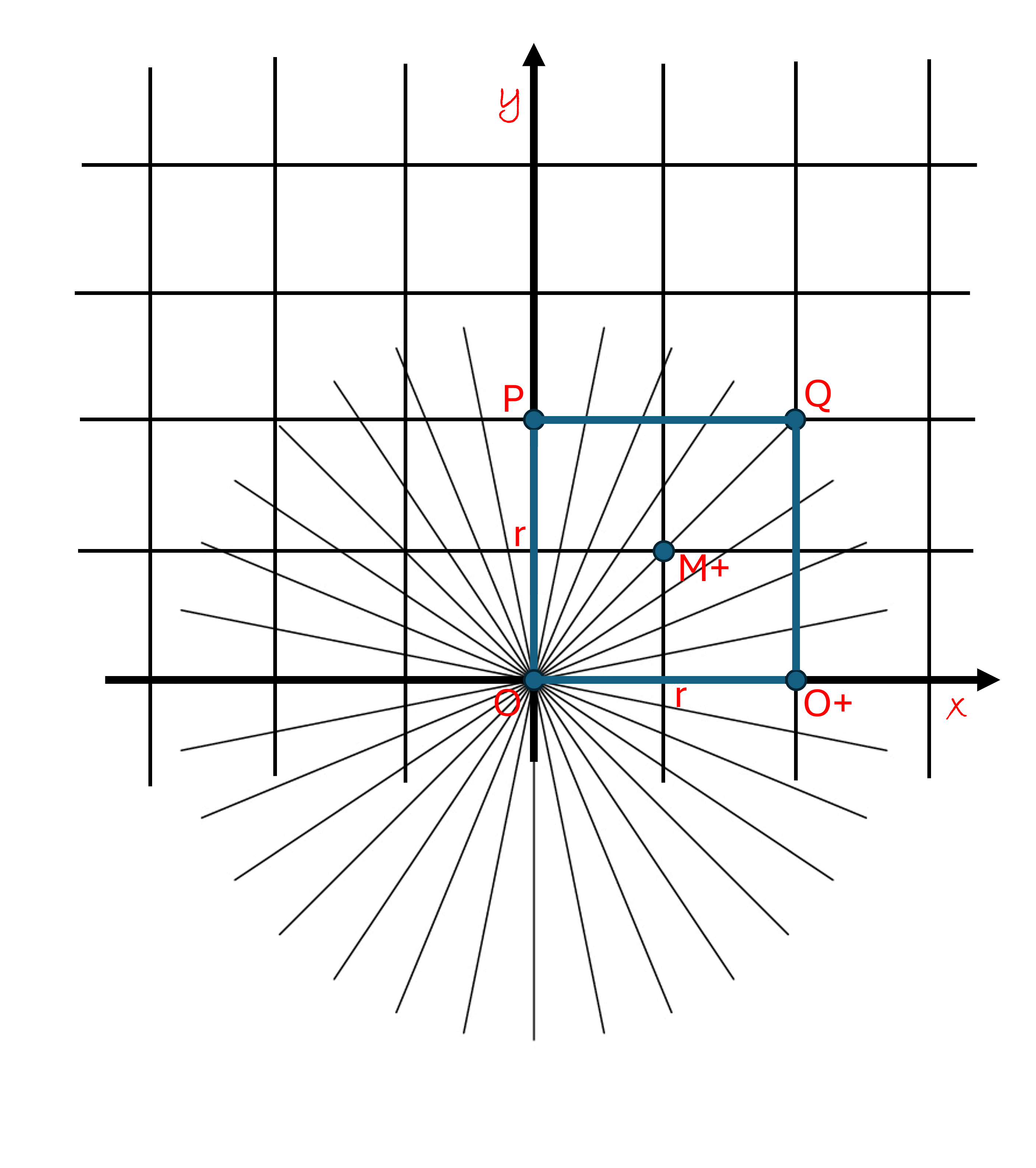
Do you remember how we generated new dimensions? Look back to the expanding dimensions post to refresh your memory. Take the 2-dimensional x-y plane where we have been working and find a point “P” that is NOT in it.  Now imagine line segments between every point in our 2-D space (x-y plane) and the new point P.  Find the point on the x-y plane (2-D space) that forms the line segment with the shortest distance to P and label it “O”.   Call this minimal distance “r”.

We can choose the point O to be the origin on the x-y plane and pick an x-direction for the x axis, which also determines the direction for the y-axis.  We can now use the same diagram above, the same procedure (and a bit of imagination) to generate a 3-D space from a 2-D space with one observation. In our original 1-D space there were only two directions from the point O, negative (O-) and positive (O+).  In the 2-D space, there are an infinite number of directions pointing away from the point O, and each direction is indistinguishable from any other direction.

We can use this rotational symmetry to generate our 3-D space.  Imagine that you printed the diagram above and on a sheet of paper and placed it so that the point O is on the origin of the x-y plane, the point P (the new point) is above the x-y plane, and make the x-axis go through the O+ point.  The sheet (plane) of our diagram would now be perpendicular (vertical) to the x-y plane.  The same argument holds that since the O-P segment is the shortest one that connects the x-y plane it is an axis of symmetry.

We call this new O-P direction the “z” axis.  Now imagine rotating this diagram around the z axis.  The O+ point would trace out a circle on the x-y plane, and touch every point on the plane that is a distance “r” from point O.  The distance from every one of these points on this circle would also be the same distance from P.  The segments P-O+ would sweep out the surface of a cone as we rotated the diagram around the z axis, and parallel lines would sweep out parallel planes along the z axis. We can rotate our sheet of paper around the z-axis to any angle and the cross section would still remain the same. Can you see it?

We can use the same trick as before, we can imagine that these parallel planes are mirrors facing each other that will reflect an infinite array of parallel planes to the x-y plane along the z axis, thanks to reflection symmetries.  We can also make an infinite set of parallel planes along the x axis, and along the y-axis by processes similar to those we did before in 2-D to make a cartesian “grid” of planes and fill in all the gaps.

Note that the line segment O-P does not move when we rotate the diagram around it.  It is stationary under rotation.  Now we have fully leveraged the rotational and reflectional symmetries of 3-D space.  We can pick any axis of rotation (a line), rotate the universe around it, and the universe will remain unchanged, only our vantage point changes.

As always, we can pick any point in 3-D space to be the reference point (origin). And any 2 perpendicular directions (an x and y axis) can be chosen to define a 2-D plane, and the third direction (z axis) perpendicular to this x-y plane is determined. These three directions define how we write points in this new 3-D space.

In cartesian coordinates,  the vector (x, y, z) can label every point and (Dx, Dy, Dz) can label every direction.

Lines in 3-D space can be defined by:

   (x, y, z) = (x0, y0, z0) + (Dx, Dy, Dz)*S

Where (x0, y0, z0) is the point of origin for the line, (Dx, Dy, Dz) is the direction of the line, and “S” is the distance along the line from the origin.  At this point, this notation should not be difficult or surprising.  The above is also an equation for a sphere if you hold S constant to be the radius and vary the direction.

There might be some questions on how you can determine directions in 3-D space. Similar to 2-D space, the direction vector always has a length of 1 unit:

    Dx2 + Dy2 + Dz2 = 1

A natural way to determine directions is by using your head.  Stand facing North (the x-axis), now rotate your head an angle “Axy” to the left (West towards the y-axis).  You can determine every direction on the x-y plane with this angle Axy (between -180 and 180 degrees).  Now tip your head up an angle “Az” off the x-y plane (between -90 and 90 degrees).  Varying these two angles, you can now look in any direction possible in 3-D space.

This is also how we locate positions on the spherical surface of the earth.  We place an imaginary observer in the middle of the earth and have it “face” 0 degrees longitude and 0 degrees latitude (the x-axis).  The Axy angles are degrees of longitude as the observer rotates its head around the north pole (z-axis), and the Az are degrees of latitude as the observer tips its head up and down.  Using this scheme the observer can look at any place on the surface of the earth given a longitude (Axy) and latitude (Az).

Standard

Math Moments – The Rotation Matrix

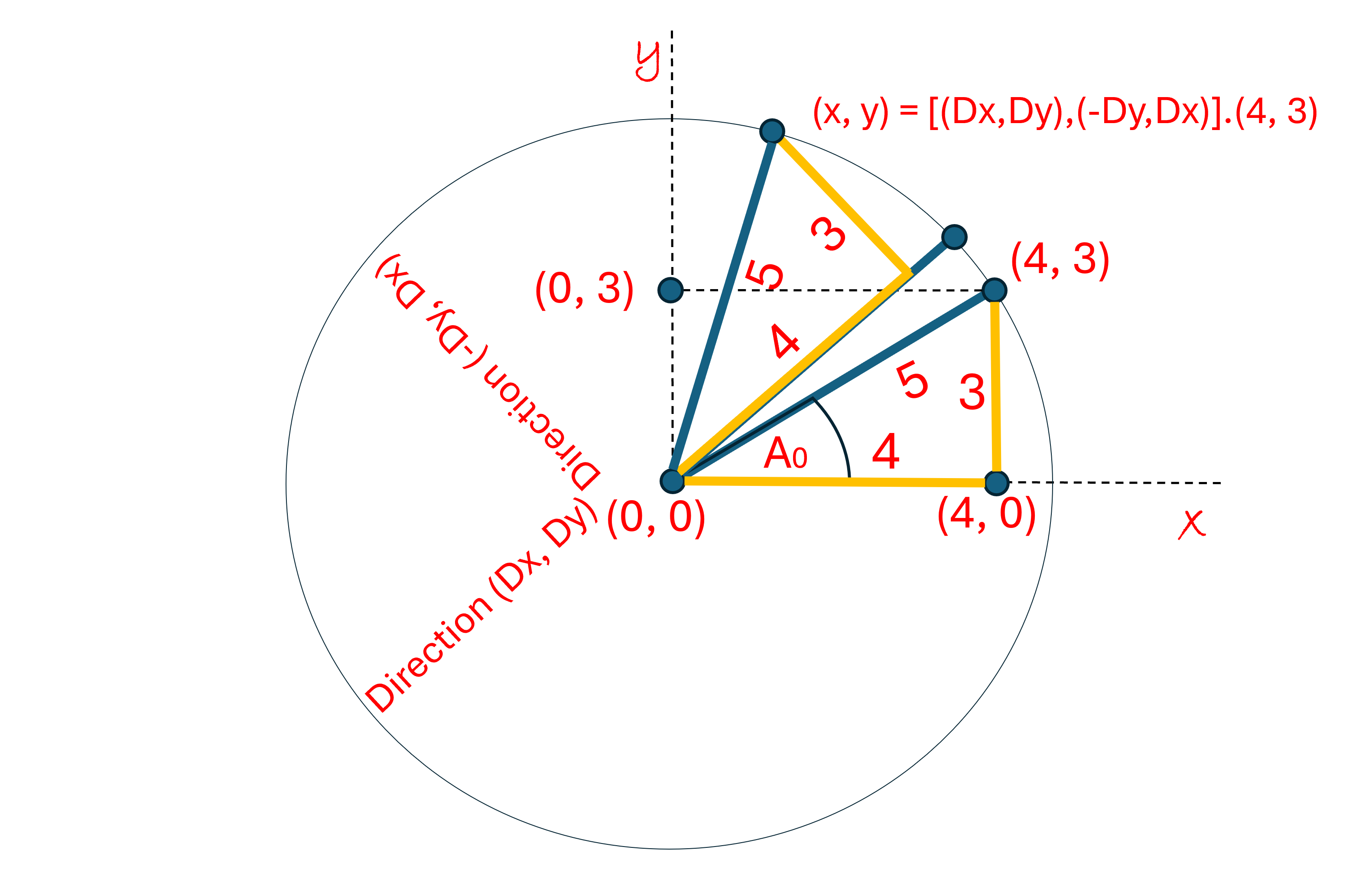
On the Cartesian plane, if we walk along the x-direction (1, 0) for a distance of 4 units, then turn left 90 degrees (perpendicular) and walk a distance of 3 units, we arrive at the point (4, 3), which is a distance of 5 units from the origin (42 + 32 = 52), great.  Well, what happens if we do the same, but start off walking in any direction (Dx, Dy) 4 units and then turn left 90 degrees (-Dy, Dx) and walk 3 units; we are still 5 units from the origin.  We have just “rotated” the whole path to a new direction.  Where would we end up (x, y)?  We use our orienteering skills:

     (x, y) = (Dx, Dy)*4 + (-Dy, Dx)*3
     (x, y) = [(Dx, Dy), (-Dy, Dx)].(4, 3)  –  using the dot product

Now notice that the matrix [(Dx, Dy), (-Dy, Dx)] when dotted with the cartesian point (4, 3) rotates it to another point on the circle (radius 5).  See the diagram. This matrix is called the “rotation matrix”.

Now that we are getting a bit more comfortable with the dot product, let’s play around and see what happens when we dot direction vectors with each other?  We’ll start off by dotting a direction with itself:

     (Dx, Dy).(Dx, Dy) = Dx2 + Dy2 = 1

Any direction dotted with itself is just “1”.  What about dotting a direction with its perpendicular direction?

    (Dx, Dy).(-Dy, Dx) = Dx*(-Dy) + Dy*Dx = 0

It turns out that any direction dotted with its perpendicular direction is “0”.  Now how about dotting the position (x, y) above with the direction vector?

   (Dx, Dy).(x, y) = (Dx, Dy).((Dx, Dy)*4 + (-Dy, Dx)*3)
                             = (Dx, Dy).(Dx, Dy)*4 + (Dx, Dy).(-Dy, Dx)*3
                             = 1*4 + 0*3
                             = 4

And so, dotting a direction vector (Dx, Dy) with any position vector (x, y) gives you the distance (Sx) you would have to travel in that direction before making a 90 turn and traveling the distance (Sy) that would bring you to the position (x, y).  Now let’s dot the perpendicular direction with the position vector:

   (-Dy, Dx).(x, y) = (-Dy, Dx).((Dx, Dy)*4 + (-Dy, Dx)*3)
                             = (-Dy, Dx).(Dx, Dy)*4 + (-Dy, Dx).(-Dy, Dx)*3
                             = 0*4 + 1*3
                             = 3

You can see that dotting the perpendicular direction with a position also gives you the distance (Sy) you would have to travel in the perpendicular direction (-Dy, Dx) to get to the position (x, y).

And so can you see that in this case:

     [(Dx, Dy), (-Dy, Dx)].(x, y) = (4, 3)

So in general if

     (x, y) = [(Dx, Dy), (-Dy, Dx)].(Sx, Sy)

              then

     [(Dx, Dy), (-Dy, Dx)].(x, y) = (Sx, Sy)

What does this mean?  The rotation matrix […] when it “operates” on (is dotted with) any point (x, y), gives you the coordinates of the point relative to a new set of “x-y” axis that is pointing in a direction (Dx, Dy) relative to the old axis.  Or you can say that it rotates the point around the origin.  Either vantage point is valid, you can rotate the point around the origin or rotate the reference frame in the opposite way around the origin; either way, it is describing the same thing.

Remember the concept of “rotational symmetry”, that we can pick the direction of the x-y axis to be in any direction we want.  Now we have the tools to convert the cartesian coordinates of a set of points from any reference frame to a reference frame pointing in any direction we choose.

THIS IS A FUNDAMENTAL CONCEPT of the MATH Language: ROTATIONAL SYMMETRY means that the universe is the same no matter the direction of your frame of reference.  The Rotation matrix gives you a way of describing the same universe from any prospective of direction.  It is pure magic.

One more point, remember that

   (Dx, Dy) = (Cos(A), Sin(A))

Where “A” is the angle of the direction off x-axis.  Thus, the rotation matrix “R(A)” can be written as:

     R(A) = [(Cos(A), Sin(A)), (-Sin(A), Cos(A))]

And there you have it.

Standard

Math Moments – Using Vectors in Orienteering

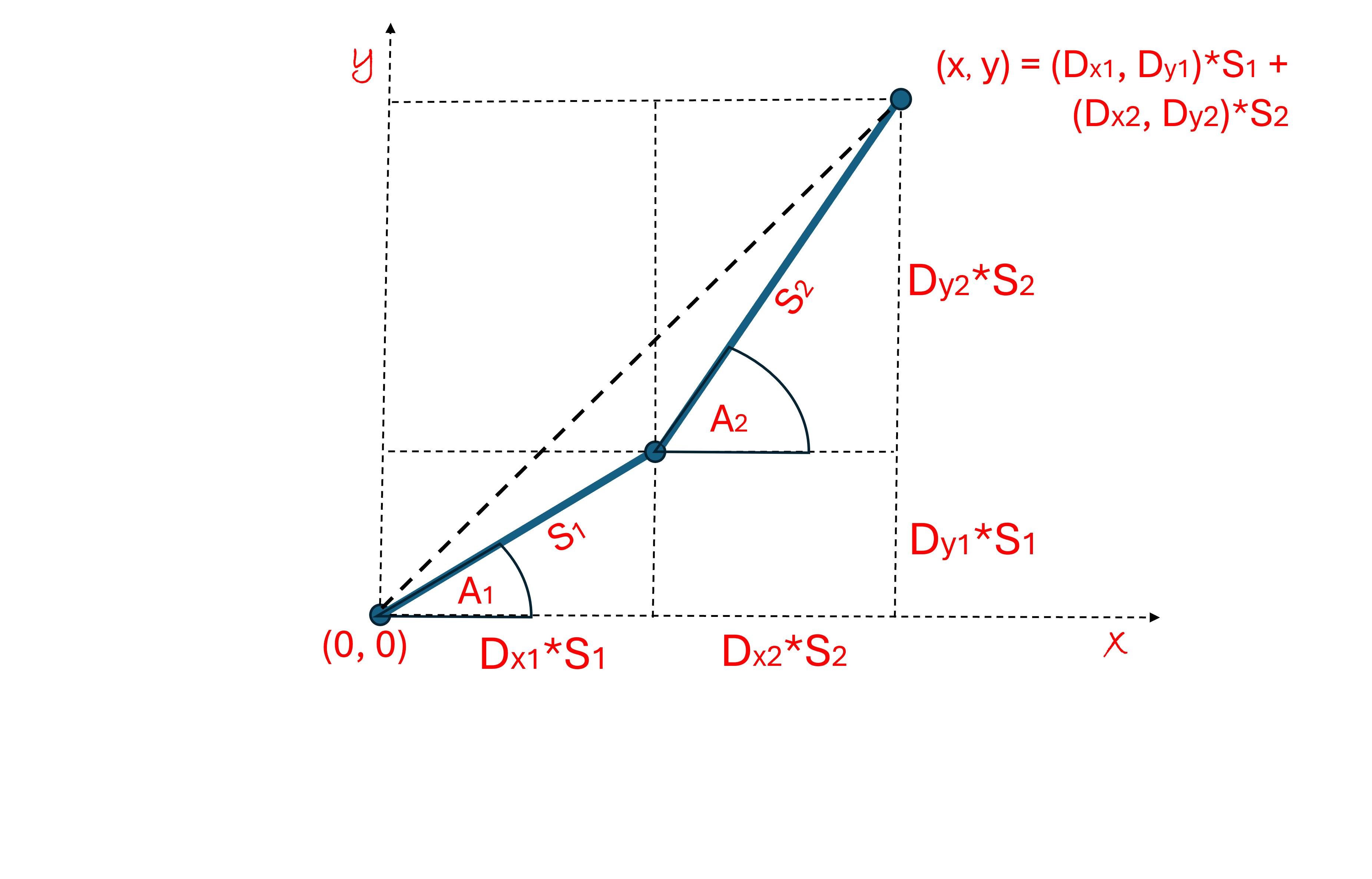
Soldiers and airplanes in unfamiliar places need to find their way around. They can do this with methods similar to what we have already discussed.  They receive instructions to go first in a certain direction (Dx1, Dy1) for a certain distance S1, and then to change course to another direction (Dx2, Dy2) and keep going for a distance S2.  This same pattern can be followed for many different directions and distances. This discipline is called orienteering.  Soldiers are trained to find directions with their compasses and measure distances with the number of steps they take.

With our new vector notation, we can say the same thing in math language:

     (x, y) = (Dx1, Dy1)*S1 + (Dx2, Dy2)*S2

Which says that the point of our destination (x, y) can be found by going in the direction (Dx1, Dy1) for a distance (S1) and then going a direction (Dx2, Dy2) for a distance (S2).  Notice that to find our destination (x, y), we just add these two vectors together.  It is just like piecing together lines to form a path.

Any destination (x, y) is determined by just adding together all the lines (vectors) that form the path in between.  In the example above, there were only 2 directions and distances (lines), but we could keep on going for as many vectors as we want, adding on lines, one line after another until we arrive at our destination.

It is helpful to define yet another notation that is even more compact.

     (x, y) = (Dx1, Dy1)*S1 + (Dx2, Dy2)*S2

   can be written

     (x, y) = [(Dx1, Dy1), (Dx2, Dy2)] . (S1, S2)

The dot “.” between the two vectors is called a “dot product”.  In the case above the dot product means you multiply the first direction vector in the square brackets [1,2] with the first distance in the round brackets (1,2) and do the same with the second direction vector and second distance and then add them both together.

This new notation might seem a bit mysterious at first, but it does make things clearer later on.  The dot product is one of the most fundamental operations of “linear algebra” which is the math that tells you where you end up when adding together a bunch of lines (vectors) to form a path.

We do something similar to write the (x, y) coordinates of a point in our cartesian plane.  Let’s look at the point (3, 4), we can get there by walking along the x-direction 3 units, then turning left 90 degrees and walking in the y-direction 4 units:

    x-direction: (Dx1, Dy1) = (1, 0)
    y-direction: (Dx2, Dy2) = (0, 1)

Then using the “dot product” notation we discussed above:

    (x, y) = [(Dx1, Dy1), (Dx2, Dy2)].(S1, S2)

    (x, y) = [(1, 0), (0, 1)].(3, 4)
               = (1, 0)*3 + (0, 1)*4
               = (3, 0) + (0, 4)
               = (3+0, 0+4)
               = (3, 4)

We find that we end up at the point (3, 4).  This is also one way in the cartesian coordinates that we can define the location of a point.  So, the [(1, 0), (0, 1)] vector when “dotted” with any two distances (Sx, Sy) brings you to the point (x, y) = (Sx, Sy).

     (x, y) = [(1, 0), (0, 1)].(Sx, Sy) = (Sx, Sy)

Do you get the point?  You are starting to see the “language” of the dot product.  In math language a vector of vectors is called a matrix and [(1, 0), (0, 1)] is called the “identity matrix”, because when you dot it with any vector you get back the same vector.

The dot product can be applied to any two vectors of the same size. This concept is used all over the place.  Here is an interesting example, we can use the dot product notation to write down the number 365 (in decimal) starting with the vector (3, 6, 5):

   (3, 6, 5).(100, 10, 1) = 3*100 + 6*10 + 5*1 = 365

This is how we write numbers (in base 10). It is read like this: 3 in the 100’s column, 6 in the 10’s column and 5 in the one’s column, added together, normally written “365”.

We could also use it to find the number of seconds from midnight to 04:35:20am from the vector (4, 35, 20):

   (4, 35, 20).(3600, 60, 1) = 4*3600 + 35*60 + 1*20
                                                  = 16520 sec

There are 3600 seconds in an hour, and 60 seconds in a minute.  I think you got the idea.

Standard

Math Moments – Pointing the Direction

It might be good just to pause here for a minute or two and get our bearings.  If you were deep in the woods with a compass, you could get to any point you want by simply knowing the direction you need to travel and how far you need to go in that direction.  On a grid, we could call the point where you are “the origin”, you are starting at the point (0, 0).

You also have a map with a grid and want to be able to draw a line on the map from where you are to your destination.  We are going to draw this line using the general line parametric equations for a line we have already discussed:

x = x0 + Dx*S
y = y0 + Dy*S

With the origin as your starting point (x0, y0) = (0,0).  Notice that I used different simpler notation that says

x0 = 0 and
y0 = 0.

This is called vector notation, instead of stacking the parametric equations on top of each other, we put them side by side in parenthesis and separate them with a comma (x, y). Using this vector notation I can rewrite both general parametric equations for a line as:

      (x, y) = (x0, y0) + (Dx, Dy)*S

A “vector” is expressed as two numbers written in parenthesis, separated by commas. In this case, the first number is the “x term” and the second number is the “y term”. When we “add” two vectors we add both “x terms” together and also both “y terms”.  When we multiply a vector times a number, then we just multiply both the “x term” and “y term” by that number.  And so, the “vector” equation for a line can be expanded like this:

   (x, y) = (x0, y0) + (Dx, Dy)*S
   (x, y) = (x0, y0) + (Dx*S, Dy*S)  (multiply the Direction vector by S)
   (x, y) = (x0+Dx*S, y0+Dy*S)        (add this to the starting point)

You can see how this last equation looks like the original stacked parametric equations, but they are written side by side in the parenthesis instead of one on top of the other.

This vector notation has an advantage, it is easier to write, and it lets us express the direction of the line on as (Dx, Dy). 

This becomes very helpful.

If you are in the deep woods, then it would be very helpful to convert your compass heading direction into this Direction vector and find (Dx, Dy) for your desired direction heading so you can draw the line on your “grid” map.

Since you set the origin (x0, y0) = (0, 0) to be where you are, the vector equation for the line to your destination is:

   (x, y) = (Dx, Dy)*S

Now suppose that your destination is a distance “R” away from where you are. You can then draw a circle on your map with a radius “R” from the origin where you are.  You know that your destination is then somewhere on that circle.  You just need to know the direction (Dx, Dy) of your line to your destination point (see diagram above).

Let’s call the destination point (xR, yR).  Since we figure that the distance is “R”, then when S = R our vector equation is written:

(xR, yR) = (Dx, Dy)*R

And so using vector notation:

(Dx, Dy) = (xR, yR)/R = (xR/R, yR/R)

This tells us that if we know the point of our destination:

(xR, yR) and the distance R2 = xR2 + yR2, then we can find the direction vector and draw our line on the map.  And if we only know the Angle “A” off the ‘x-axis’ from our compass, We can use our calculator and the definitions of Cos(A) = xR/R and Sin(A) = xR/R, to find the direction vector:

    (Dx, Dy) = (Cos(A), Sin(A))

Let us look at an example:  Suppose we knew that if we walked north 3 miles and then east 4 miles, we would reach our destination.  Then our destination is at (3 miles north, 4 miles east) on our map:

   (xR, yR) = (3, 4)  and R2 = xR2 + yR2 = 32 + 42 = 25 or R = 5.

       So,

   (Dx, Dy) = (xR, yR)/R = (3/5, 4/5) North-east

       The line on the map could be drawn by using:

   (x, y) = (3/5, 4/5)*S    where S varies from 0 to R.

If we wanted to know the compass heading, then we could use the “inverse” Cos and Sin functions on our calculator to find the angle “A”:

   Cos(A) = 3/5   and Sin(A) = 4/5.

This might require a bit more knowledge of trigonometry.

Now we do something really interesting.  Suppose that we are still at the origin, facing directly at the point (xR, yR) but we want to find the point on the circle that is exactly 90 degrees to our left. If you look at the diagram, you will easily see that the point of destination would then be (-yR, xR).  The point directly behind us would be (-xR, -yR) and the point 90 degrees to the right would be (yR, -xR).

This is very useful if we want to draw lines that are perpendicular to the direction we are traveling along a line.  The direction (-Dy, Dx) is perpendicular to the left of the direction (Dx, Dy).

Standard

Math Moments – Drawing Lines

If we want to show a computer how to draw lines in a virtual world (using a 2-D cartesian grid), then the best tools are things called parametric equations.  When drawing a line, the 3 parameters we need are:
(1) the starting point: (x0, y0), (2) the direction of the line: Dx, Dy, and (3) the length of the line: S.
The “parametric equations” that draw a line are written like this:

    x = x0 + (Dx * S)
    y = y0 + (Dy * S)

where x and y mark the point where the “pencil” is placed on the grid when drawing the line. Notice how “symmetrical” the equations are. Can you guess what the “z” coordinate would look like for drawing lines in 3-Dimensions?

We will learn how to find the Dx, Dy direction parameters later. Notice that plugging S = 0 in the equations above sets the “pencil” at the starting point (x = x0, y = y0).  When S = 1, the pencil has moved a distance of 1 unit away from the starting point, a distance Dx in the x-direction and a distance Dy in the y-direction. The pencil is now at the point (x = x0 + Dx, y = y0 + Dy), as seen when plugging S = 1 into equations. See the diagram above. Since the “pencil” has moved a total distance of 1 unit in total, we know from the Pythagorean theorem that:

   Dx2 + Dy2 = 12.

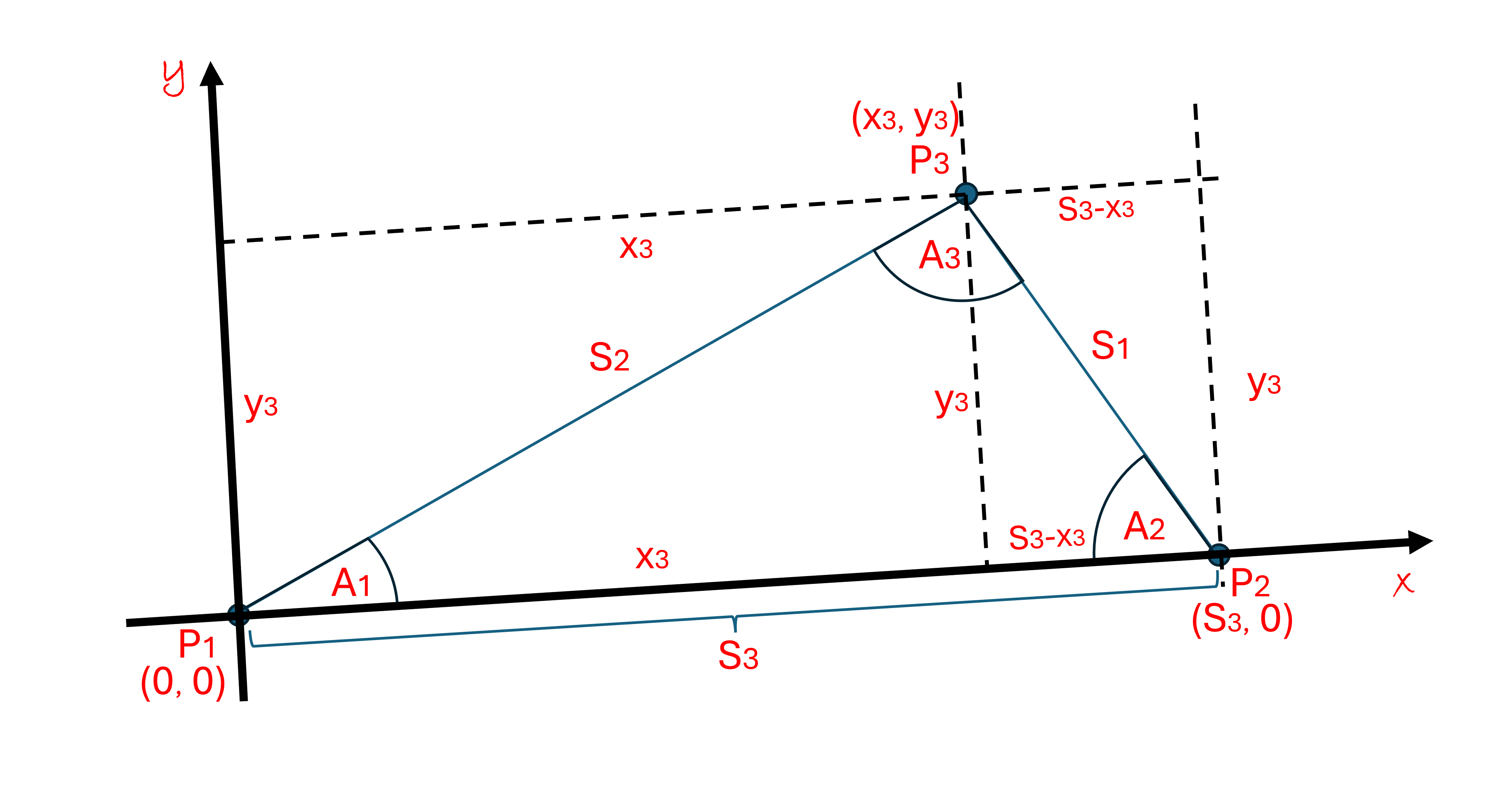
To draw our first line, let us first look at the simplest example: drawing the side S3 of the triangle in the diagram.  Note that we have changed the diagram a bit from previous posts, here we use the symbols x3 and y3 to specify the point P3:(x3, y3) and we now name the symbols x and y to mark the point where the pencil is drawing the line on the grid.

We picked the grid so that the line segment S3 lies along the x-axis. If we start at the point P1:(0, 0), then the starting point parameters are: x0 = 0 and y0 = 0.  This line segment ends at the point P2:(S3, 0), where x = S3, y = 0, and S = S3.  Thus, plugging these values into the parametric equations gives us:

     x = S3 = 0 + (Dx * S3)
     y = 0 = 0 + (Dy * S3)

It is not too hard to see that Dx = 1 and Dy = 0. And so, the complete parametric equations, with these parameters are:

     x = 0 + (1 * S) = S
     y = 0 + (0 * S) = 0

Let’s try this out. Remember, the point (x, y) determines the point where the “pencil” is drawing the pixel on the computer screen. To draw the S3 side you start with S = 0, where the “pencil” is at point P1:(0, 0) and then increase the length of the line, S, by one pixel length, compute x and y and draw in the next pixel at the point (x, y).  You keep on increasing S one pixel length at a time and drawing in pixels until the total length of the complete line segment is S3, when S = S3, you have reached the point P2:(S3, 0) and the S3 line segment is complete.

Note that you could also draw the line by putting your pencil on starting point P2 and drawing in the negative direction until you reach P1.  Since you are drawing in the negative direction, this time the parameter x0 = S3 and Dx = -1. Plugging these into the parametric equation for this line segment:

   x = S3 + (-1 * S) = S3 – S
   y = 0

Try it out.  When S = 0, your pencil is at P2:(S3, 0).  As S increases, the line is growing in the negative direction until S = S3 and then x = S3 – S3 = 0 at P1:(0, 0).  The same line segment has been drawn backwards.

Things get a little more interesting when finding the parameters to draw the side S2.  Let’s start at P1:(0, 0) and draw a line segment S2 to P3:(x3, y3).  As before, at the starting point P1, x0 = 0 and y0 = 0.  Things get just a bit more interesting when trying to find the direction parameters Dx and Dy.  The parametric equations are:

     x = 0 + (Dx * S) = Dx * S
     y = 0 + (Dy * S) = Dy * S

and at the endpoint P3, the parameters are S = S2, x = x3 and y = y3. Plugging them in:

    x = x3 = Dx * S2  and so Dx = x3/S2
    y = y3 = Dy * S2 and…     Dy = y3/S2

Note that: Dx2 + Dy2 = x32/S22 + y32/S22 = (x32 + y32)/ S22 = 1, recall that x32 + y32 = S22 from the Pythagorean Theorem and everything checks out.

Finally, the parametric equations can be written:

     x = (x3/S2) * S
     y = (y3/S2) * S

Now, in the last blogpost, we saw that the definition the Cos(A1) and Sin(A1) were:

Cos(A1) = x3/S2
Sin(A1) = y3/S2

These are exactly what you see in the equations above, Thus, the parametric equations for the line segment S2 are:

       x = Cos(A1) * S
y = Sin(A1) * S

Where S goes from 0 to S2. Quickly, if we want to draw this line in reverse, from P3 to P1, then our starting point is (x3, y3), moving in the negative direction, thus:

      x = x3 – Cos(A1) * S
y = y3 – Sin(A1) * S

Again S goes from 0 to S2.

The equations above will also draw circles.  If you keep the distance (S) constant and vary the angle (A1) from 0 to 360 degrees, the (x, y) “pencil” will sweep out all the points on a circle that are a radius S away from the center (x0, y0).  This is an extra bonus.

For reference, below are the general parametric equations for drawing both lines and circles:

       x = x0 + Cos(A1) * S
       y = y0 + Sin(A1) * S

If you want to draw lines, vary S.  If you want to draw circles, vary the angle A1.

Our last task is finding the parametric equations to draw the last side, S1.  Let’s start at the point P2:(S3, 0) and go to P3:(x3,  y3).  And so, our starting point is x0 = S3 and y0 = 0.  We just need to find the Dx and Dy parameters.  We can find these by looking at the parameters at the ending point, x = x3 and y = y3, and S = S1, thus:

     x3 = S3 + (Dx * S1)   thus   Dx = (x3 – S3)/S1
     y3 = 0 + (Dy * S1)    thus   Dy = y3/S1

If we want to write Dx and Dy in terms of the angle A2, then we need to find expressions for Cos(A2) and Sin(A2). Looking at the diagram, the triangle in the left dashed box has a base of length x3 and the side S2, forming the angle A1.  In the right dashed box, the triangle has the base length S3-x3, with the side S1 that form the angle A2.  The left and right triangles face each other and are joined by the common height length y3.  If we map out the corresponding parts of the left and right triangles:

Left –> Right
    x3 –> (S3-x3)
    y3 –> y3
    A1 –> A2
    S2 –> S1

                                    Thus

Cos(A1) = x3/S2  –> Cos(A2) = (S3 – x3)/S1
Sin(A1) = y3/S2   –>  Sin(A2) = y3/S1

This idea of mapping is very powerful, especially when it is used to change perspectives from one frame of reference to another.  In this case, it gives us the desired expressions that we need to draw the line segment S1 in the perspective of the angle A2. Below are the resulting parametric equations, with Dx and Dy as found a few paragraphs ago:

   Dx = (x3 – S3)/S1 = -(S3 – x3)/S1 = -Cos(A2)
   Dy = y3/S1 = Sin(A2)

Thus

     x = S3 + (-Cos(A2) * S) = S3 – (Cos(A2) * S)
     y = Sin(A2) * S

Check it out!  After a little practice, finding the parametric equations for lines and circles becomes very easy to do, much easier than other methods.

 One huge advantage of using these parametric equations is that the parameter S in these equations is the actual distance of the point (x, y) from the starting point (x0, y0).  At times, this is convenient when measuring the distance between points along a given angle.  Some examples of this will be given in later posts.  It makes geometry problems so much easier.

Standard