Math Moments – A Universal Triangle

Take any three points in the universe, that are not on the same line, and they form a triangle.  We also have seen how these three points can generate the 2-D Euclidean space where the triangle lives.  Oh, the things we can do with a humble triangle.

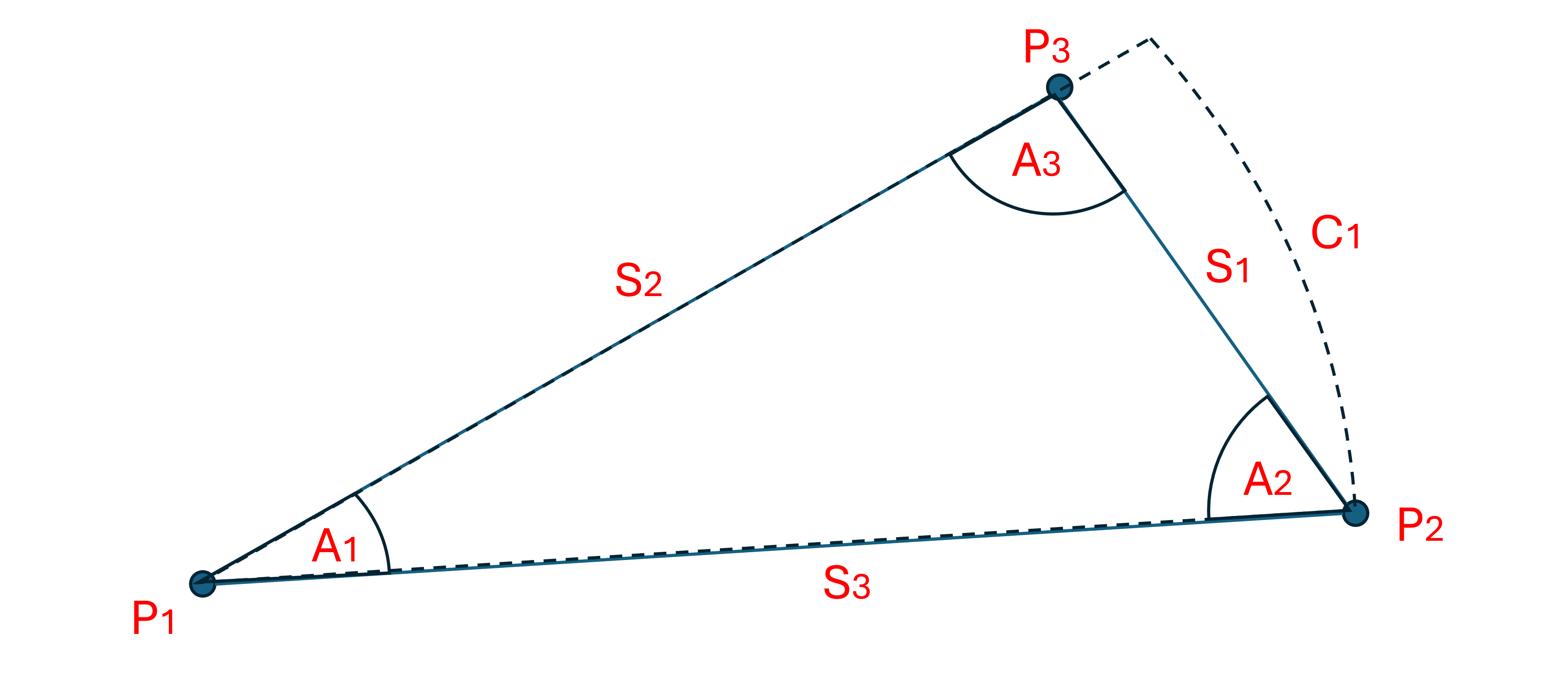
We can start by labeling its parts.  The points are connected by the three line segments called sides. Let’s call the point that is farthest away from the other two points, P1.  This is also the point that connects the two longest sides.  We can label the point on the other side of the longest side P2, and the remaining point P3.

It makes sense to put the label S1 for the side opposite the point P1, and the same for S2, and S3.  The side S3 then connects the points P1 and P2, and is the longest side, simply because we chose P1 and P2 to be on the longest side.  And so the side S2 is the second longest side, and S1 the shortest side with the same reasoning.  In math language S1 is less than or equal to S2 and S2 is less than or equal to S3 : S1 <= S2 <= S3.

We simply chose the labels so this is true. The way you choose to label things makes things easy to remember and deal with.  We can also choose to label the angle A1 to be next to the point P1, A2 to be next to P2, and A3 to be next to P3.

Angles are measured as percentages of the “piece of pie” inside the angle in proportion to the whole pie.  You can find the angular percentage of A1 by taking the length of the circular arc C1 (in the diagram) and dividing it by the circumference of the whole circle, 2*π*S3.

The angle in degrees is found by multiplying this percentage, C1/(2*π*S3), by 360 degrees in the whole circle:

A1 = 360 * C1/(2*π*S3).

Mathematicians chose 360 “degrees” in a full circle because it can be divided equally into 2, 3, 4, 5, 6, 8, 9, 10, 12, 15, 18, 20, 24, 30, 36, 40, 45, 60, 72, 90, 120, 180, and 360 pieces.

Another way to measure angles is to use “radians”, chosen so that 2*π radians are in a full circle. Thus in radians,

A1 = 2*π * C1/(2*π*S3) = C1/S3

Which is a more natural measure for angles based on the arc lengths of a circle.

If you really want to learn geometry, trigonometry, or build virtual worlds, then understanding the concepts we are about to explore gives you great power.

Suppose, for example, you want to find a cartesian grid that will map where these points are in space, then choosing good reference points and directions can make all the difference.
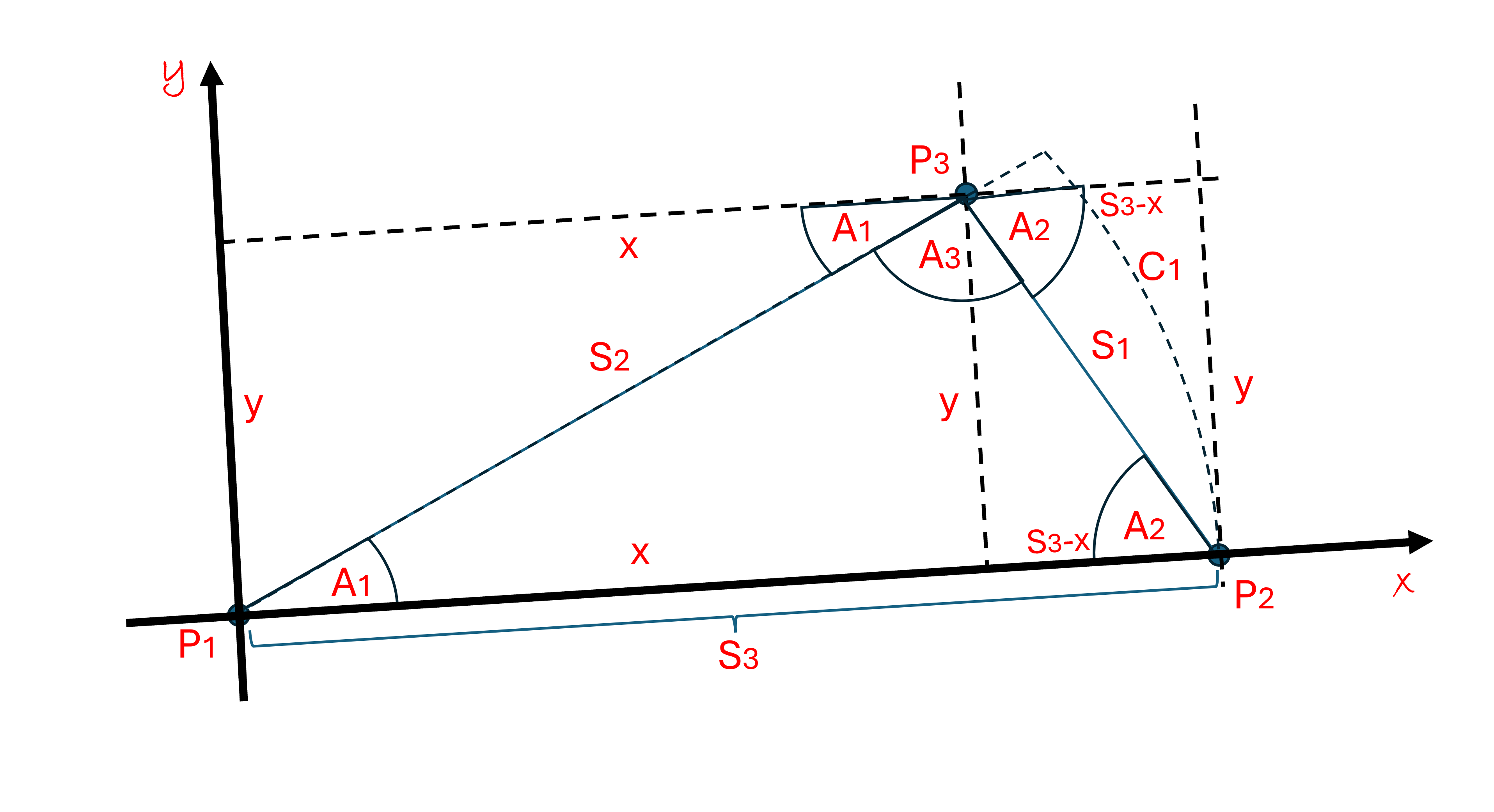
If you choose P1 to be the reference point (the origin), then choose the “x” direction to point directly along the S3 side toward point P2, and pick the perpendicular “y” direction so that P3 is on the positive side.  Then you placed this universal triangle on a grid as shown on the diagram above.  P3 is the only point that does not lie on an axis.  The distance of P3 from the y axis is labeled “x” and the distance of P3 from the x axis is labeled “y”, as shown in the diagram.

This breaks the triangle up into two rectangular regions, as shown by the dashed lines in the diagram.  The area of the left rectangle is x * y, and the area of the right one is (S3-x) * y.  If you add these two areas together you get a total area of S3 * y.  It is easy to see that the area of the triangle, by symmetry, is exactly half of the area of the two rectangles, so:

Area of triangle = ½ * S3 * y.

We can easily see this from the diagram. The left rectangle is made with two exact copies of the x, y, S2 triangle so the angle, A1, is the same on the top and bottom half of the first rectangle.  The same goes for the A2 angle in the (S3-x), y, S1 triangles on the right.  Adding the angles together on the top junction of the rectangle, it is easy to see that:

A1 + A2 + A3 = 180 degrees (universally true for all triangles).

From the diagram and by the Pythagorean theorem we can also see that:

 S22 = x2 + y2

S12 = (S3-x)2 + y2

       = S32 – 2*S3*x + x2 + y2  (and x2 + y2 = S22)

       = S32 + S22 – 2*S3*x    (known as the law of cosines)

And when S1 and S2 are the same length then:

S22 = S12

S22 = S32 + S22 – 2*S3*x

Thus by simple algebra

S32 = 2*S3*x

x = ½ * S3

And so we see that when x is halfway between P1 and P2, then the sides S1 and S2 must be equal in length. We can also see that if S2 is greater than S1 then x must be greater than ½ * S3, on the right-hand side of the midpoint.
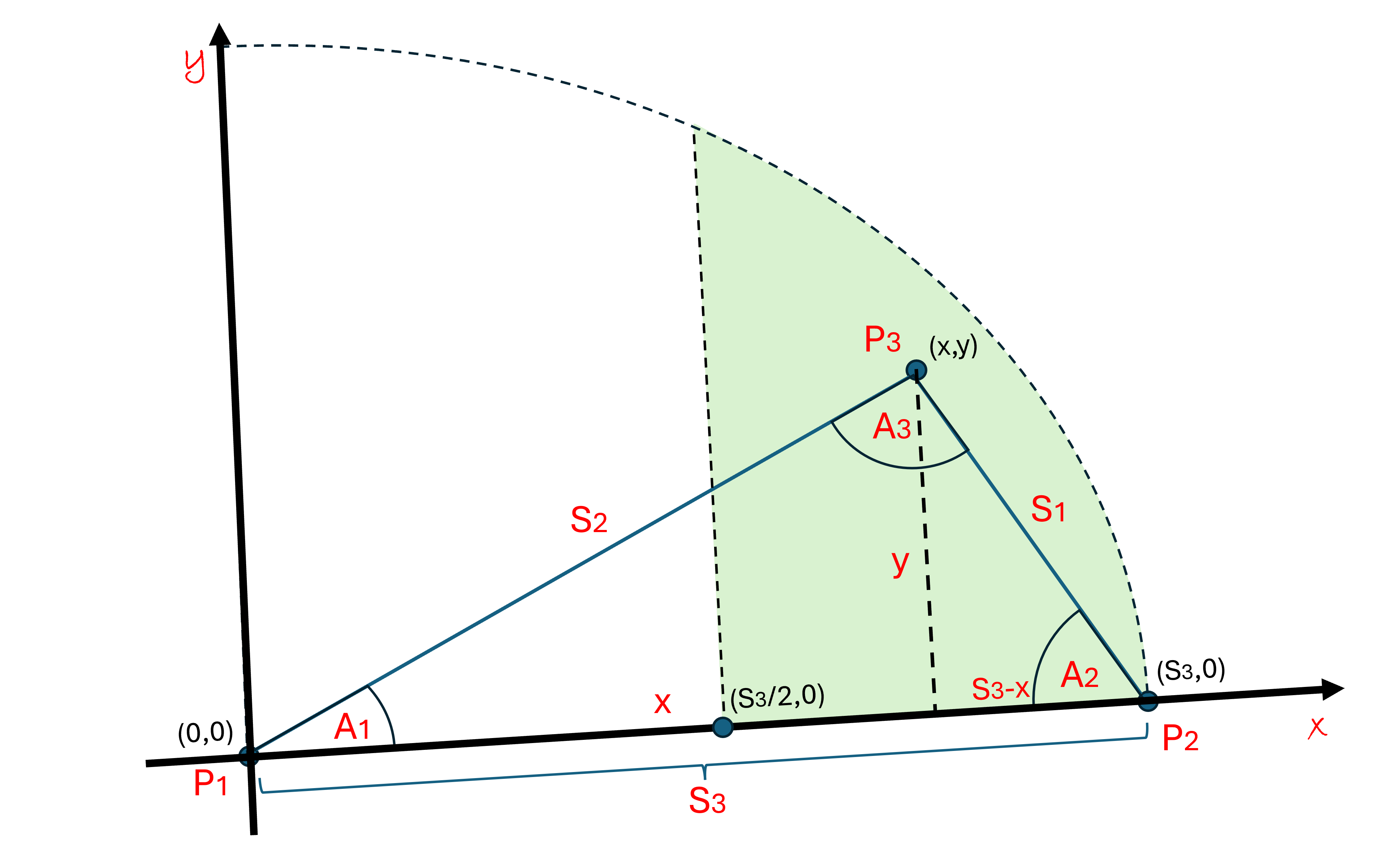
We now can see that there are some natural restrictions on where P3 can be in the above diagram, since S2 is greater than or equal to S1, then x >= ½ * S3, and since S2 is shorter than S3, P3 must be inside a circle of radius S3.  Thus, P3 is restricted to be in the shaded region shown in the diagram.  If P3 was outside this region, then S2 would be longer than S3 or shorter than S1 and we would need to re-label the points and sides accordingly and redraw our grid, then P3 would again be in the region.

We now can supply the Cartesian coordinates of the three points in this grid:

P1: (0,0)
P2: (S3,0)
P3: (x,y)

Note that this applies to all triangles in the universe, as long as we follow the labeling guidelines for the parts of the triangle and set up the grid like we have done here.

To work with the angles and find x and y, there are “trigonometric” functions on our calculators, Sin(Angle) and Cos(Angle), to find x and y from the angles, that are defined as follows:

Sin(A1) = y/S2  [or y = S2 * Sin(A1)]

Cos(A1) = x/S2 [or x = S2 * Cos(A1)]

We can also work with the angle A2 by looking at things from the P2 side:

Sin(A2) = y/S1           [or y = S1 * Sin(A2)]

Cos(A2) = (S3-x)/S1 [or x = S3 – S1 * Cos(A2)]

The angle A3 can be found because A1 + A2 + A3 = 180 degrees.

Notice that now you can find x and y if you know the angle A1 or A2, and the sides.  You can fool around with this to find the missing information.  For example, combining both expressions for x and y shown above, we get:

   x = S2 * Cos(A1) = S3 – S1 * Cos(A2)

   y = S2 * Sin(A1) = S1 * Sin(A2)    (known as the law of sines)

These relations can be used to find x and y from the angles and sides, or the angles from x and y, or the sides from combinations of each.  These are very useful in geometry.  You can explore all the possibilities by taking a trigonometry course.

A surprising and revealing fact: you can use reflection symmetry to find a point that is the same distance away from all three points P1, P2, and P3.  We call this the “center” point, C, and thus you can draw a circle that connects all three points. This means that if you randomly choose any 3 non-linear points, you can find a unique circle that connects these points.

To show this, we start by recalling the wonders of reflection symmetry.  The midpoint of S3 between P1 and P2 is the same distance from both these end points. We can find all the points that are the same distance away from P1 and P2 by drawing a perpendicular line of reflection through the midpoint of S3.  We saw that this is the line where x = ½ * S3.  Any point on this vertical line is the same distance away from P1 as it is from P2.  This is shown by the vertical dashed line in the diagram above.  In the same fashion, the points that are the same distance from P1 as they are from P3 are found to be along the line of reflection that cuts the segment S2 in half, as is shown by the other dashed line on the diagram.  These two midpoint lines of reflection from S3 and S2 meet at the “center point” C.  And so, we see that this point C is the same distance “r” from P1, P2, and P3.  We can draw a circle with center C and radius r that connects all three of these points, as shown in the diagram above.

Before we finish, let’s explore one other surprising universal fact about triangles. This comes from reflection symmetry of bisected angles that we have not covered yet.  Any angle made from two lines can be cut in half, this forms a line of reflection symmetry.  For example, in the diagram above, there is a dotted line that divides the angle A1 in half.
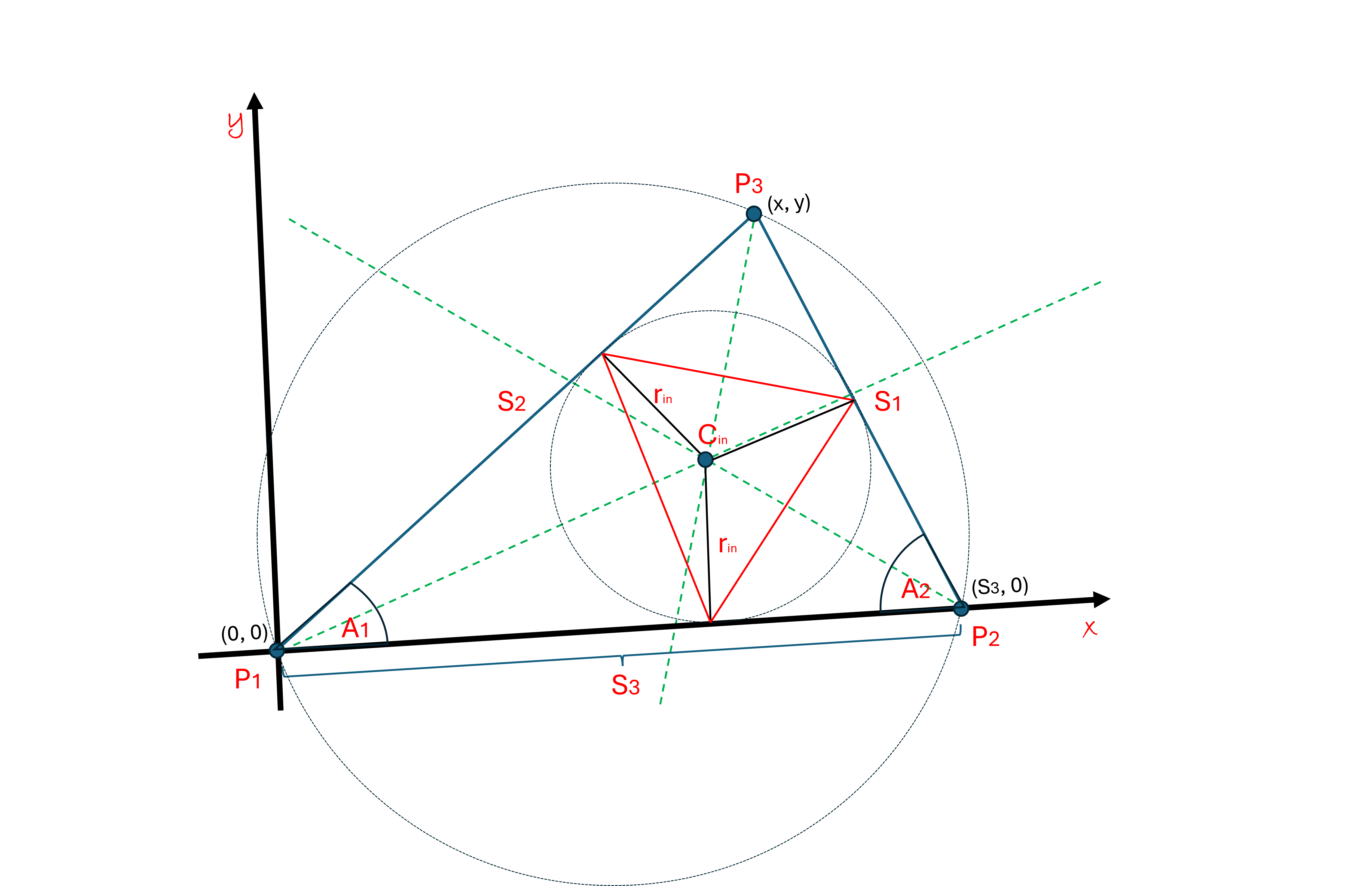
Through this line of reflection, you can reflect the line passing through P1 and P3 onto the line passing through P1 and P2. It might take a minute to see it. If I draw a circle with its center on this line, then the half-circle above the line can be reflected onto the half-circle below the line.  This means that if the circle touches the line on the top, then by symmetry, it must touch the line on the bottom at exactly the same distance from P1.

Similarly, the point where the bisector lines of symmetry of A1 and A2 meet is the center of a circle that touches all three sides of the triangle.  If you connect the three points where this circle touches all three sides with line segments, then you have a smaller triangle that breaks the triangle into three triangles that have two sides of equal length.  The smaller triangle is inscribed inside a circle, and forms three other triangles with two equal sides (these are called isosceles triangles).

When you stare at the diagram, do you see the multiple symmetries here?  You can divide any triangle into 6 isosceles triangles.  Also note that the angle bisectors pass through the center of the inscribed circle and thus are perpendicular bisectors to the sides of the small triangle inside.  The distance from the center of the circle to the sides is equal to the radius of the circle.  Believe me, understanding this makes geometry and trigonometry so much more simple.  May the wonders of symmetry never cease!

Standard

My Greatest Vacation Ever!

Iris (my wife) and I decided to take some time off from “saving the world” for a week and enjoy a Disney Wish Cruise vacation to the Bahamas with our grandchildren (we have 10.6 grandchildren now).  For those of you who haven’t taken a cruise, or think they might not like it, I am writing this post to share my first impressions with you to let you know what it is really like. It turned out to be the greatest vacation of my life (and I didn’t even have to pay for it).  I might have even liked it a little too much, after all it had been 10 years since I went on vacation with my family.

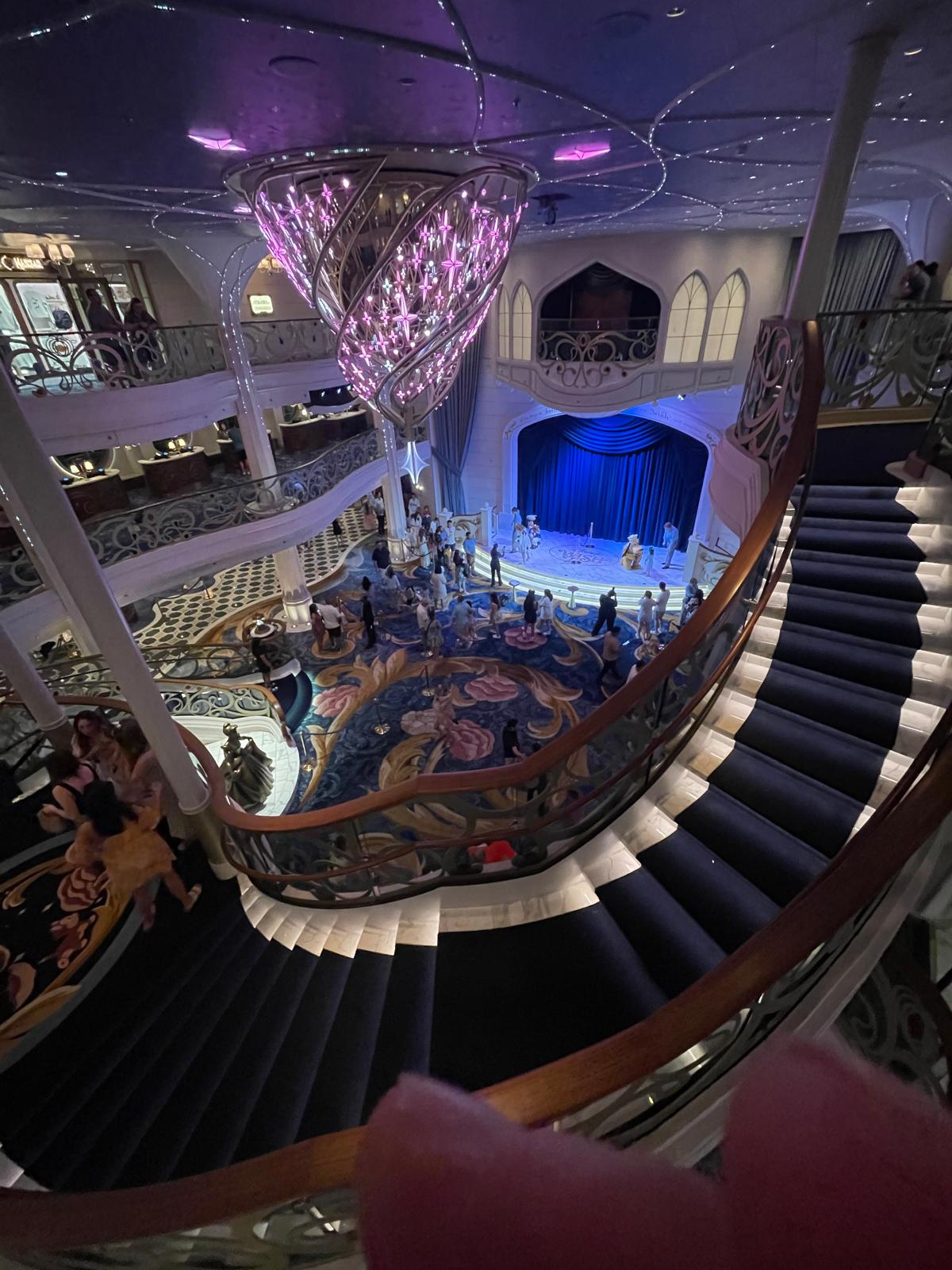
The vacation started the first step onto the ramp into the enormous cruise ship. It was huge, almost ¼ mile long and 20 stories high.  I left my tagged suitcases on the side and walked with Iris and a few of my children and grandchildren through the ornate “castle” doors into a the most elegant and spacious three-story reception area I have ever seen.

The announcement reverberated, “Welcome Samuelson Family”, and a Disney prince and princess waved at us from a balcony high above.  Spiraling staircases, twinkling lights, the experience almost took my breath away, like I had returned to some huge childhood fantasy land.  My grandchildren began running around, with many of the other children there.

This impression never faded. Everything was perfect. After a short walk to our stateroom, the key cards were clipped there near the white ship-portal door, and our suitcases magically had arrived before us.  Iris and I shared this stateroom with one of our children and two of our grandchildren.  We took a short look around and decided to take a stroll around the main deck (11th floor).  Stepping out onto the main deck from the hallway was another experience.

It was a huge open deck, the size of a football field with several pools in the front and a huge 2 story jumbotron screen in the back.  It was filled with deck chairs.  The “party” was already going, people were sitting on deck chairs, relaxing, eating, watching the movie. As we strolled around the back side, there were food stations, just like a large food court in a mall, serving thick fries, thick hamburgers, pizza, soft cones. But it got better, we passed a place serving fall-off-the-bone juicy BBQ ribs, mac and cheese, steamed veggies; then around the other side were cakes, doughnuts, fruit bowls, puddings and custards, an almost unimaginable variety of foods.  Self-serve soda fountains were everywhere.

The best part about it was that to get a serving, all I had to do was point at it.  There were no prices anywhere, and no plastic spoons, just metal utensils.  There was also ample seating on tables facing ceiling-high windows facing out into the open ocean.  We sat down with the kids and filled our tummies with yummies.  After our little stroll, we found that we were just getting started.  On the other side of the deck near the pools, there was a huge indoor restaurant with all sorts of breakfast foods, all for the taking, with seating for many hundreds of people.  We soon came to the realization that we would not have to worry a bit about food during our cruise.  The quality of the food was also excellent, like what you would find in a fine restaurant, and a whole level above what you would find in a mall.  And if we couldn’t make it to a restaurant, there was unlimited complementary room service with food brought right to our stateroom.  This ended the first hour of our cruise, and we had not even left the harbor yet.  Our vacation was in full swing.  We went to our stateroom to rest up and dress up for the disembarkation party.

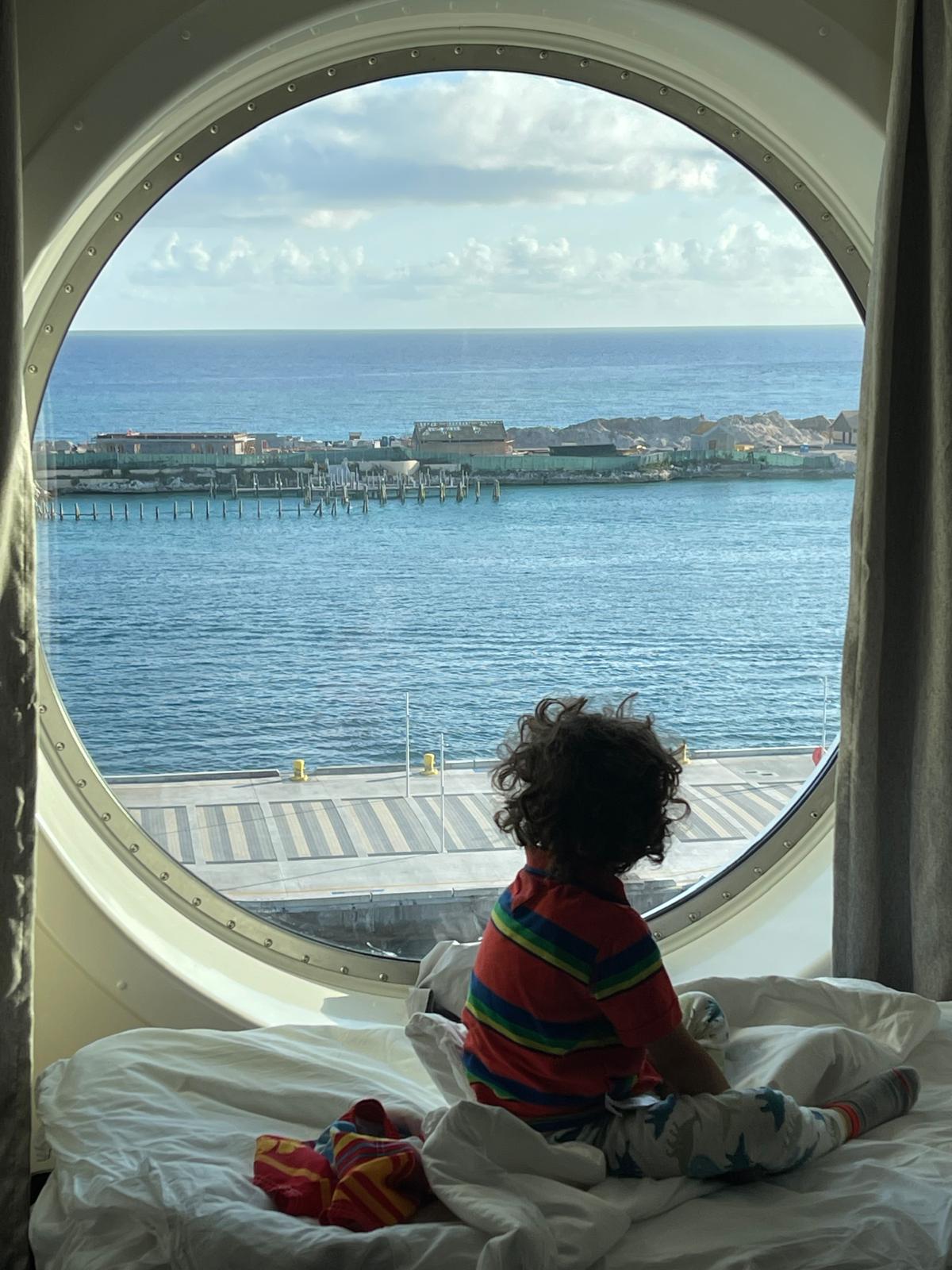
The party was on the main deck, with literally thousands of people standing and swaying while Disney Characters, and dancers, put on a spectacular show, backed up by music and scenes on the jumbotron. We met the rest of our family there, put the grandkids up on our shoulders to watch.  The captain’s steward came out, there was a countdown, when it reached zero the ships horns blasted the “When you wish upon a star” theme and we were off. The departure was so smooth that no one could even feel us start moving and I didn’t even know we were moving until later when we looked out of our large round stateroom window into the vast ocean moving by.

There was never a sensation of movement whatsoever the whole trip.  When we closed the curtains, it was just like being in a luxury hotel on land.  That evening we passed through a huge thunderstorm, we could see it coming, lightning flashing on the horizon and rain bouncing off our window.  There still was no sensation of movement or sound. We went to our scheduled luxury dinner and a show at the Marvel restaurant, replete with the best scallops I have ever eaten, spiderman, and a funny Ant Man show on the monitors that lined the walls.

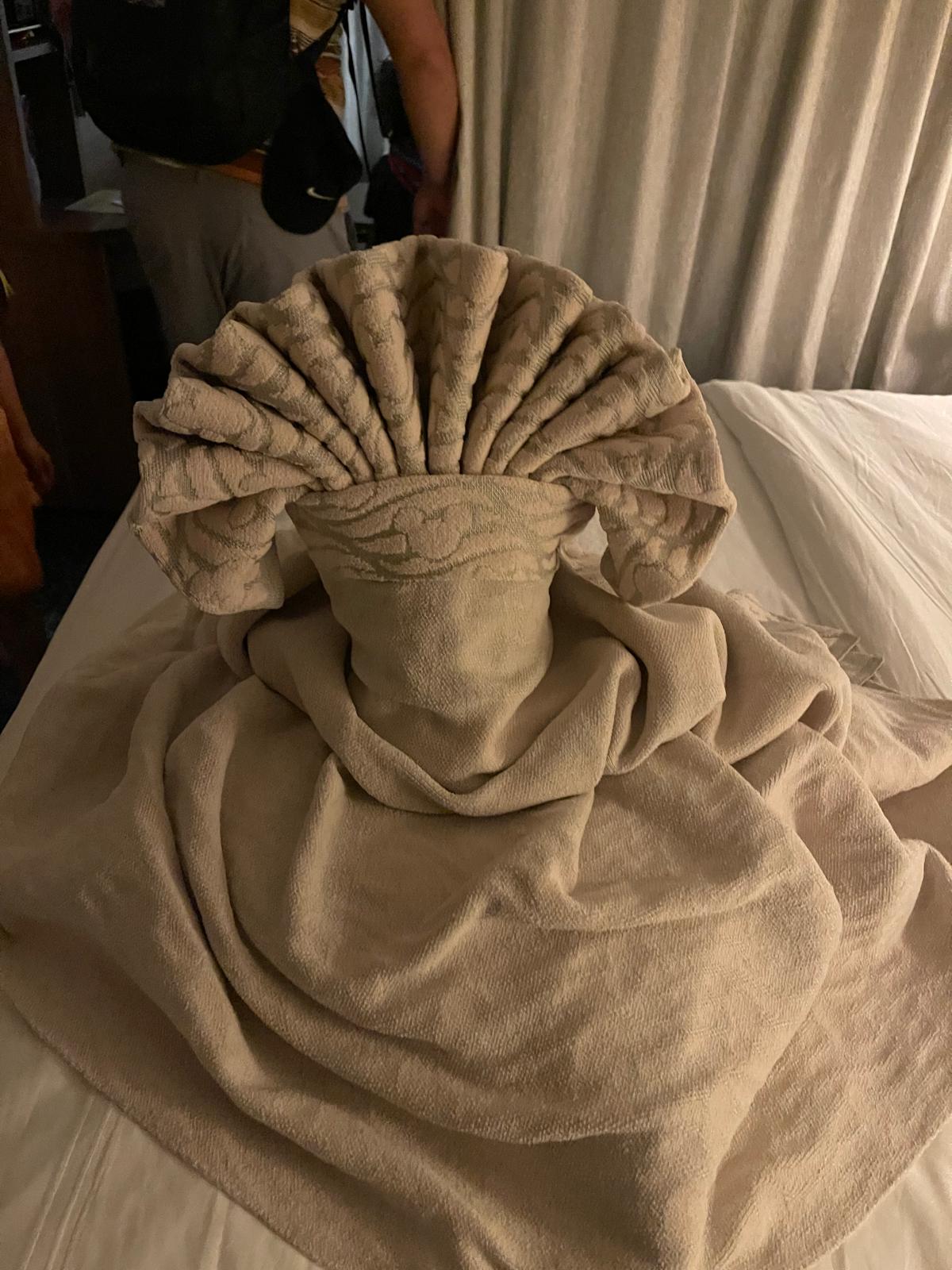
The food servers knew our names, carefully memorized our preferences, and playfully interacted with our grandchildren throughout the whole meal.  We found out later that while Ant Man was mistakenly “shrinking our ship” during the show, a huge storm was actually raging outside, with golf-ball-sized hail pounding down on the main deck. The ship just brushed it off, without a scratch. We felt absolutely nothing inside, all felt rock solid, we could barely hear the hail hitting our stateroom window.  What we did notice, however, is that the staff had prepared our stateroom, they put up bunk beds for the grandchildren, a murphy bed for our son, and had made up our bed with beautiful towel art and chocolates.  The beds were very comfortable. We slept like babies all night long.

When we woke up in the morning, we were only a half day into our 5-day cruise.  We pulled up the cruise app on our phone.  There were more than 5 activities every hour the whole day long.  There was no internet, but the app connected to the ship Wi-Fi and we could chat with the other members of our family on the ship.

The whole second day we were at sea and took the time to explore more of the ship.  Breakfast was fantastic, the kids got cute Micky Mouse sugar waffles. There were lounges, restaurants, boutiques, and theaters everywhere. We dropped the grandchildren off at the Oceaneer’s club.  They put on little Mickey mouse electronic bracelets, with glowing lights, to identify them and sent them off down a tube slide where they were supervised and had tons of activities, as they played with other children.  It was their favorite place to go on the whole ship. They stayed there for hours without a peep of complaint.  While the grandchildren were playing, we checked out some of the other entertainment.  We went to the huge gym, exercised for an hour, walked around the outside deck, caught a jazz concert and show, relaxed in the sun on deck chairs around the pool, while watching Disney movies on the jumbotron.  The weather was gorgeous, and the food was as good as it was the first day.  One of the theaters even had free popcorn you could bring inside.  I learned how to draw Goofy.  It was one of the most stress-free days I have ever had.

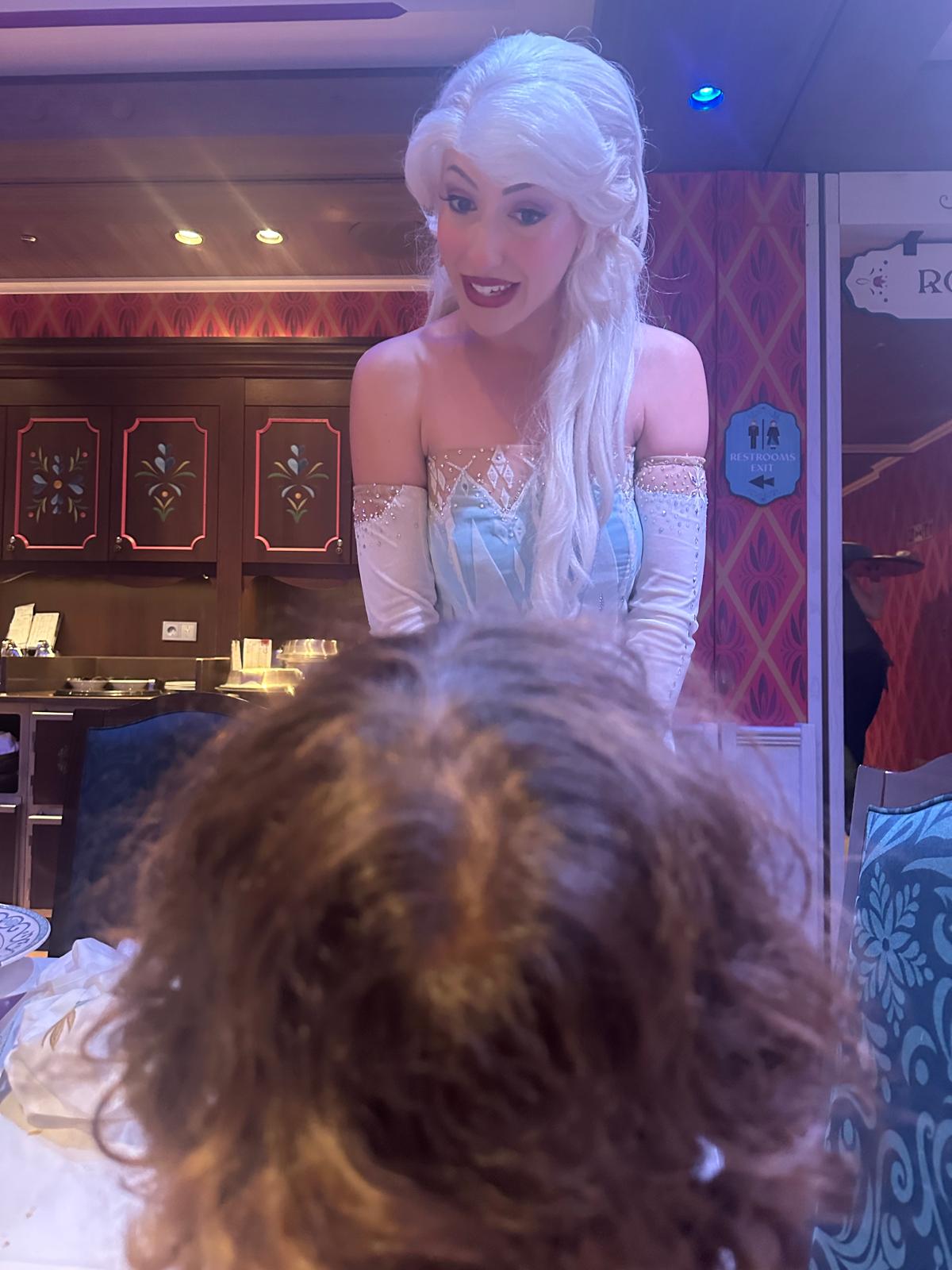
In the evening, we were assigned to go to another luxury restaurant themed like the movie “Frozen”, where the same servers met us and we again enjoyed a great meal and a show.  The children really loved meeting the Frozen characters, Anna and Elsa, and especially liked the little Micky Mouse chocolate-dipped ice dreamsicles they had for dessert.  Again, we returned to a beautifully made-up stateroom and watched movies on the TV as we drifted off to sleep.  We woke up at Nassau in the Bahamas.

That day was mostly spent exploring the Bahamas until the children got tired, then we headed back to the ship for another dose of rest and king-like pampering.  It doesn’t seem possible, but I even got a little tired of all the free food and lounging on board.  So, we went to the pool with the grandchildren and went down the water slides.  After all the activity, it was really nice to be able to just put a towel over our shoulders and walk over to the food stations to grab a bite to eat.

I was amazed that everything was kept so beautifully in order, there was not a shred of paper on the ground, not a dirty table, or even a wet towel left anywhere without quickly being picked up.  There were so many new places on the ship that we could not even possibly explore everything.  We found a five-star Michelin restaurant with $18,000/bottle wine on our Disney app.  I could have spent a whole year’s earnings in a heartbeat, if I wanted to, but there was no need to even spend a dime.  That evening we again had to endure another luxury restaurant, filled with entertainment and our beloved playful servers.  We went back to our perfectly clean stateroom for another night of blissful sleep. The next day we woke up at the Disney private island, Castaway Cay.

On this tropical island, we really got to spend some great time with our grandchildren at the beach.  They collected shells and went wading in the ocean cove (protected by huge embankments and shark netting off on the horizon).  We all got perfect tans. The food arrangements were just like the boat; you walked by pavilions filled with the same great food.  There were soda fountains and self-serve ice cream machines everywhere along the walk.  The kids went to play at a two-story water park.  And, just like the Bahamas, when everyone was tired, we caught the shuttle back to the ship, rested, and played.

Sadly, this was the last night we would have on the ship.  I forgot to mention, that somewhere in there, we found time to go to a few Broadway-type shows, The Little Mermaid and Aladin.  Some of the grandchildren slept through the show, but loved to catch the confetti that fell from the ceiling at high-points.  The time passed so quickly, like frozen scenes in a beautiful memory.  A luxury meal, fireworks and a pirate party was the last big bang.  The next morning we woke up in Florida, had a luxury breakfast and left the ship.

That was the end of this greatest-of-all vacations. We had so much great family time together with our children and grandchildren. I would encourage anyone of any age to go on one of these cruises at least once, and to take as many people along with you as you can. All of this was possible thanks to Iris signing up for a cruise club two years ago.  We started saving, the club doubled our savings.  After referring our family to the club, we didn’t even have to pay the monthly membership payments. If you want to know more about how to cruise without paying the price, please put “I want to know more” in the comments. Best to you all!

Standard

Math Moments – The Pythagorean Theorem

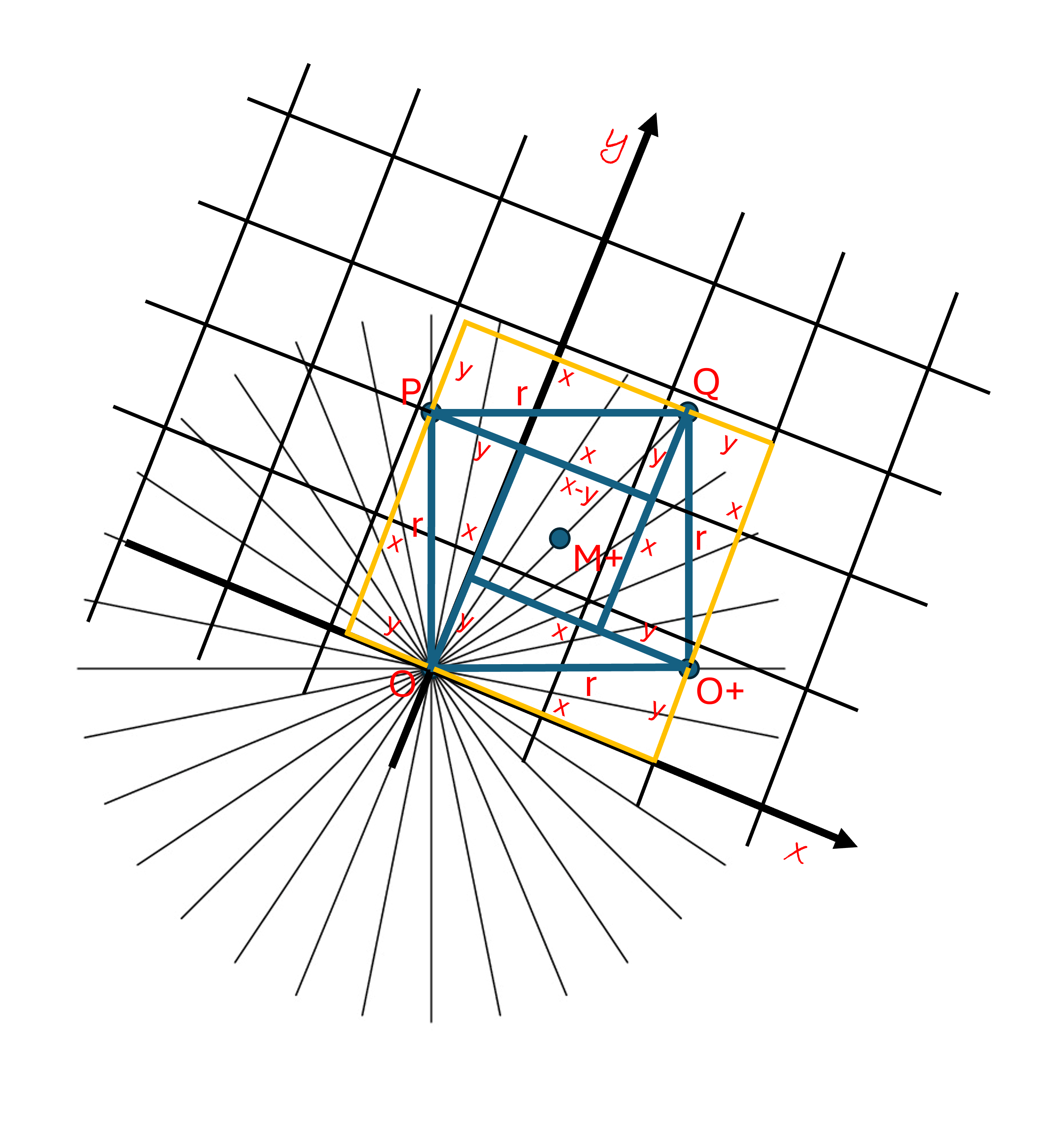
In the diagram above, we used the 4-fold symmetry squares to map the rectangle we saw in the last post onto the sides of the original square. You can rotate this diagram onto any of the sides of the yellow square (with side lengths of x+y) and see that it looks exactly the same, but with the reference points and directions rotated.

It also becomes immediately obvious that the area of the larger yellow square is (x+y)*(x+y) = x2 + 2*x*y +y2 (from the distributive property, not explained here). Since we know that all the triangles have an area ½*x*y and there are 4 of these triangles (one on each side of the large square) the total area of the 4 triangles are 4*½*x*y = 2*x*y.

By staring at the diagram, you can easily see that the area of the large square is the same as the area of the original square (r2) plus the area of the 4 exterior triangles. This is written:
(x+y)*(x+y) = r2 + 4 * ½*x*y
using the relations above, this is:
x2 + 2*x*y + y2 = r2 + 2*x*y
since the 2*x*y is the same on both sides:
x2 + y2 = r2
This proves the Pythagorean theorem and shows how we can relate any rotated frame of reference with any other one. Finally, this gives us a ruler that we can use to measure distances in any direction.

Standard

Math Moments – A New Perspective

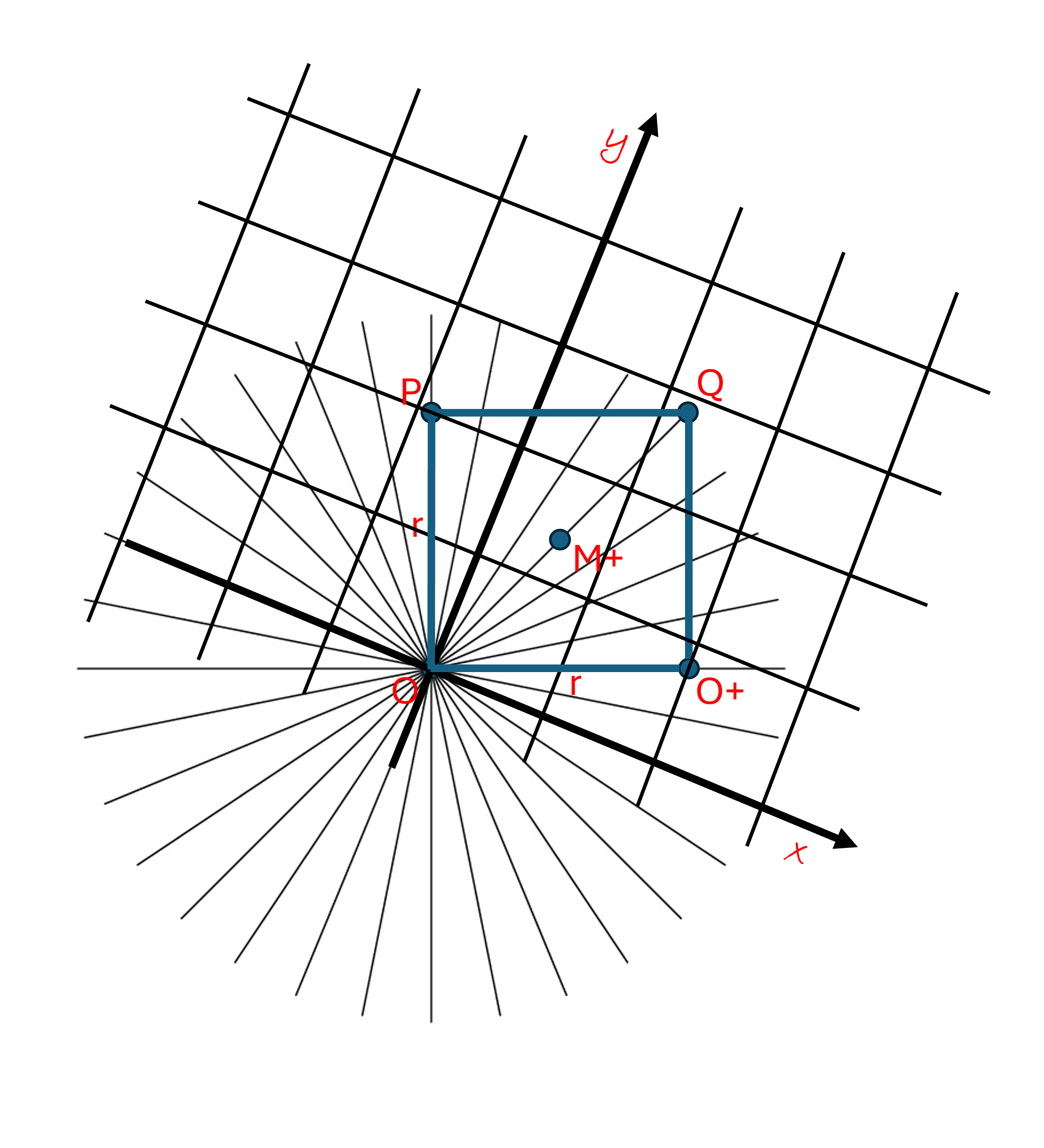
You can learn a lot about something when looking at it from a new perspective. In the diagram above we are looking at the exact same square as in the last post from a different vantage point. Again, I use my right to choose a reference point and direction. I keep the point O as my reference point, but I rotate the cartesian grid a bit clockwise.

Notice that I have not changed anything about the square, it has the same points. I have only changed the way I am looking at the square. The area of the square has not changed, it is still r2. I have just “tilted my head” a little bit. I chose an “x” direction that is not along the O O+ side of the square and the “y” direction to be perpendicular. This is certainly within my rights under the axiom of choice.

From this perspective, however, the way I measure the area of the square is a bit different, I cannot “tile” the square with the cartesian tiles in this direction without “cutting off” the corners of the tiles. From here grows the whole field of trigonometry. I need to rotate my ruler to measure distance from any point and in any direction in 2-D space.

In the diagram above, I am looking at the “bottom” line segment of the square, O O+, from this new perspective, I have also modified the grid spacing a bit for better clarity. In this diagram, I found the “coordinates” of the O+ point by finding the perpendicular distance from both the x and y axis, as is customary. The distance away from the y axis is labeled “x”, and the distance away from the x axis is labeled “y”.

It is obvious from the diagram that, by parallel sides, the respective distances from O+ form a rectangle with one side a distance “x” along the x axis and another side a distance “y” along the y axis. These distances are called the cartesian “coordinates” of the point O+. It is also obvious that the area of this rectangle is x times y, written as x*y ( we use “*” to mean “multiplied by” for clarity).

If I now choose the O+ point to be the point of reference and chose the “y” direction to be down and “x” direction to be to the left, as shown by the yellow script “x” and “y” in the diagram, I basically would have chosen to look at this same rectangle from an “upside down” perspective. By flipping the diagram upside down, you can see that the rectangle and O O+ line segment looks exactly the same from this perspective.

This shows an important symmetry of the rectangle. It also shows that the area of the triangle on the top half of the rectangle is exactly the same as the area of the triangle on the bottom half. Or to say, the segment O O+ cuts the rectangle in half. Thus, the area of both triangles is ½ * x * y. This also shows that the angles of both corresponding triangles are exactly the same. We will talk about this later.

The equivalence of areas (the real estate of 2-D), regardless of our choice of reference point and direction, gives us a way to “rotate” our ruler into any angle and direction. This relation was found by Pythagoras many millennia ago and is called the Pythagorean theorem.

Standard

Math Moments – 2-Dimensional Real Estate

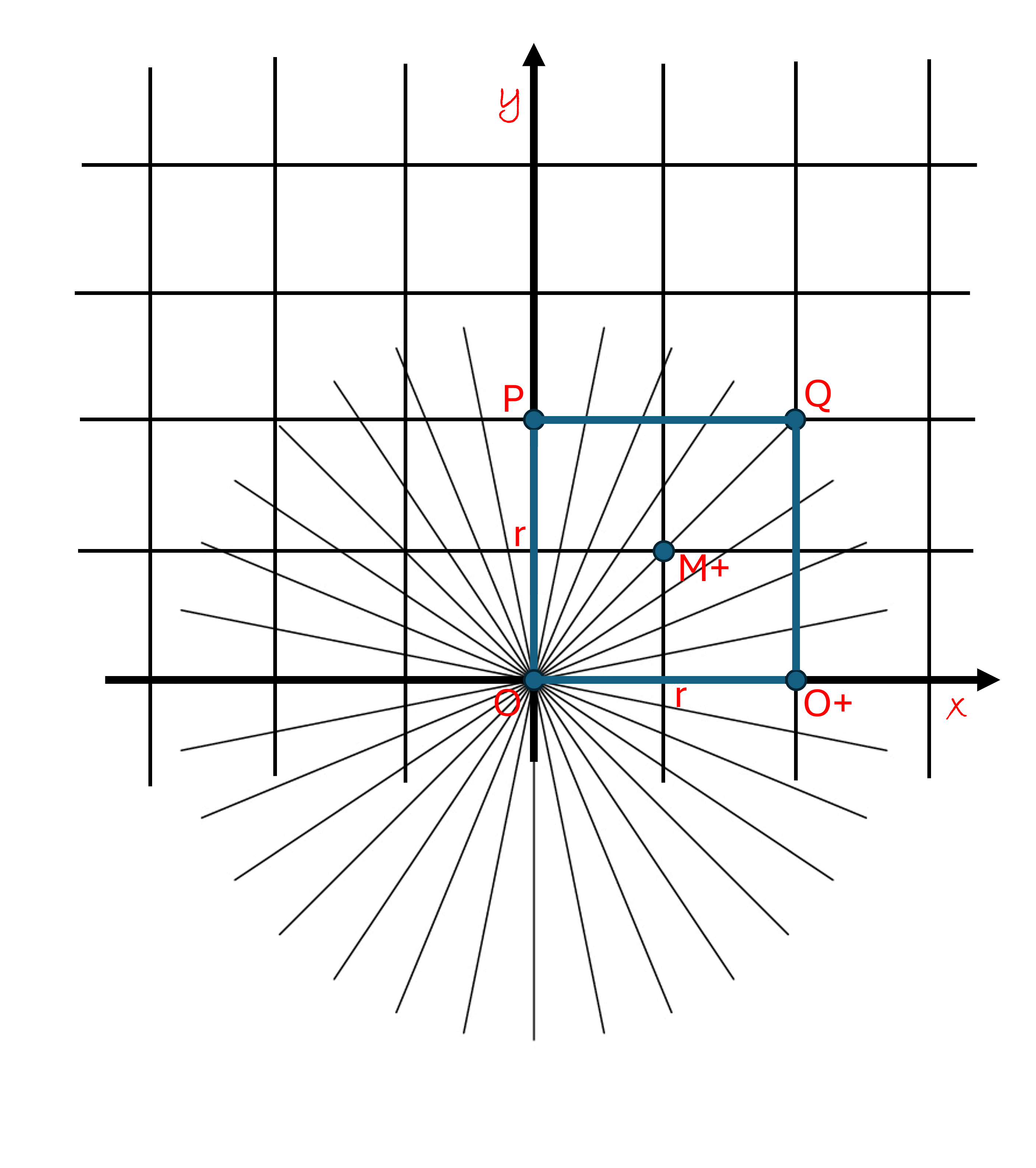
In the last post’s “cartesian grid” diagram, if you remember, the radial lines went through the point P. By reflection symmetry, I can reflect these radial lines onto any cartesian grid point I want. In the diagram above, I decided to reflect the radial lines so they now radiate from point O. I now choose point O to be the reference point.

I choose one of the “cartesian” directions to be from the reference point O to the point O+, I will call this direction the positive “x” direction, labeled by the red script “x”. I call this line the “x” axis, shown as a bold horizontal line in the diagram.

The second “cartesian” direction I choose to be from the reference point O to the point P. I call this direction the positive “y” direction (as customary), and label it with a red script “y”. This vertical line in the diagram is called the “y” axis and is bolded. There are always two perpendicular independent directions I can choose in a 2-D space. The axiom of choice allows me to choose whatever reference point I want and whatever two reference directions I want. As mentioned before, the right to choose is one of the fundamental concepts of math.

Alright, let’s talk money. In 1-D space, distance is everything, it is the most valuable asset, but in 2-D, distance alone is not worth anything. A piece of land that is 10 meters long has no value until you know how wide it is. The real estate of 2-dimensional space is called “area”. Area is measured by how many squares, or fractions of squares can fit within a given border. The number of squares determines the value.

In the diagram, we form a square by taking the segment O O+ (of length r) and the perpendicular segment O P (also of length r) and reflecting them through M+ to form the opposite sides P Q and O+ Q. Note that we found a point Q that is exactly the distance “r” from both the “x” and the “y” axis. This square (in green) now has value, it is the real estate of 2-D space.

We have seen that the whole 2-dimensional space can be “tiled” with the squares of a cartesian grid. The number of “tiles” within a boundary determines the area. For example, in the diagram above, the green r x r square has 4 cartesian tiles inside. Each side has 2 tiles and 2 x 2 = 4 tiles. Since we could shrink the size of the tiles, we could also fill the square with lots of tiny tiles. From this, it can be deducted that the area of the square is found by multiplying the length of the square by the width of the square (r x r = r2).

The area of the green square in the diagram is r2. In 2-dimensions, the “real estate” or area is always measured as a distance times a distance, like a square meter, or a square foot. In 2-D, a line segment alone has no width, and so it has no area, and thus line segments have no real value in 2-D space.

In concept, you can fit an infinite amount of parallel line segments into a square no matter how small it is. This becomes clear when we recall the same concept in 1-D space to show that an infinite number of points can fit between any two points on a line segment, no matter how small.

Standard

Math Moments – The Cartesian Plane

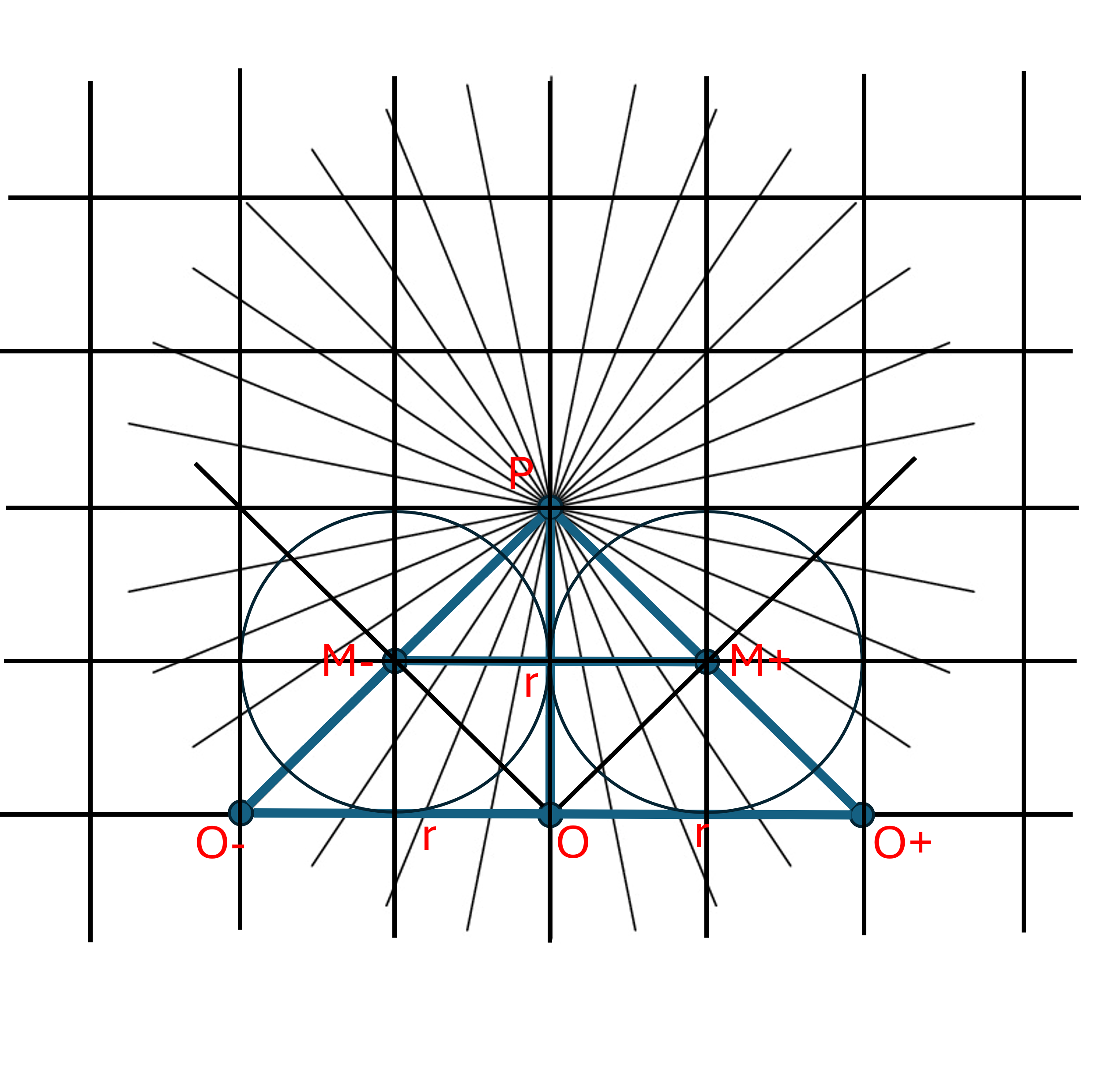
The diagram above shows what our 2-dimensional space looks like when we take the original line (through the points O- O+) and reflect it through the parallel line passing through the points M- M+ to form a reflected parallel line passing through point P. Then like parallel mirrors, we reflect these lines through each other. We can then keep on doing this, reflecting lines to get an infinite set of “horizontal” parallel lines with the same distance apart going on forever upwards and downwards.

Let’s do the same with the perpendicular lines we generate through points M- and M+ and then original line. As we discussed before, the distance between M- and the line of symmetry (O P) is the same as the distance to M+ by symmetry. So, if we generate lines from M- and M+ perpendicular to the original line, they are also parallel to each other, they have the same distance between them forever in each direction.

We can then reflect these “vertical” parallel lines through each other to get an infinite set of vertical lines the same distance away from each other. From the circles around M- and M+ we can see that the distance between these parallel vertical lines is the same as the distance between the horizontal lines. Thus, we have formed a “cartesian” grid that maps out our 2-dimensional space.

One last thing to notice before we finish this thought, the distance “r” between points P and O, could be made to be smaller than an atom, or bigger than a galaxy. Just think, we can make the distance r to be anything we want and then generate a cartesian grid that is any size, from an infinitely large grid to an infinitesimally fine grid.

Standard

Math Moments – Constructing Parallel Universes

The diagram above (which looks a little like Homer Simpson) shows you how to build a 2-dimensional universe from 1-dimensional universes. There is a lot in the diagram so we will go over it a piece at a time then you can use your imagination to build another universe.

Start with the original 1-dimensional line, the one that passes through the points labeled O, and O+ on the diagram. Remember that we need only 2 points on the line, any 2 of them will generate the whole line. We then need to find another point, labeled P, that is not on the original line. The lines radiating out of the point P represent all the lines connecting P with all the points on the original line “O”.

Each one of the line segments between point P with a point on the line spans a different distance. We find a line of symmetry with respect to P by finding the segment with the shortest distance. This segment goes to the point labeled O. Point O is an important point of reflection, a point of symmetry on the line with respect to P, any point on the positive side of O and its reflection on the negative side of O has the same distance to Point P.

We use the label “r” to refer to the distance between point P and point O. In math language, the symbol “r” reminds us of a “radial” distance from the point P. This r distance is referred to as the “distance” between P and the line. If we put together all the points (on the radial lines) that are a distance r from point P, we form a circle of radius r around P. Notice that since r is the shortest distance between P and the line, this circle only touches the line at point O and cannot reach the line anywhere else. Can you find this circle in the diagram?

The line passing through O and P is a special line of symmetry in this case. It is often called the “normal” of the line that passes through point P. It is also called the perpendicular to the line passing through P. Any set of points on the “positive” side of a line can be reflected onto the “negative” side by finding the perpendiculars passing through the points and then reflecting the points along their perpendicular lines the same distance on the “negative” side of the line. In this diagram, this symmetry is obvious, every point on the right (+) side of the perpendicular (O P) is a reflection of points the left (-) side and vice versa.

In the diagram, we show the point O+ on the positive side of the original line at a distance r from the point O. Its reflection on the negative side is labeled O-. We can easily see that the line (O O+) is also the perpendicular of the line (O P). If we wanted to, we could reflect this whole diagram through the original line and we would get the diagram flipped upside down on the bottom half. For clarity’s sake, I didn’t do this in the diagram.

You might be starting to see the amazing symmetries represented in this diagram. It gets even more obvious when you look at the midpoint between O+ and P. This is labeled M+. Its reflection is labeled M-. If we draw a line segment between M+ and M-, as shown in the diagram, notice that it is also perpendicular to the line of symmetry. To show this better I drew a circle around point M+ and M- that touches the perpendicular line at one point. It also becomes obvious that M+ and M- are the same distance from the original line O O+, by symmetry. All distances are preserved upon reflection.

Alright, now we use our imagination to see what would happen if we drew another perpendicular to the original line through point M+ and another through M-. We can use the small circles drawn to visualize where the circle touches the line to draw these perpendiculars. We can now reflect everything in the middle of these perpendiculars on either side. Like two mirrors facing each other, the reflections go on forever in both directions.
From these symmetries, the line M- M+ can be shown to always be the same distance away from the original line forever in both directions. These lines will never cross.

We have finally found two parallel 1-dimensional spaces that do not intersect each other. Do you think you could find an infinite number of parallel lines in the vertical direction by using reflections?

This is a concept utilized by the mathematician Rene Descartes. He built what is known as the Cartesian plane, composed of infinitesimally close parallel vertical and horizontal lines all normal to each other. These concepts give us many ways to look at 2-dimensional space. One of the most important qualities of this space is that it is assumed to be exactly the same in all directions. Very flat indeed.

Standard

Math Moments – Expanding into Parallel Universes

Alright, this is where it starts getting really interesting. We started out saying that we can use the language of math to build universes, at least in our imagination. We started out with (1) one point in the whole universe. Since a point has no size, the whole universe was simply a 0-dimensional space (a bit mind blowing).

After thinking about nothing for a while, we then thought about having (2) two points in the universe. We argued the concept of distance between these two points. We imagined two distinct completely identical points separated by a distance, this is the origin of the concept of the number 2. We then discussed a way to build a whole 1-dimensional space of points, a line between the two points.

We said that we could fill in the points on a line between these two points by first creating a midpoint a distance half-way between these points then, including the midpoint, use the same concept to create more new points in the middle of these points, and so on forever filling in the gaps (a bit more mind blowing).

We realized that there are an infinite number of points that can fit between our original 2 points, each of them described by the distance and direction they are from the midpoint. We started finding other points to fill in all the gaps between points.

We introduced the concept of symmetry; for every point on the line, everything must look exactly the same in both directions. This symmetry concept required that every point on the line has the same arrangement of points in either direction. If we ever found a point where the line ends, we could just add another segment onto the empty direction and keep doing this forever. This complete infinite 1-dimensional space of points is called a “line” (oh, the things we can think).

We named the two directions in this 1-dimensional space to be “negative” and “positive”. We can now choose any of the points to be a reference point and describe the position of any point in this space by its distance and direction from the reference point. We have thus introduced the number line.

I hope you enjoyed this line of reasoning so far. We can now use the same line of reasoning we used to expand 0-dimensional space into 1-dimensional space in order to expand a 1-dimensional space into a 2-dimensional space.
As before, we only need to take the points we have in a 1-D space, on the line, and introduce another new point that is not in that space, not on the line. With this new point, we can now define another line by using this new point and any of the points on the original line to create a new line going in a different direction.

Since we can now create a distinct new line through the new point for every point on the original line, we have created an infinite array of new lines (1-D spaces) going off in different directions. Since the points on the original line can be infinitesimally close together, so are the lines. We include all the points on all these lines as part of a new 2-D space. We now have lots of points to connect together to form new lines. All these lines are said to live in this new 2-D space. An ancient mathematician, Euclid, studied these spaces, in honor of him, these “flat” spaces, of straight and parallel lines are called Euclidean spaces.

There are still some gaps. For example, there is a line that passes through the new point that is not connected to the original line, this line is said to be “parallel” to the original line, and since it never can cross the original line, it does not contain any of the points of the original line. As it turns out, building parallel lines using the tools we have requires a bit of doing.

Standard

New Hope for Health Care – Value Proposition

It always amazes me that after spending over $800,000,000 USD (as required by the FDA) to approve a medication for a specific disease, and after conducting dozens of placebo-based double blind human studies, the results of these studies are rarely publicized by the pharmaceutical companies. In many cases, the study results are even hidden behind foundations or other barriers to prevent inspection by the public eye.

Even more amazing to me, after a medication has been released to be sold to the public, there are rarely follow up studies to determine the real-world safety and efficacy of such (unless a large number of people are gravely harmed by it). Any attempt to hide scientific research that is of paramount public interest has never set well with me, especially when the research has been financed by public funds. I speak from the viewpoint of a PhD level researcher.

The adverse side effects of medications, however, are required to be publicly disclosed. Evidence of this can be seen in pharmaceutical advertisements. Public advertisements often feature actors that are depicted as being happy to be free from the ravages of the disease but offer little else of substance except for occasional mild claims that it works under certain conditions. This is then followed by the long list of possible side effects.

New hope for health care simply comes with a better public disclosure of the scientific study results. Imagine if there was an official government website that published the scientific findings on treatments from all credible sources, summarized on a table that looks something like this:


Disease: Flojitis Type x (fictional)

TreatmentDescriptionLength of
Treatment
Improvements
Observed
Average %
of People
Improved
Cost
per
month
Side Effects
Blue Pill2x daily……Life……controlled…23%$2400…kidney…
Mineral xinfusion…3 weeks……reversed…81%$350…nausea…
If you had this disease, which one of these treatments would you choose?

My intuition tells me that this would probably be a VERY popular website. Especially if it was comprehensive, unbiased, and verified by independent scientists. The real evolution would come when people start to realize that they have the freedom and information to make informed decisions between various treatments.

The whole health care market would shift overnight. Verified treatments for certain diseases would become fiercely competitive. The science behind treatments would fall under strict scrutiny. Pharmaceutical companies, universities, and hospitals would hustle to find better, more cost-effective, solutions. The entity that found better methods would profit the most. Cost of health care would plummet. The quality of treatments would skyrocket. The number of options would compound.

In short, the health care system would naturally be healed, everyone would have a new hope for health care. What do you think? Please leave your opinions in the comments.

Standard

New Hope for Health Care

Walking into a modern hospital always gives me a sense of apprehension. Sometimes I experience an unsettling feeling of uncertainty, I am not sure what to expect. Other times I feel profound sadness, hopelessness, and sometimes emotional pain as I anticipate many shades of suffering. As an incurable optimist and medical researcher, I have often felt a sense of hope that some medical professional inside will know enough to fix the health problem that I am struggling with. As a realist, however, I know many of the limitations of medical science. Very seldom do I ever feel a sense of surety or freedom.

Imagine that you need to go to the hospital; how does it make you feel?

I have an entirely different experience walking into an electronics store. Before going in, I have already spent some time researching what I want to purchase. I know the expected prices. I know the quality and capabilities of the products I want. I have checked the reviews. I have purposefully chosen a store with great service. I still hope that someone inside knows enough to help me fix any problem I struggle with. Often, I feel a sense of surety and freedom. I am excited about seeing some new cool stuff. I feel I can make the best educated choice possible.

How do you feel when you walk into your favorite retail store?

Since health is so important, wouldn’t it be great to feel more confident in the health care system? Wouldn’t it be great to know what to expect before walking into the hospital or doctor’s office? What if you knew the available treatments, expected outcomes, and how much it would cost to get better? What if you could make the best educated choice beforehand? Wouldn’t it be wonderful to feel better and get your life back without the unnecessary pain or loss of freedom?

Our amazing mind is built to evaluate millions of pieces of information and to put them together. When there is a perceived benefit or danger, our feelings help guide us. We purchase things more based on feelings than rational thought. This is an amazing ability, and its effects are well known. It generally helps us to progress, to have a better future. Can this amazing ability to feel help us to find a way to make a better health care system?

A radically better health care system is certainly needed. We all feel it. In the United States, where I live, health care costs are escalating, and benefits are decreasing. Despite spending more, up to 25% of our GDP, our healthy lifespan is going down. This is a sure indicator of an unhealthy system. The health care system profits more from sickness than it does from wellness. In contrast, with a healthy system, the prices go down and benefits increase. This is why we all love the electronics industry so much.

What if we were to build a health care system that is designed to profit more from wellness than from sickness? After many years of being a professional in the health care industry, I have found many ways to do this. It gives me a feeling of great hope and excitement. I have grown weary of standing by and watching people suffer when there are many proven solutions available.

This is a first of a series of posts that offers a view of new hope for health care.

Standard