Math Moments – Navigating in 3-D Space

We can navigate in 3-D to any point (xR, yR, zR), in Cartesian Coordinates, by starting at the origin (0, 0, 0) and in the 2-D, x-y plane, walking in the x-direction (1, 0, 0) a distance xR, then turning left 90 degrees and walking a distance yR in the y-direction (0, 1, 0), still on the x-y plane.  This is the same as we did in 2-D except we put an extra ‘0’ in the third ‘z’ direction.  At this point we are still on the x-y plane at the point (xR, yR, 0).  The z-direction is straight up, so we would now need a ladder to climb up or a shovel to dig down, it is helpful to pretend we can fly (or dig).  From this point (xR, yR, 0) on the x-y “ground” plane, we fly straight up in the z-direction (0, 0, 1) a distance zR, and we successfully arrive at the point (xR, yR, zR).

We can express this journey with vectors, as we did in 2-D, by connecting (adding) lines together to form the path:

   (xR, yR, zR) = (1, 0, 0)*xR + (0, 1, 0)*yR + (0, 0, 1)*zR
                        = (xR, 0, 0) + (0, yR, 0) + (0, 0, zR)
                        = (xR, yR, zR)

        And using dot product notation, this can be written:

   (xR, yR, zR) = (1, 0, 0)*xR + (0, 1, 0)*yR + (0, 0, 1)*zR
                        = [(1, 0, 0), (0, 1, 0), (0, 0, 1)].(xR, yR, zR)

The [(1, 0, 0), (0, 1, 0), (0, 0, 1)] matrix is called the identity matrix.

We could also arrive faster by flying along a straight line connecting the two. Fly along a direction (Dx, Dy, Dz), from the origin directly to this point, (xR, yR, zR) a distance “R” away:

   (xR, yR, zR) = (Dx, Dy, Dz)*R

        Where the distance ‘R’ is found by:

    R2 = xR2 + yR2 + zR2

From the equation above for this line, we can easily find the direction vector from the origin to any point (xR, yR, zR), similar to what we did in 2-D.

      (Dx, Dy, Dz) = (xR/R, yR/R, zR/R)

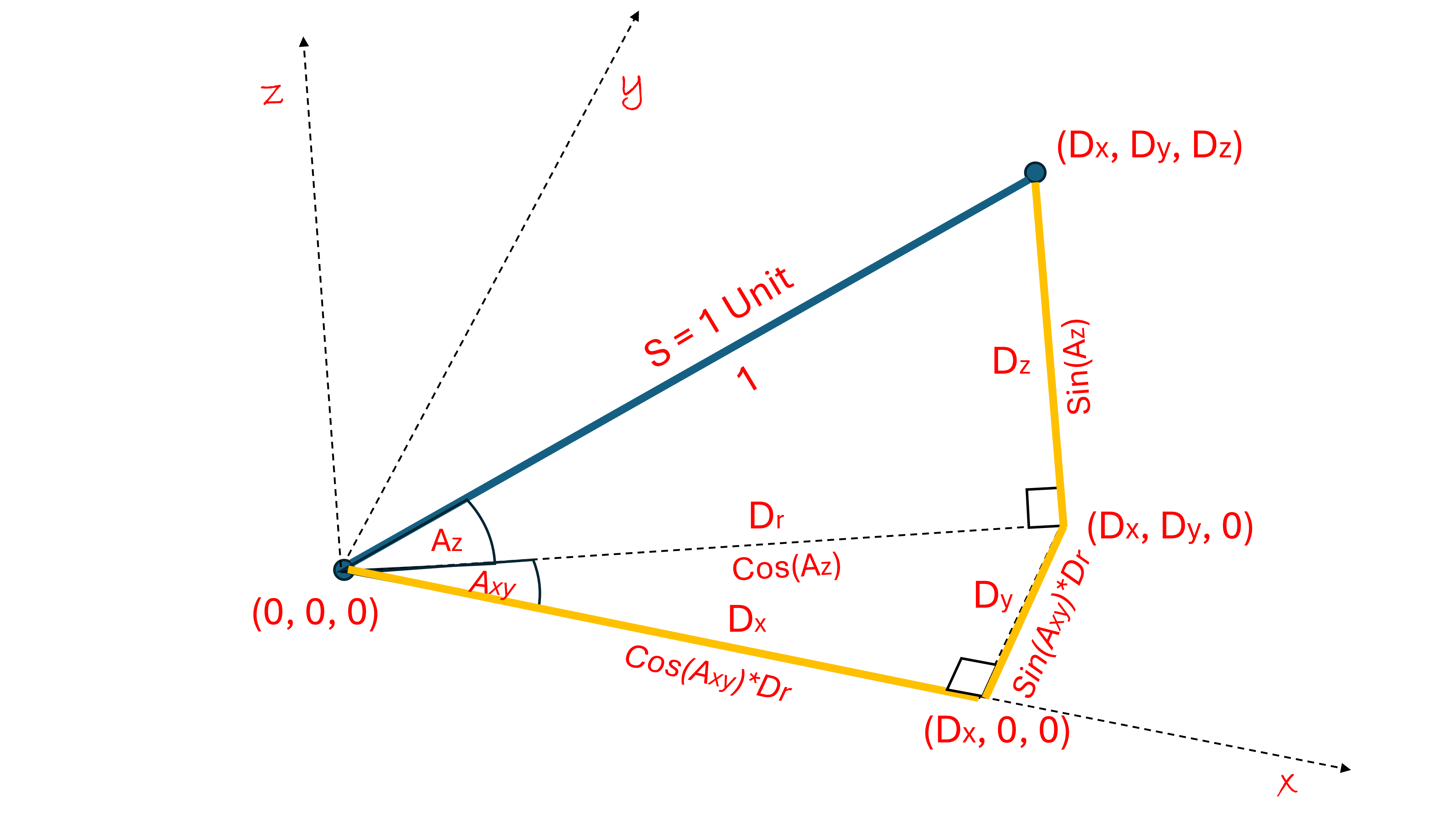
Recall that the direction vector always has a distance of 1 unit, as seen in the diagram above.  In the diagram, we have attempted to show a 3-D path on a 2-D piece of paper.  Note that in the diagram, Dr is the distance from the origin to the point (Dx, Dy, 0) in the x-y plane. From the Pythagorean theorem, we find that the length:

      Dr2 = Dx2 + Dy2    and
      Dr2 + Dz2 = 1        thus combining these
      Dx2 + Dy2 + Dz2 = 1.

The total length of the distance vector is 1 unit, as required.  Everything is consistent.  Now we use the definition of the ‘Sin’ and ‘Cos’ and can see, from the diagram above, that:

     Cos(Axy) = Dx/Dr
     Sin(Axy) = Dy/Dr

      Cos(Az) = Dr/1
      Sin(Az) = Dz/1

    Thus

       Dx = Cos(Axy)*Dr = Cos(Axy)*Cos(Az)
       Dy = Sin(Axy)*Dr = Sin(Axy)*Cos(Az)
       Dz = Sin(Az)

And so, if we stand at the origin facing in the x-direction, and rotate our “head” an angle Axy to the left, and then tilt our head an angle Az off the x-y plane to look directly at the point (xR, yR, zR), we can find the direction vector pointing to this point using these angles:

   (Dx, Dy, Dz) = (Cos(Axy)*Cos(Az), Sin(Axy)*Cos(Az), Sin(Az))

       And then draw the line to this point:

    (xR, yR, zR) = (Dx, Dy, Dz)*R

Now that we are staring at a point in the sky, with our nose pointed directly at the point, we can ask about “reference frame” of our head.  What direction is our left ear pointing, for example.  Our left ear is pointing in the direction, still in the x-y plane, that is 90 to the left of the Axy angle we rotated our head (-Dy/Dr, Dx/Dr, 0). We divide by Dr because in 3-D we must make the length of the direction vector equal to 1.  If this seems vague, look back and review how to find 90 degree directions in the 2-D plane in the top diagram taken from previous posts.

When we tilt our head, we can ask what is the direction that the top of our head points, 90 degrees up from the angle Az. It perhaps takes a bit more imagination to see this, since we are facing in the x-y plane (Dx/Dr, Dy/Dr, 0) and have tilted our head up to look at Dz, we find that the “shadow” of our head is pointed behind us, in the x-y plane (-Dx/Dr, -Dy/Dr, 0), then looking at the elevation Dr (when rotated 90 degrees) we find that (-Dx*Dz/Dr, -Dy*Dz/Dr, Dr) is the direction of the top of our head.  So, in the reference frame of our head:

     Direction of our Nose:     (Dx, Dy, Dz)
     Direction of Left ear:         (-Dy/Dr, Dx/Dr, 0)
     Direction of Top of head:  (-Dx*Dz/Dr, -Dy*Dz/Dr, Dr)

Let us verify that these direction vectors all have a length of 1.  The Nose direction we have verified.  For the Left ear direction:

    L.L = (-Dy/Dr)2 + (Dx/Dr)2 + 02 = (Dy2 + Dx2)/Dr2 = 1

For the Top of head direction:

    T.T = (-Dx*Dz/Dr)2 + (-Dy*Dz/Dr)2 + Dr2 = (Dy2 + Dx2)*Dz2/Dr2 + Dr2
                                                                    = Dz2 + Dr2 = 1

Now let’s find what happens when we find the dot product of these direction vectors, we will call them the N, L, and T directions respectively.

N.N = (Dx, Dy, Dz).(Dx, Dy, Dz) = Dx2 + Dy2 + Dz2 = 1

N.L = (Dx, Dy, Dz).(-Dy/Dr, Dx/Dr, 0) = -Dx*Dy/Dr + Dy*Dx/Dr + 0
                                                                  = 0

N.T = (Dx, Dy, Dz).(-Dx*Dz/Dr, -Dy*Dz/Dr, Dr)
        = -Dx2*Dz/Dr + -Dy2*Dz/Dr + Dz*Dr
        = -(Dx2 + Dy2)*Dz/Dr + Dz*Dr
        = -Dr2*Dz/Dr + Dz*Dr
        = 0

L.T = (-Dy/Dr, Dx/Dr, 0).( -Dx*Dz/Dr, -Dy*Dz/Dr, Dr)
       = Dy*Dx*Dz/Dr2 + -Dx*Dy*Dz/Dr2 + 0
       = 0

We also verified that L.L = 1 and T.T = 1 above.  So, in general, if we dot any of these N, L, T direction vectors with themselves, we get ‘1’, but if we dot any of them with each other, we get ‘0’.  It turns out that this is a requirement for any three perpendicular direction vectors in a 3-D Cartesian reference frame.  I find the “head” reference frame to be more natural because we can relate to it better, so I use this reference frame for whatever direction I am looking.  It is also a great reference frame for video games.

We have already seen from perpendicular 2-D paths how we can convert between a reference frame to our “ground” x-y-z reference frame.  To understand this, let’s take a journey: Fly in the Nose direction a distance SN, then fly in the Left ear direction a distance SL, and then in the Top of head direction a distance ST.  Then we will arrive at the point:

    (x, y, z) = N*SN + L*SL + T*ST

       or in dot product notation:

     (x, y, z) = [N, L, T].(SN, SL, ST)

This amazing equation lets you convert any point in your “head frame” of reference (SN, SL, ST), when your Nose is pointing in a direction N:(Dx, Dy, Dz), to a point in the “ground” frame (x, y, z).  You might also want to do this the other way around.  Review how we did this in 2-D, by “dotting” each side by each of the direction vectors, we get:

    (SN, SL, ST) = [N, L, T].(x, y, z)

This is how video games convert a 3-D world, stored in “ground” (x, y, z) coordinates, into the perspective of the viewer’s head (SN, SL, ST) coordinates.  The details need to be worked out but using this equation we can map a 3-D world onto a 2-D screen in the viewer’s perspective, no matter the relative direction of the viewer’s head.  We will stop here, there is a lot to take in.

Standard

Math Moments – The Rotation Matrix

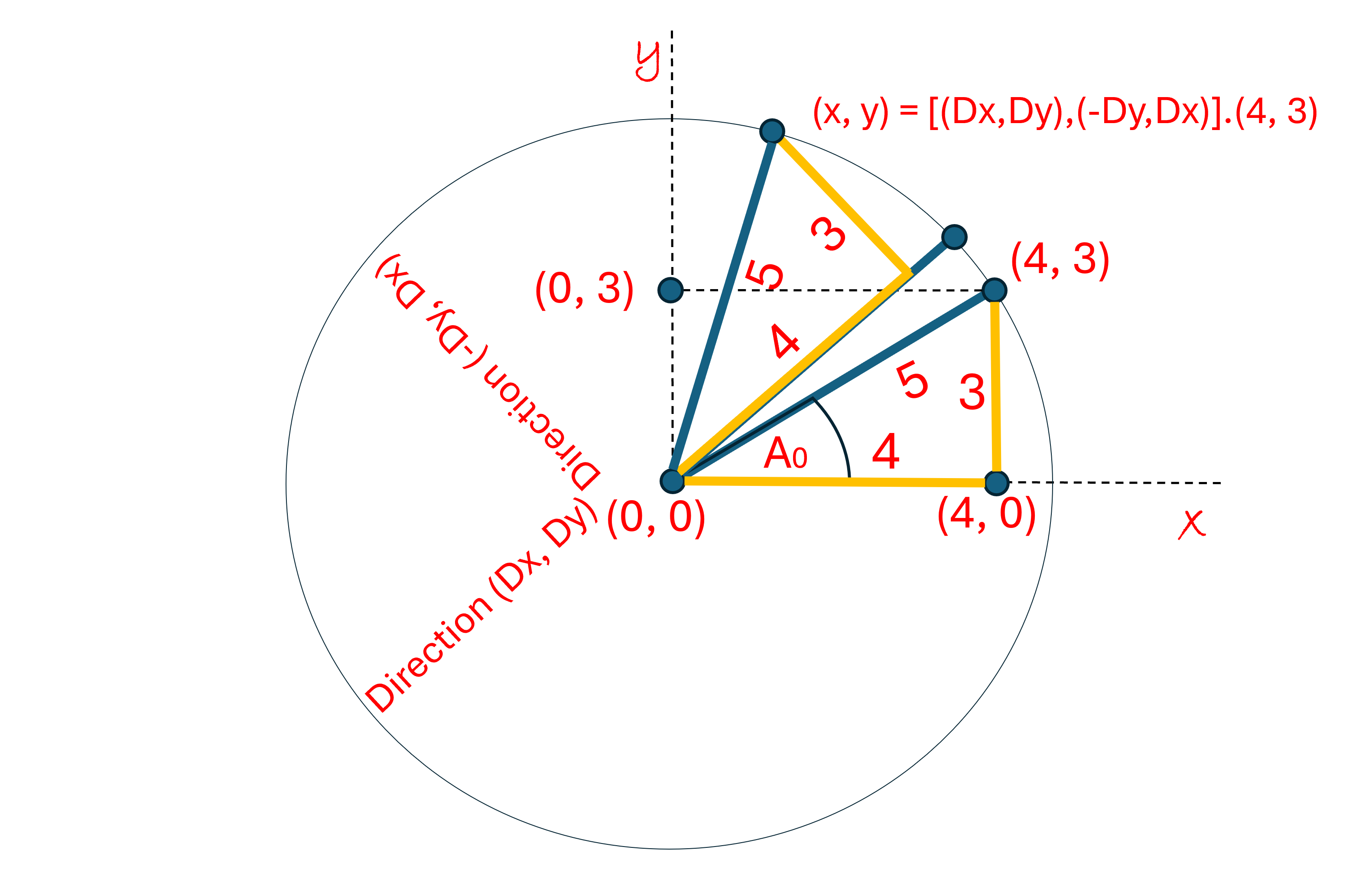
On the Cartesian plane, if we walk along the x-direction (1, 0) for a distance of 4 units, then turn left 90 degrees (perpendicular) and walk a distance of 3 units, we arrive at the point (4, 3), which is a distance of 5 units from the origin (42 + 32 = 52), great.  Well, what happens if we do the same, but start off walking in any direction (Dx, Dy) 4 units and then turn left 90 degrees (-Dy, Dx) and walk 3 units; we are still 5 units from the origin.  We have just “rotated” the whole path to a new direction.  Where would we end up (x, y)?  We use our orienteering skills:

     (x, y) = (Dx, Dy)*4 + (-Dy, Dx)*3
     (x, y) = [(Dx, Dy), (-Dy, Dx)].(4, 3)  –  using the dot product

Now notice that the matrix [(Dx, Dy), (-Dy, Dx)] when dotted with the cartesian point (4, 3) rotates it to another point on the circle (radius 5).  See the diagram. This matrix is called the “rotation matrix”.

Now that we are getting a bit more comfortable with the dot product, let’s play around and see what happens when we dot direction vectors with each other?  We’ll start off by dotting a direction with itself:

     (Dx, Dy).(Dx, Dy) = Dx2 + Dy2 = 1

Any direction dotted with itself is just “1”.  What about dotting a direction with its perpendicular direction?

    (Dx, Dy).(-Dy, Dx) = Dx*(-Dy) + Dy*Dx = 0

It turns out that any direction dotted with its perpendicular direction is “0”.  Now how about dotting the position (x, y) above with the direction vector?

   (Dx, Dy).(x, y) = (Dx, Dy).((Dx, Dy)*4 + (-Dy, Dx)*3)
                             = (Dx, Dy).(Dx, Dy)*4 + (Dx, Dy).(-Dy, Dx)*3
                             = 1*4 + 0*3
                             = 4

And so, dotting a direction vector (Dx, Dy) with any position vector (x, y) gives you the distance (Sx) you would have to travel in that direction before making a 90 turn and traveling the distance (Sy) that would bring you to the position (x, y).  Now let’s dot the perpendicular direction with the position vector:

   (-Dy, Dx).(x, y) = (-Dy, Dx).((Dx, Dy)*4 + (-Dy, Dx)*3)
                             = (-Dy, Dx).(Dx, Dy)*4 + (-Dy, Dx).(-Dy, Dx)*3
                             = 0*4 + 1*3
                             = 3

You can see that dotting the perpendicular direction with a position also gives you the distance (Sy) you would have to travel in the perpendicular direction (-Dy, Dx) to get to the position (x, y).

And so can you see that in this case:

     [(Dx, Dy), (-Dy, Dx)].(x, y) = (4, 3)

So in general if

     (x, y) = [(Dx, Dy), (-Dy, Dx)].(Sx, Sy)

              then

     [(Dx, Dy), (-Dy, Dx)].(x, y) = (Sx, Sy)

What does this mean?  The rotation matrix […] when it “operates” on (is dotted with) any point (x, y), gives you the coordinates of the point relative to a new set of “x-y” axis that is pointing in a direction (Dx, Dy) relative to the old axis.  Or you can say that it rotates the point around the origin.  Either vantage point is valid, you can rotate the point around the origin or rotate the reference frame in the opposite way around the origin; either way, it is describing the same thing.

Remember the concept of “rotational symmetry”, that we can pick the direction of the x-y axis to be in any direction we want.  Now we have the tools to convert the cartesian coordinates of a set of points from any reference frame to a reference frame pointing in any direction we choose.

THIS IS A FUNDAMENTAL CONCEPT of the MATH Language: ROTATIONAL SYMMETRY means that the universe is the same no matter the direction of your frame of reference.  The Rotation matrix gives you a way of describing the same universe from any prospective of direction.  It is pure magic.

One more point, remember that

   (Dx, Dy) = (Cos(A), Sin(A))

Where “A” is the angle of the direction off x-axis.  Thus, the rotation matrix “R(A)” can be written as:

     R(A) = [(Cos(A), Sin(A)), (-Sin(A), Cos(A))]

And there you have it.

Standard

Math Moments – Constructing Parallel Universes

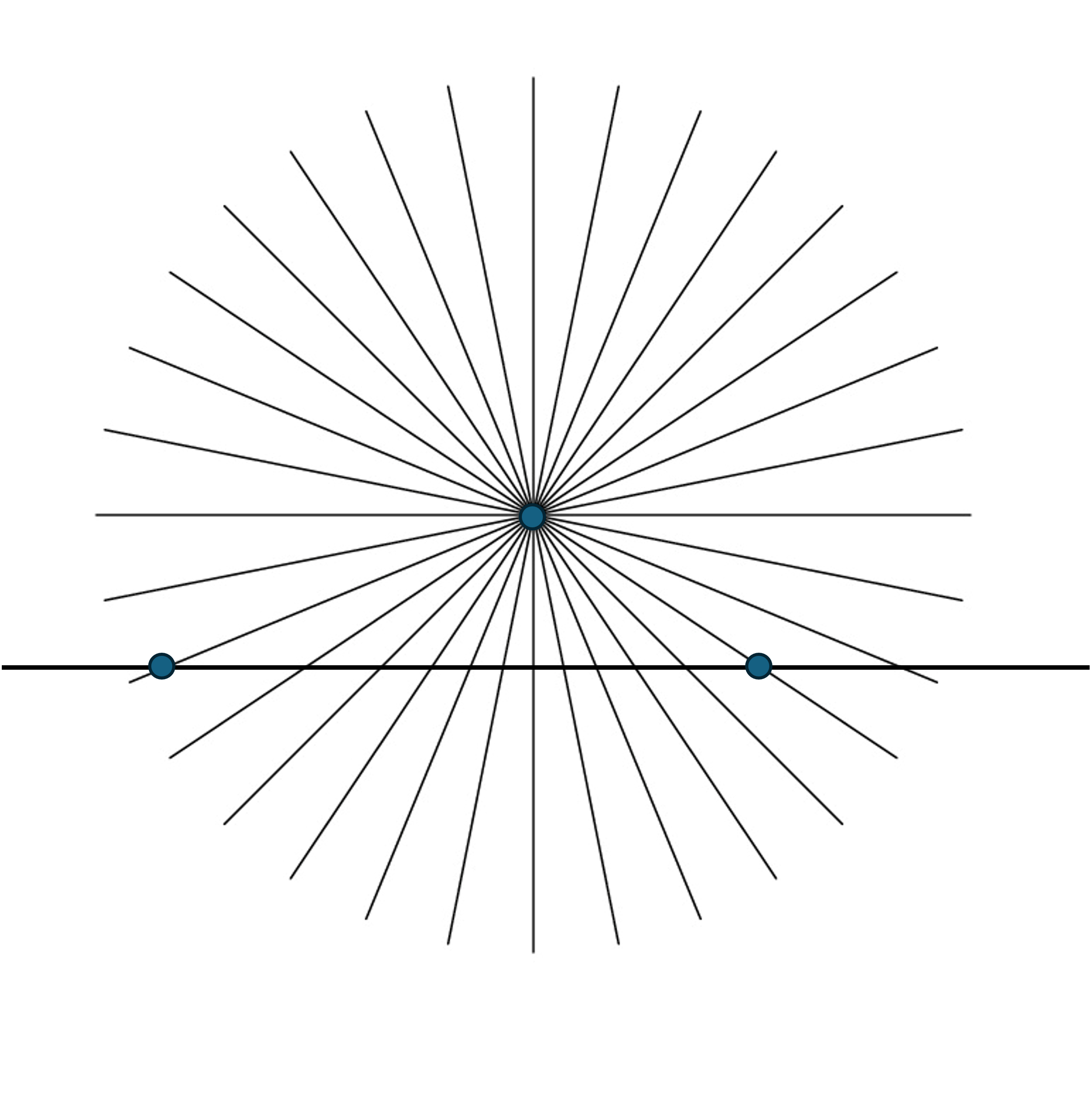
The diagram above (which looks a little like Homer Simpson) shows you how to build a 2-dimensional universe from 1-dimensional universes. There is a lot in the diagram so we will go over it a piece at a time then you can use your imagination to build another universe.

Start with the original 1-dimensional line, the one that passes through the points labeled O, and O+ on the diagram. Remember that we need only 2 points on the line, any 2 of them will generate the whole line. We then need to find another point, labeled P, that is not on the original line. The lines radiating out of the point P represent all the lines connecting P with all the points on the original line “O”.

Each one of the line segments between point P with a point on the line spans a different distance. We find a line of symmetry with respect to P by finding the segment with the shortest distance. This segment goes to the point labeled O. Point O is an important point of reflection, a point of symmetry on the line with respect to P, any point on the positive side of O and its reflection on the negative side of O has the same distance to Point P.

We use the label “r” to refer to the distance between point P and point O. In math language, the symbol “r” reminds us of a “radial” distance from the point P. This r distance is referred to as the “distance” between P and the line. If we put together all the points (on the radial lines) that are a distance r from point P, we form a circle of radius r around P. Notice that since r is the shortest distance between P and the line, this circle only touches the line at point O and cannot reach the line anywhere else. Can you find this circle in the diagram?

The line passing through O and P is a special line of symmetry in this case. It is often called the “normal” of the line that passes through point P. It is also called the perpendicular to the line passing through P. Any set of points on the “positive” side of a line can be reflected onto the “negative” side by finding the perpendiculars passing through the points and then reflecting the points along their perpendicular lines the same distance on the “negative” side of the line. In this diagram, this symmetry is obvious, every point on the right (+) side of the perpendicular (O P) is a reflection of points the left (-) side and vice versa.

In the diagram, we show the point O+ on the positive side of the original line at a distance r from the point O. Its reflection on the negative side is labeled O-. We can easily see that the line (O O+) is also the perpendicular of the line (O P). If we wanted to, we could reflect this whole diagram through the original line and we would get the diagram flipped upside down on the bottom half. For clarity’s sake, I didn’t do this in the diagram.

You might be starting to see the amazing symmetries represented in this diagram. It gets even more obvious when you look at the midpoint between O+ and P. This is labeled M+. Its reflection is labeled M-. If we draw a line segment between M+ and M-, as shown in the diagram, notice that it is also perpendicular to the line of symmetry. To show this better I drew a circle around point M+ and M- that touches the perpendicular line at one point. It also becomes obvious that M+ and M- are the same distance from the original line O O+, by symmetry. All distances are preserved upon reflection.

Alright, now we use our imagination to see what would happen if we drew another perpendicular to the original line through point M+ and another through M-. We can use the small circles drawn to visualize where the circle touches the line to draw these perpendiculars. We can now reflect everything in the middle of these perpendiculars on either side. Like two mirrors facing each other, the reflections go on forever in both directions.
From these symmetries, the line M- M+ can be shown to always be the same distance away from the original line forever in both directions. These lines will never cross.

We have finally found two parallel 1-dimensional spaces that do not intersect each other. Do you think you could find an infinite number of parallel lines in the vertical direction by using reflections?

This is a concept utilized by the mathematician Rene Descartes. He built what is known as the Cartesian plane, composed of infinitesimally close parallel vertical and horizontal lines all normal to each other. These concepts give us many ways to look at 2-dimensional space. One of the most important qualities of this space is that it is assumed to be exactly the same in all directions. Very flat indeed.

Standard

Math Moments – Expanding into Parallel Universes

Alright, this is where it starts getting really interesting. We started out saying that we can use the language of math to build universes, at least in our imagination. We started out with (1) one point in the whole universe. Since a point has no size, the whole universe was simply a 0-dimensional space (a bit mind blowing).

After thinking about nothing for a while, we then thought about having (2) two points in the universe. We argued the concept of distance between these two points. We imagined two distinct completely identical points separated by a distance, this is the origin of the concept of the number 2. We then discussed a way to build a whole 1-dimensional space of points, a line between the two points.

We said that we could fill in the points on a line between these two points by first creating a midpoint a distance half-way between these points then, including the midpoint, use the same concept to create more new points in the middle of these points, and so on forever filling in the gaps (a bit more mind blowing).

We realized that there are an infinite number of points that can fit between our original 2 points, each of them described by the distance and direction they are from the midpoint. We started finding other points to fill in all the gaps between points.

We introduced the concept of symmetry; for every point on the line, everything must look exactly the same in both directions. This symmetry concept required that every point on the line has the same arrangement of points in either direction. If we ever found a point where the line ends, we could just add another segment onto the empty direction and keep doing this forever. This complete infinite 1-dimensional space of points is called a “line” (oh, the things we can think).

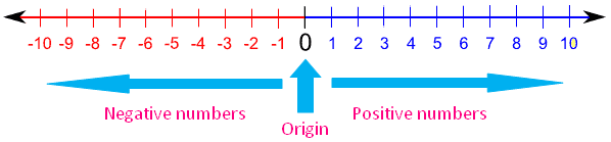
We named the two directions in this 1-dimensional space to be “negative” and “positive”. We can now choose any of the points to be a reference point and describe the position of any point in this space by its distance and direction from the reference point. We have thus introduced the number line.

I hope you enjoyed this line of reasoning so far. We can now use the same line of reasoning we used to expand 0-dimensional space into 1-dimensional space in order to expand a 1-dimensional space into a 2-dimensional space.
As before, we only need to take the points we have in a 1-D space, on the line, and introduce another new point that is not in that space, not on the line. With this new point, we can now define another line by using this new point and any of the points on the original line to create a new line going in a different direction.

Since we can now create a distinct new line through the new point for every point on the original line, we have created an infinite array of new lines (1-D spaces) going off in different directions. Since the points on the original line can be infinitesimally close together, so are the lines. We include all the points on all these lines as part of a new 2-D space. We now have lots of points to connect together to form new lines. All these lines are said to live in this new 2-D space. An ancient mathematician, Euclid, studied these spaces, in honor of him, these “flat” spaces, of straight and parallel lines are called Euclidean spaces.

There are still some gaps. For example, there is a line that passes through the new point that is not connected to the original line, this line is said to be “parallel” to the original line, and since it never can cross the original line, it does not contain any of the points of the original line. As it turns out, building parallel lines using the tools we have requires a bit of doing.

Standard

Math Moments – Extending Spaces into New Dimensions

So far, we have been exploring a 1-dimensional “space” of points along an infinitesimally thin line. Mathematicians call this a 1-dimentional space. The concept of symmetry implies that the line looks exactly the same in both directions. Therefore, this line must extend on forever in both directions, there is no point on the line where it ends. The line looks exactly the same on both sides of every point.

The concept of point symmetry in 1-dimensional space also means that if you were to reverse the direction of the “ruler” that measures the distance between any two points in this space, you will still measure the same distance between the points. This concept of invariance of direction is one of the most important characteristics of space. Of course, we need a lot more than just one line to describe all the space around us.

In order to expand the dimensions of space beyond this 1-dimensional space, we must assume that there is some point that is not in this space, a point that is not on the line. When we find a point that is not on the line, we can create a new line between any point on the line and the new point. This defines a new 1-dimensional space (a line) for every point on the original line, all of these new lines pass through the new point.

Since there are an infinite number of points on the original line, we see that there are an infinite number of 1-dimensional lines that can be drawn through the new point all in different directions. The space formed by this infinite number of lines is called a 2-dimensional space. It is called 2-dimensional due to the “language” necessary to describe the location of any point in this space. To locate any point, we must choose a reference point, then first (1) we need to choose one of the lines passing through the reference point, and second (2) we use the methods we have already discussed to determine the location of a point along this reference line. Thus, the location of a point thus requires 2 numbers, one (1) to locate the reference line, and the other (2) to determine the location of the point along this line.

The concept of point symmetry in 2-dimensional spaces also comes into play. It means that measuring distances is the same in every direction. This invariance of direction means that if we have a “ruler” that measures a distance along any of the lines in this space, and we change the direction of the ruler, the length of the ruler does not change.

Imagine how the world would look if measuring lengths in one direction were different than lengths in another direction. If the invariance of direction was not true, then when we changed direction, the distance between things would shorten or lengthen, depending on which direction we faced. This is not what we experience in real life.

We can use the same concepts that we used to extend 1-dimensional space to 2-dimensional space to extend into spaces into any number of dimensions. How many distinct points do you need to generate a 3-dimensional space? Think about it. We will discuss how it can be done later.

Standard

Math Moments – The power of symmetry

If we were to consider any two points in the universe (A and C) and draw an imaginary line segment between these two points, there would be only one singular point on that line segment that preserves symmetry (under reflection). This is the midpoint (B) on the line segment which is exactly the same distance from each of the endpoints. You can reflect (flip) either one of the endpoints through the midpoint and it would fall exactly on the other endpoint. Such symmetry applies to all points on the line segment that are the same distance from this midpoint.

If you were to pick the midpoint as the reference point and the positive direction pointing toward one of the endpoints, then from the midpoint, the line segment in the positive direction looks exactly the same as the line segment in the negative direction. You could conceptually switch the positive direction with the negative direction, and nothing would change. This is called reflection symmetry, for obvious reasons.

If you have reflection symmetry, then anything that exists at a certain distance along the positive direction, also exists at that same distance in the negative direction; just like looking at things through a mirror. We use such symmetries in atomic physics all the time to make things easier.

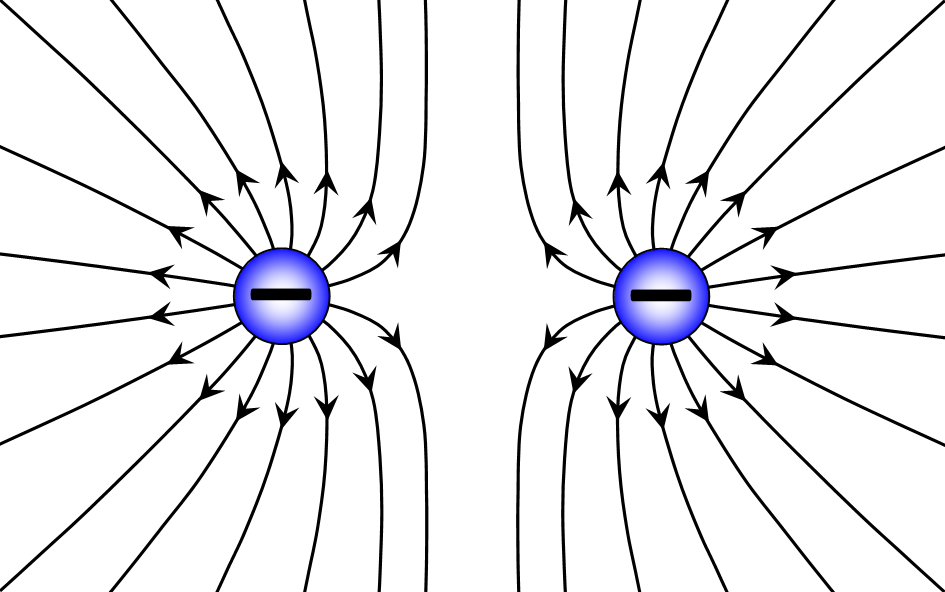
For example, the electric field between two identical electrons, as observed from the midpoint between them, looks exactly the same when you are facing one electron as it does when you are facing the other. From the midpoint, everything is exactly the same in both directions, you cannot tell the difference between the electrons nor any of their physical properties from this perspective. To tell the difference, you would need to “break the symmetry” by introducing something else that is not symmetric to the midpoint.

So, once you have seen what exists on one side of the “mirror” we also know what will exist on the other side. It makes the math (and the diagrams) so much easier. We always should seek out these points of symmetry when we are doing the math, it makes everything so much more…symmetric.

Standard

Math Moments – How many Points are on a Line Segment?

If you have fun with the concept of being able to zoom in to a single Point forever, always getting closer and closer but never arriving, you are one step closer to understanding the concepts of advanced math and calculus.
You saw that with any two points you could always find a point that is exactly in the middle. You can then take this midpoint as a new end point and find another point that is in the middle of it. Since points have no size, you can keep on cutting these line segments in half forever.


No matter how close two points are together, you can still find a point in the middle. Thus, there are an infinite number of points in any line segment, no matter how short it is. This is an example of the concept of a countably infinite set of points. It is possible to write out list the location of these points as their distance from the reference point: 1/2, 1/4, 1/8, 1/16, … and so on forever.


You could just as well cut the segments into thirds, with the location list of points: 1/3, 1/9, 1/27, … and so on forever. Notice that this list of points does not have any of the same points as the one in the last paragraph. So, it appears like you could go on forever filling in all the gaps by dividing the segments up evenly and still never fill in all the gaps. So how many points can fit into the line segment between any two endpoints, no matter how short? Can we ever find a way to fill in all the gaps between points? To fill in all the points between any two points, we would need what is called an uncountably infinite number of points. This is a concept that mathematicians have not yet resolved.

Standard

Math Moments – The Number Line

Let’s imagine that you have a universe with only two points in it. You now draw a line segment between the two points and choose one of them to be the reference point. The location of any point along the line segment is now determined by the distance it is from the reference point. Now make a third point on the line segment that is exactly half-way between the two points. This new point is located at exactly half of the distance between the two end points.


Can you see the symmetry that is formed by these three points? The distance from the center point to either of the two end points is exactly the same. If you now were to choose the center point to be the reference point, then both end points would be the same distance away, but in opposite directions.


You would now need more than just the distance measurement alone to determine the location of points along the line. With three points, now direction becomes important. Again, using the axiom of choice and can choose which direction from the center point is positive, and which direction is negative.


We can then, finally, determine the location of every point on the line by specifying both a distance and a direction (positive or negative) from the center point. This arrangement of determining the locations of points on a line is called a “number line”. We call the distance and direction of each point on the line the Point’s coordinates. A Point’s coordinates uniquely determine its location on the line. Finally, we have a way of determining the location of a Point.


The center point is a special point of symmetry between the two endpoints. We can “rotate” the direction (exchange negative for positive directions) and the location (distance and direction) of the two identical endpoints would be exactly the same. This is called “rotational symmetry”. It means you can switch reference directions and the list of all the point coordinates will be the same. Remember that since you can’t tell the difference between points, the order of the list of points is not important.


Please believe me, taking the time to understand these concepts makes math so much more fun and easier later on. Learning these concepts is like learning the basic vocabulary of the math language.

Standard

Math Moments – 1-Dimensional Space

How can the exact location of the Point be described? This is a conceptual problem. It is also where some very advanced concepts of math (found in calculus and number theory) come to play. After some thought, it becomes obvious that if there was just one point in the universe, all by itself, it does not have an absolute location until you look at where it is relative to another point in the universe.


If there were only two points in the universe you could imagine a line segment drawn between the two points, and then there is some distance between the two points, you could pick one of the points as the reference point. Then you could describe the location of the second point as being a certain distance from the reference point. You only need one (1) distance measurement from the reference point to describe the location of the Point. This is why such a line is called 1-dimensional space.


You have now discovered quite a few interesting concepts, including the concept of the number “2”. Two identical objects in space that are distinguished by the distance between them. You have also discovered the concept of the number “1”, the concept of distance, and you are also starting to realize why Einstein’s theory is called the theory of relativity. Distances and times are only measurable relative to a reference point, and you can pick any of the points to be the reference point.


The idea that you can pick any of the points to be the reference point is called the axiom of choice. An axiom is something that is assumed to be true even though it has no definite proof. The axiom of choice forms the conceptual foundation for all mathematics.


Another concept that comes from using the distance from a reference point to describe location is the idea of symmetry. You can exchange the locations of two points, and you have not changed anything. It is impossible to tell the two points apart, and both points still have the same locations relative to every other point. This is called exchange symmetry. Symmetries makes math and physics much easier.

Standard