Math Moments – Pointing the Direction

It might be good just to pause here for a minute or two and get our bearings.  If you were deep in the woods with a compass, you could get to any point you want by simply knowing the direction you need to travel and how far you need to go in that direction.  On a grid, we could call the point where you are “the origin”, you are starting at the point (0, 0).

You also have a map with a grid and want to be able to draw a line on the map from where you are to your destination.  We are going to draw this line using the general line parametric equations for a line we have already discussed:

x = x0 + Dx*S
y = y0 + Dy*S

With the origin as your starting point (x0, y0) = (0,0).  Notice that I used different simpler notation that says

x0 = 0 and
y0 = 0.

This is called vector notation, instead of stacking the parametric equations on top of each other, we put them side by side in parenthesis and separate them with a comma (x, y). Using this vector notation I can rewrite both general parametric equations for a line as:

      (x, y) = (x0, y0) + (Dx, Dy)*S

A “vector” is expressed as two numbers written in parenthesis, separated by commas. In this case, the first number is the “x term” and the second number is the “y term”. When we “add” two vectors we add both “x terms” together and also both “y terms”.  When we multiply a vector times a number, then we just multiply both the “x term” and “y term” by that number.  And so, the “vector” equation for a line can be expanded like this:

   (x, y) = (x0, y0) + (Dx, Dy)*S
   (x, y) = (x0, y0) + (Dx*S, Dy*S)  (multiply the Direction vector by S)
   (x, y) = (x0+Dx*S, y0+Dy*S)        (add this to the starting point)

You can see how this last equation looks like the original stacked parametric equations, but they are written side by side in the parenthesis instead of one on top of the other.

This vector notation has an advantage, it is easier to write, and it lets us express the direction of the line on as (Dx, Dy). 

This becomes very helpful.

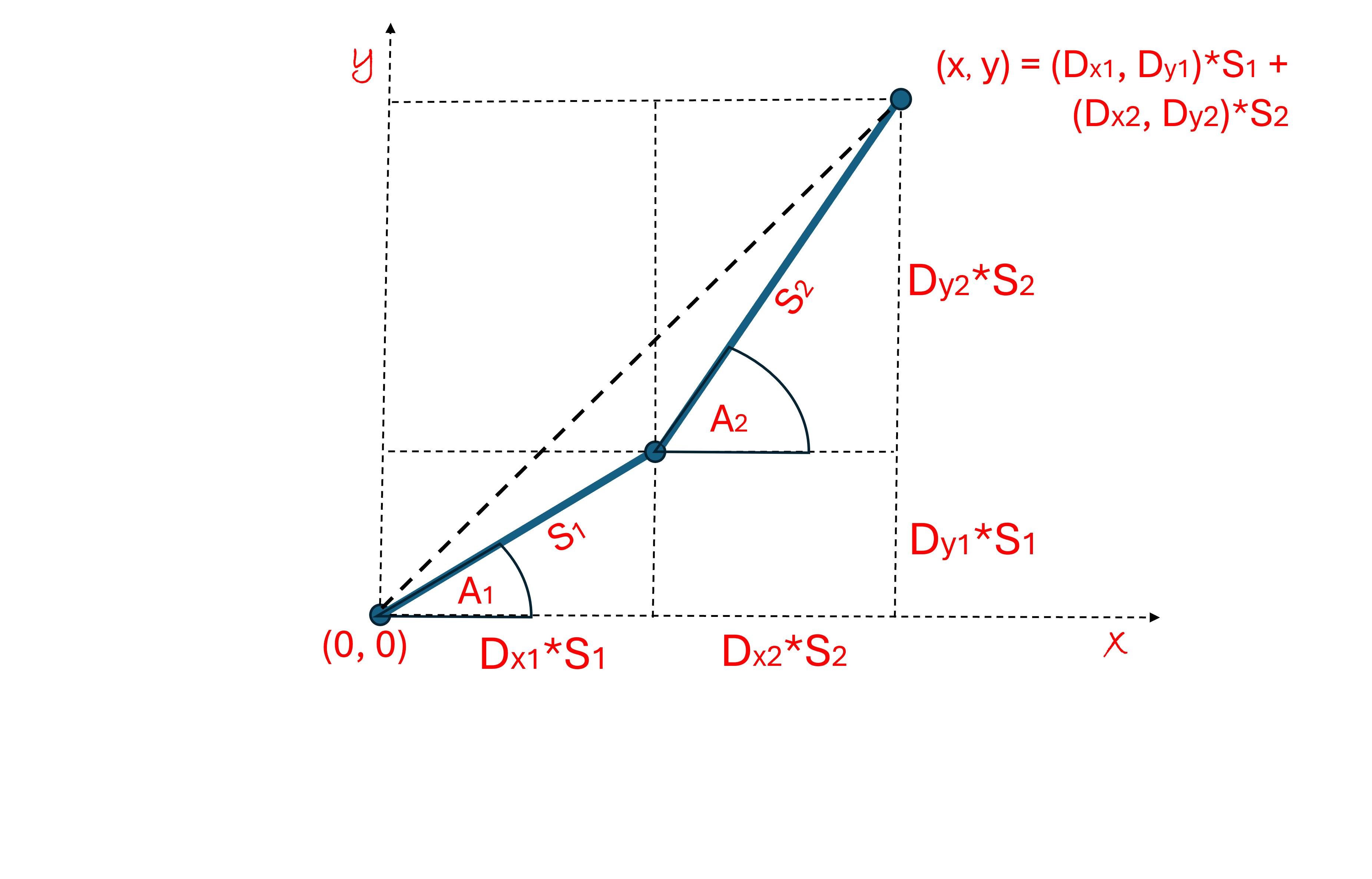
If you are in the deep woods, then it would be very helpful to convert your compass heading direction into this Direction vector and find (Dx, Dy) for your desired direction heading so you can draw the line on your “grid” map.

Since you set the origin (x0, y0) = (0, 0) to be where you are, the vector equation for the line to your destination is:

   (x, y) = (Dx, Dy)*S

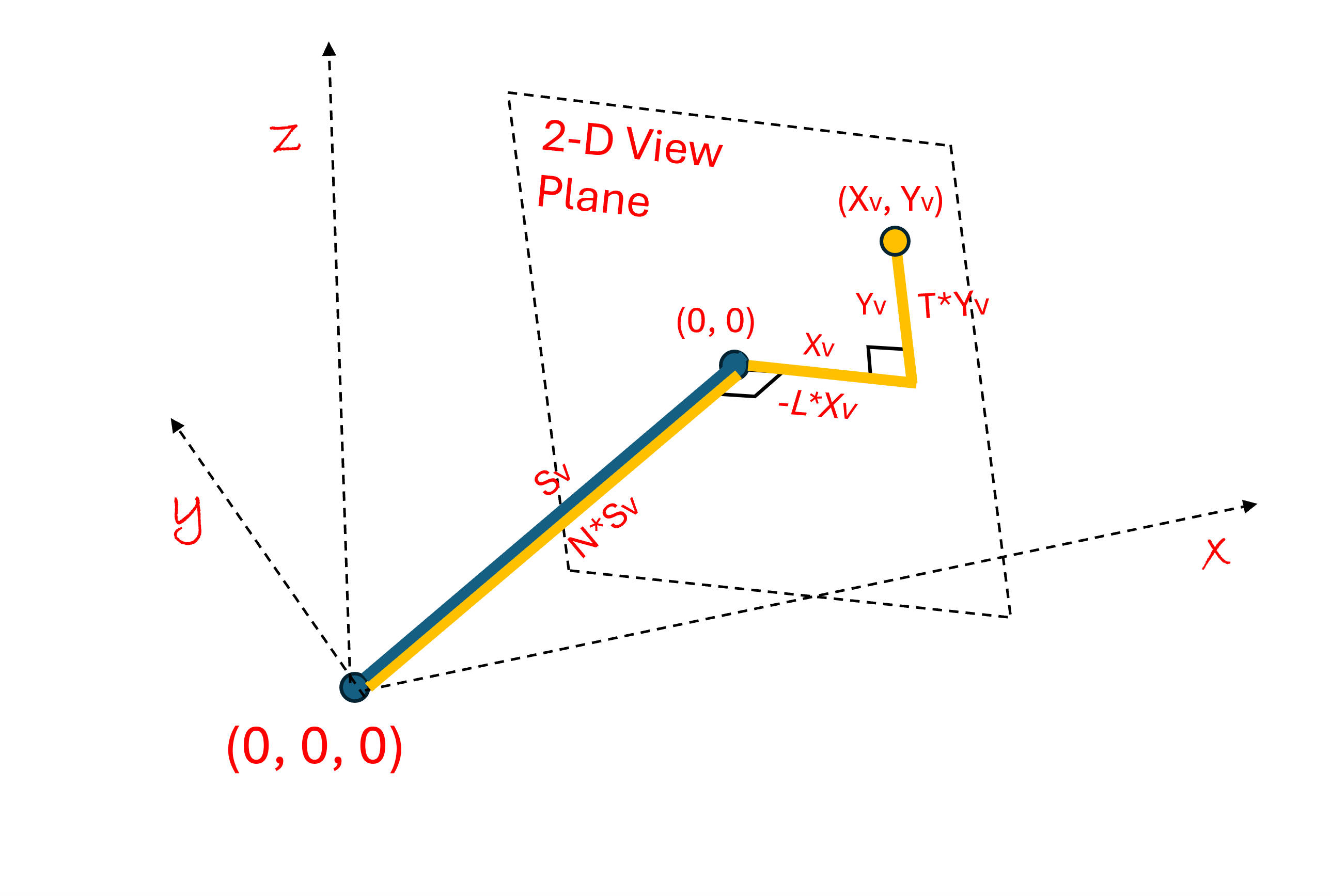
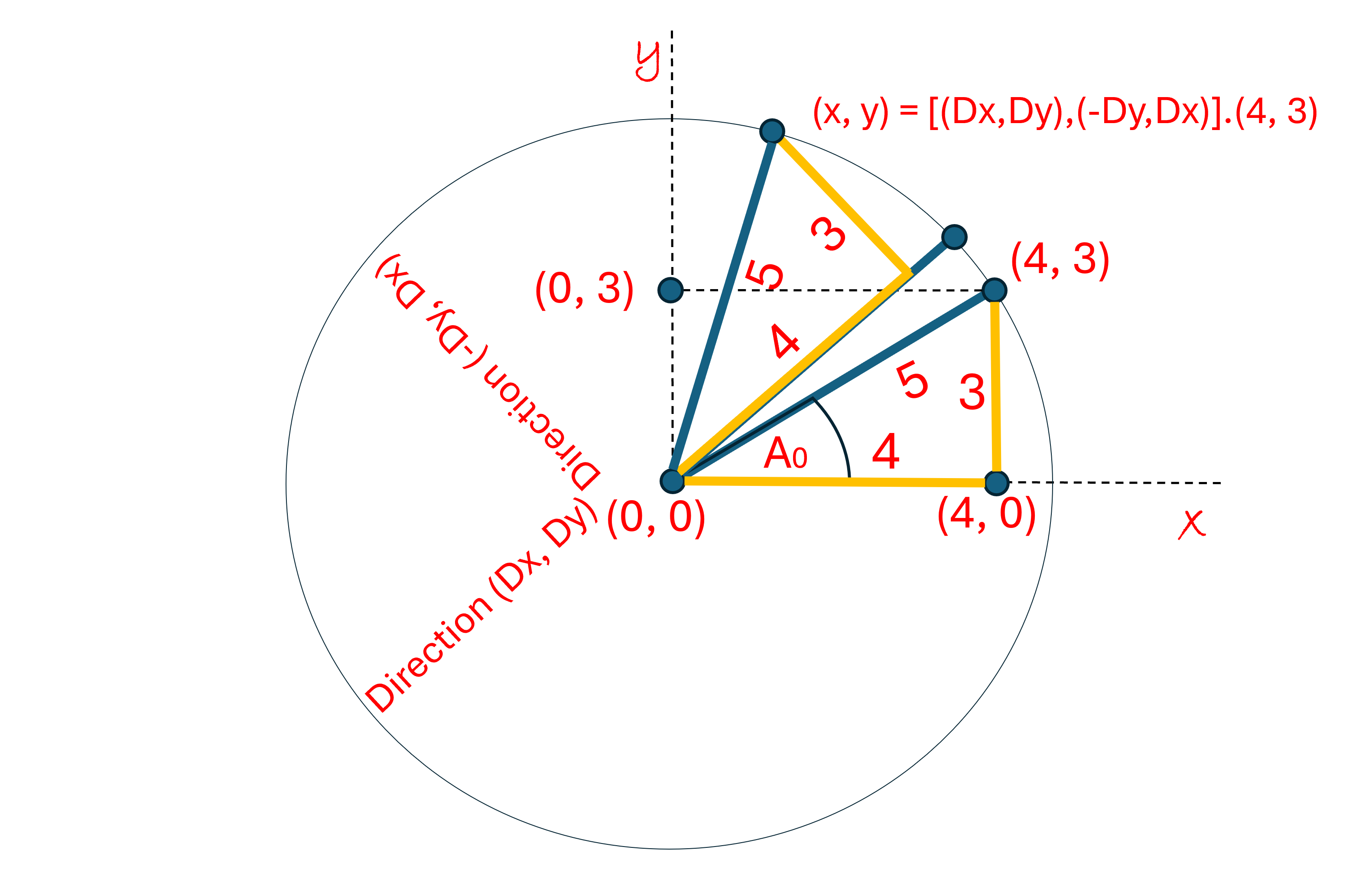
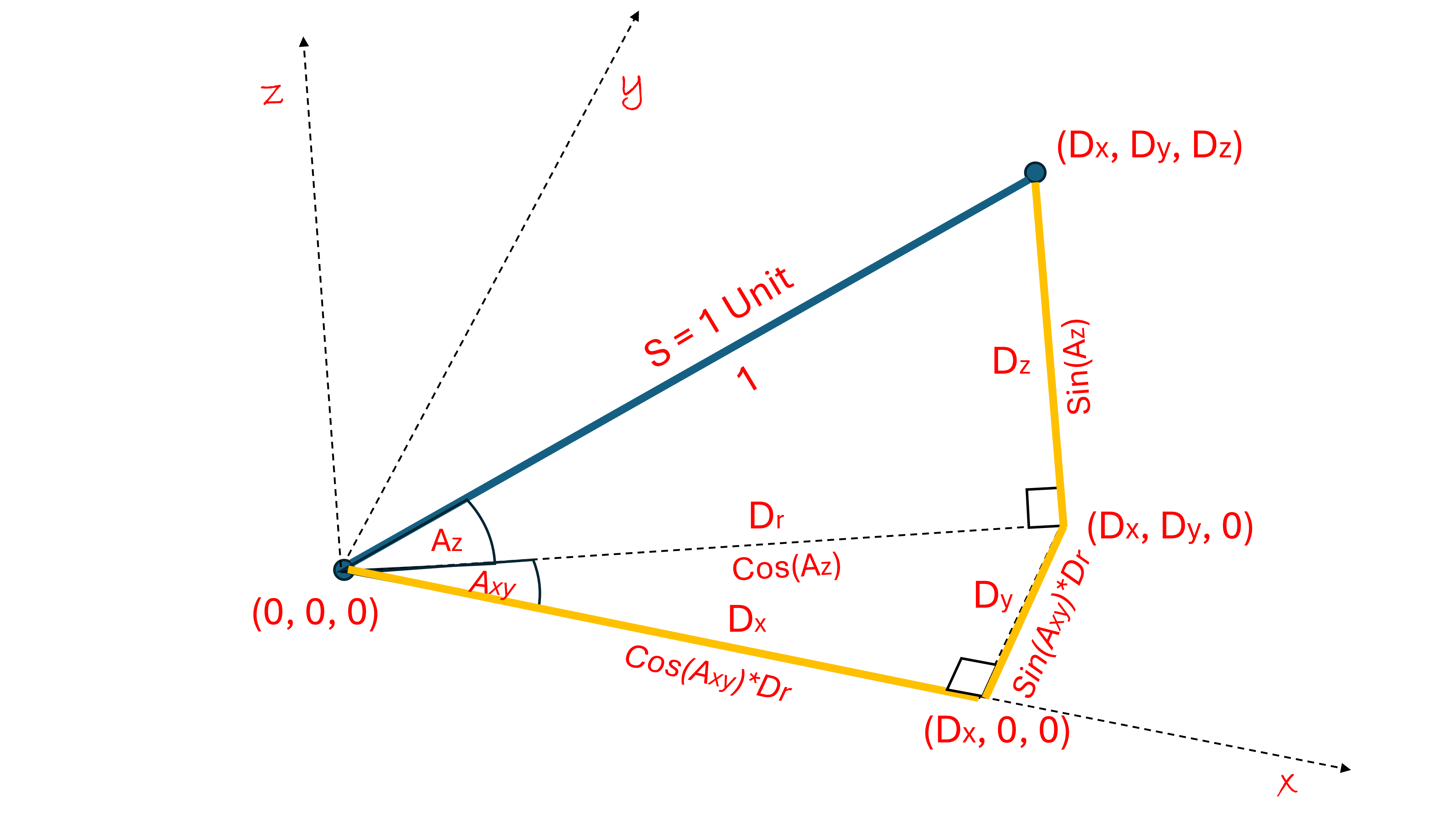
Now suppose that your destination is a distance “R” away from where you are. You can then draw a circle on your map with a radius “R” from the origin where you are.  You know that your destination is then somewhere on that circle.  You just need to know the direction (Dx, Dy) of your line to your destination point (see diagram above).

Let’s call the destination point (xR, yR).  Since we figure that the distance is “R”, then when S = R our vector equation is written:

(xR, yR) = (Dx, Dy)*R

And so using vector notation:

(Dx, Dy) = (xR, yR)/R = (xR/R, yR/R)

This tells us that if we know the point of our destination:

(xR, yR) and the distance R2 = xR2 + yR2, then we can find the direction vector and draw our line on the map.  And if we only know the Angle “A” off the ‘x-axis’ from our compass, We can use our calculator and the definitions of Cos(A) = xR/R and Sin(A) = xR/R, to find the direction vector:

    (Dx, Dy) = (Cos(A), Sin(A))

Let us look at an example:  Suppose we knew that if we walked north 3 miles and then east 4 miles, we would reach our destination.  Then our destination is at (3 miles north, 4 miles east) on our map:

   (xR, yR) = (3, 4)  and R2 = xR2 + yR2 = 32 + 42 = 25 or R = 5.

       So,

   (Dx, Dy) = (xR, yR)/R = (3/5, 4/5) North-east

       The line on the map could be drawn by using:

   (x, y) = (3/5, 4/5)*S    where S varies from 0 to R.

If we wanted to know the compass heading, then we could use the “inverse” Cos and Sin functions on our calculator to find the angle “A”:

   Cos(A) = 3/5   and Sin(A) = 4/5.

This might require a bit more knowledge of trigonometry.

Now we do something really interesting.  Suppose that we are still at the origin, facing directly at the point (xR, yR) but we want to find the point on the circle that is exactly 90 degrees to our left. If you look at the diagram, you will easily see that the point of destination would then be (-yR, xR).  The point directly behind us would be (-xR, -yR) and the point 90 degrees to the right would be (yR, -xR).

This is very useful if we want to draw lines that are perpendicular to the direction we are traveling along a line.  The direction (-Dy, Dx) is perpendicular to the left of the direction (Dx, Dy).

Standard

Math Moments – A Universal Triangle

Take any three points in the universe, that are not on the same line, and they form a triangle.  We also have seen how these three points can generate the 2-D Euclidean space where the triangle lives.  Oh, the things we can do with a humble triangle.

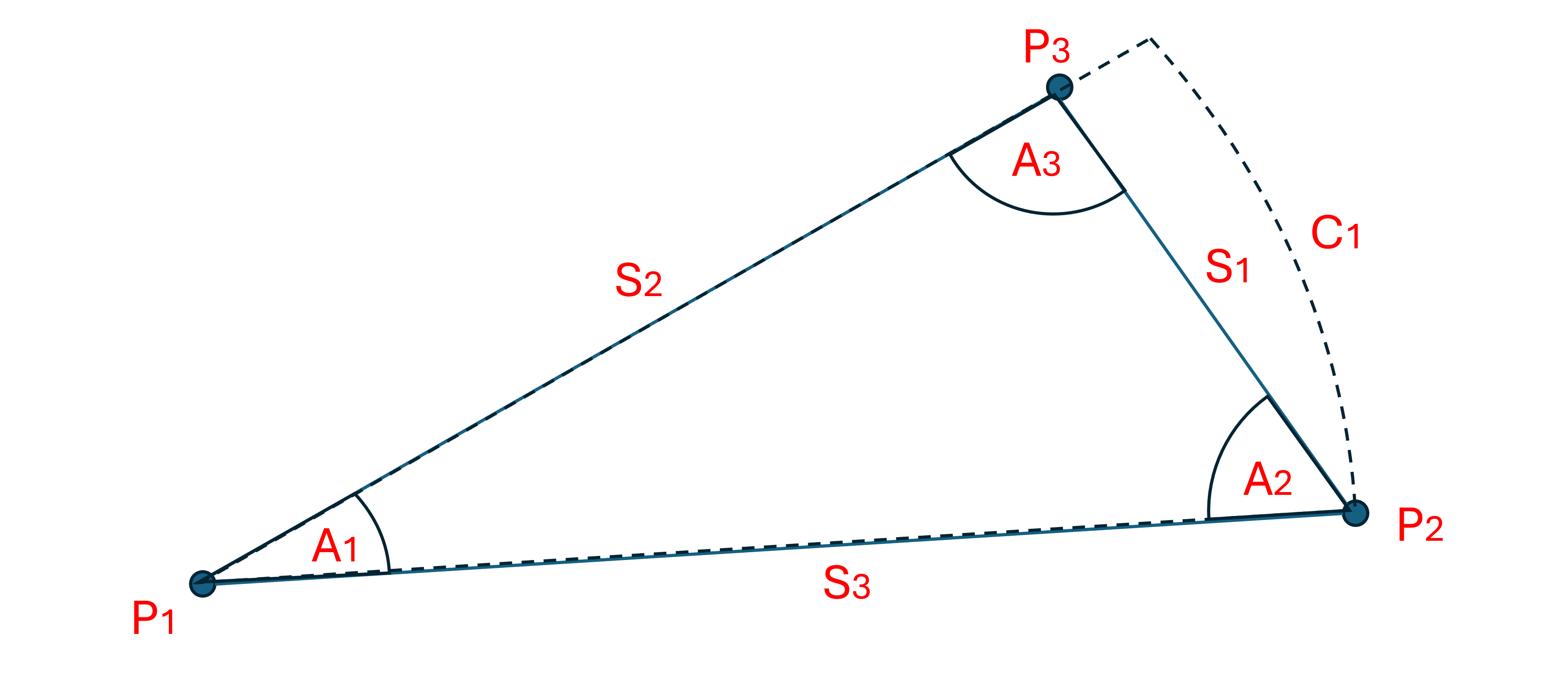
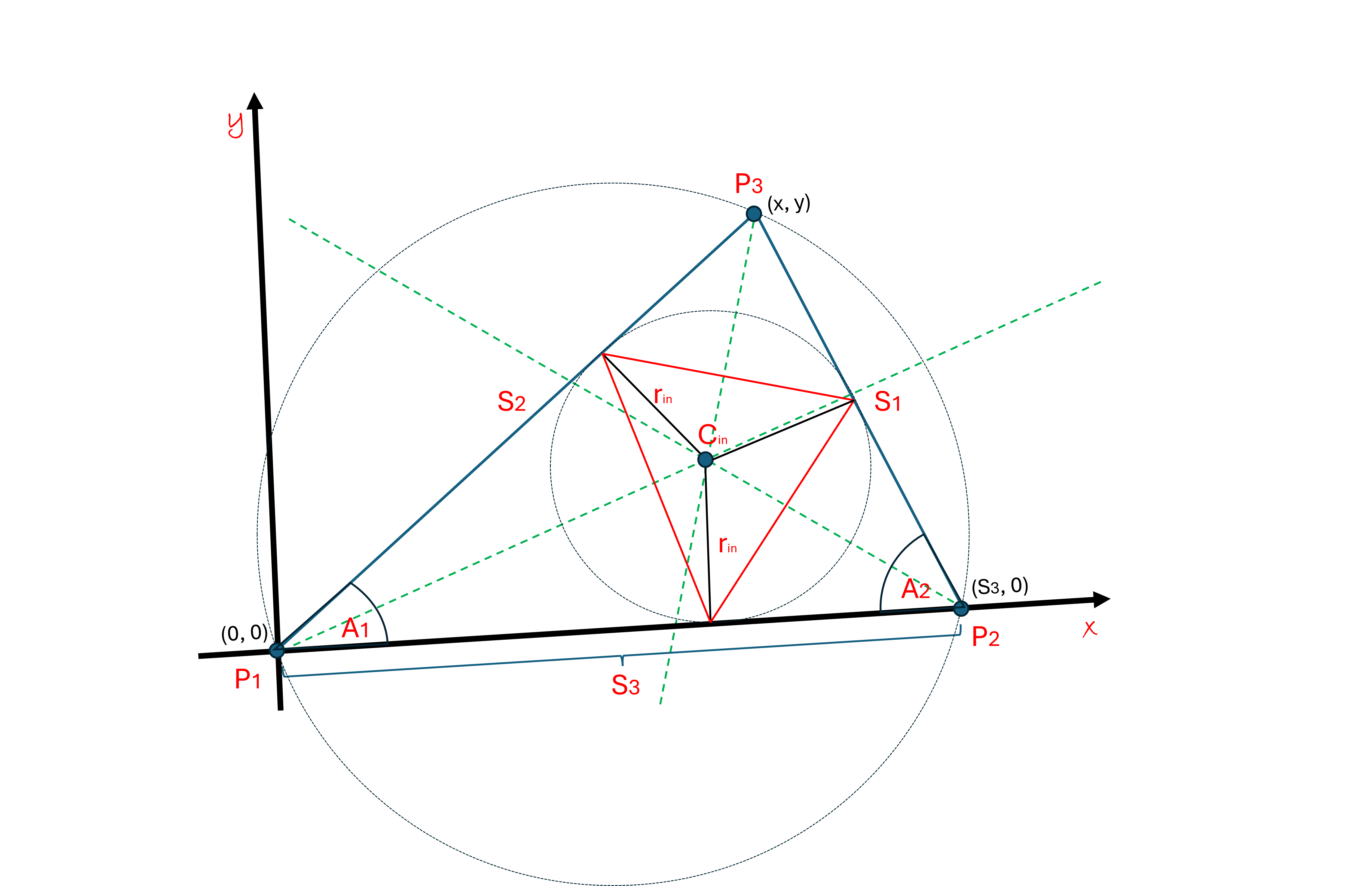
We can start by labeling its parts.  The points are connected by the three line segments called sides. Let’s call the point that is farthest away from the other two points, P1.  This is also the point that connects the two longest sides.  We can label the point on the other side of the longest side P2, and the remaining point P3.

It makes sense to put the label S1 for the side opposite the point P1, and the same for S2, and S3.  The side S3 then connects the points P1 and P2, and is the longest side, simply because we chose P1 and P2 to be on the longest side.  And so the side S2 is the second longest side, and S1 the shortest side with the same reasoning.  In math language S1 is less than or equal to S2 and S2 is less than or equal to S3 : S1 <= S2 <= S3.

We simply chose the labels so this is true. The way you choose to label things makes things easy to remember and deal with.  We can also choose to label the angle A1 to be next to the point P1, A2 to be next to P2, and A3 to be next to P3.

Angles are measured as percentages of the “piece of pie” inside the angle in proportion to the whole pie.  You can find the angular percentage of A1 by taking the length of the circular arc C1 (in the diagram) and dividing it by the circumference of the whole circle, 2*π*S3.

The angle in degrees is found by multiplying this percentage, C1/(2*π*S3), by 360 degrees in the whole circle:

A1 = 360 * C1/(2*π*S3).

Mathematicians chose 360 “degrees” in a full circle because it can be divided equally into 2, 3, 4, 5, 6, 8, 9, 10, 12, 15, 18, 20, 24, 30, 36, 40, 45, 60, 72, 90, 120, 180, and 360 pieces.

Another way to measure angles is to use “radians”, chosen so that 2*π radians are in a full circle. Thus in radians,

A1 = 2*π * C1/(2*π*S3) = C1/S3

Which is a more natural measure for angles based on the arc lengths of a circle.

If you really want to learn geometry, trigonometry, or build virtual worlds, then understanding the concepts we are about to explore gives you great power.

Suppose, for example, you want to find a cartesian grid that will map where these points are in space, then choosing good reference points and directions can make all the difference.

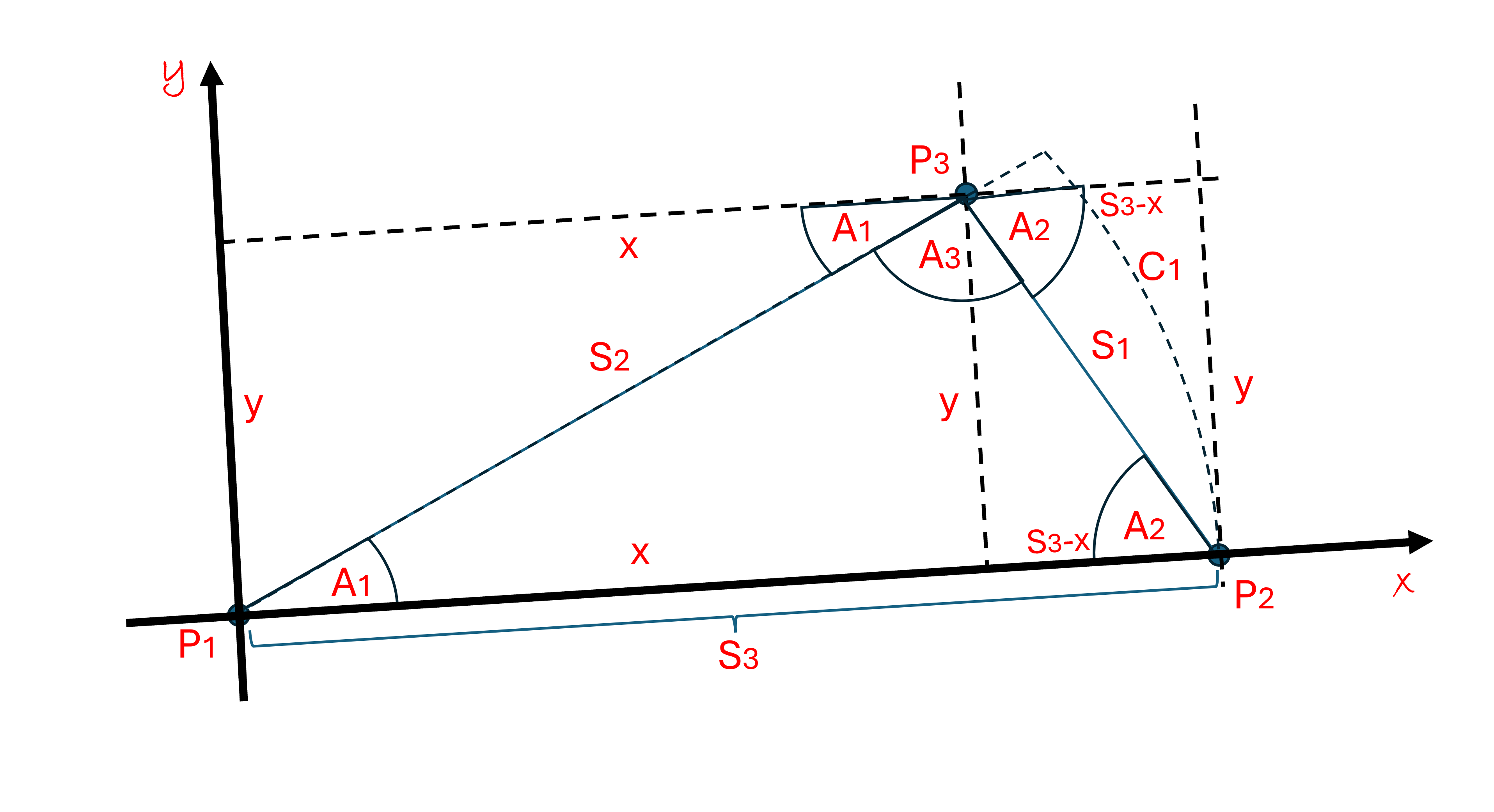
If you choose P1 to be the reference point (the origin), then choose the “x” direction to point directly along the S3 side toward point P2, and pick the perpendicular “y” direction so that P3 is on the positive side.  Then you placed this universal triangle on a grid as shown on the diagram above.  P3 is the only point that does not lie on an axis.  The distance of P3 from the y axis is labeled “x” and the distance of P3 from the x axis is labeled “y”, as shown in the diagram.

This breaks the triangle up into two rectangular regions, as shown by the dashed lines in the diagram.  The area of the left rectangle is x * y, and the area of the right one is (S3-x) * y.  If you add these two areas together you get a total area of S3 * y.  It is easy to see that the area of the triangle, by symmetry, is exactly half of the area of the two rectangles, so:

Area of triangle = ½ * S3 * y.

We can easily see this from the diagram. The left rectangle is made with two exact copies of the x, y, S2 triangle so the angle, A1, is the same on the top and bottom half of the first rectangle.  The same goes for the A2 angle in the (S3-x), y, S1 triangles on the right.  Adding the angles together on the top junction of the rectangle, it is easy to see that:

A1 + A2 + A3 = 180 degrees (universally true for all triangles).

From the diagram and by the Pythagorean theorem we can also see that:

 S22 = x2 + y2

S12 = (S3-x)2 + y2

       = S32 – 2*S3*x + x2 + y2  (and x2 + y2 = S22)

       = S32 + S22 – 2*S3*x    (known as the law of cosines)

And when S1 and S2 are the same length then:

S22 = S12

S22 = S32 + S22 – 2*S3*x

Thus by simple algebra

S32 = 2*S3*x

x = ½ * S3

And so we see that when x is halfway between P1 and P2, then the sides S1 and S2 must be equal in length. We can also see that if S2 is greater than S1 then x must be greater than ½ * S3, on the right-hand side of the midpoint.

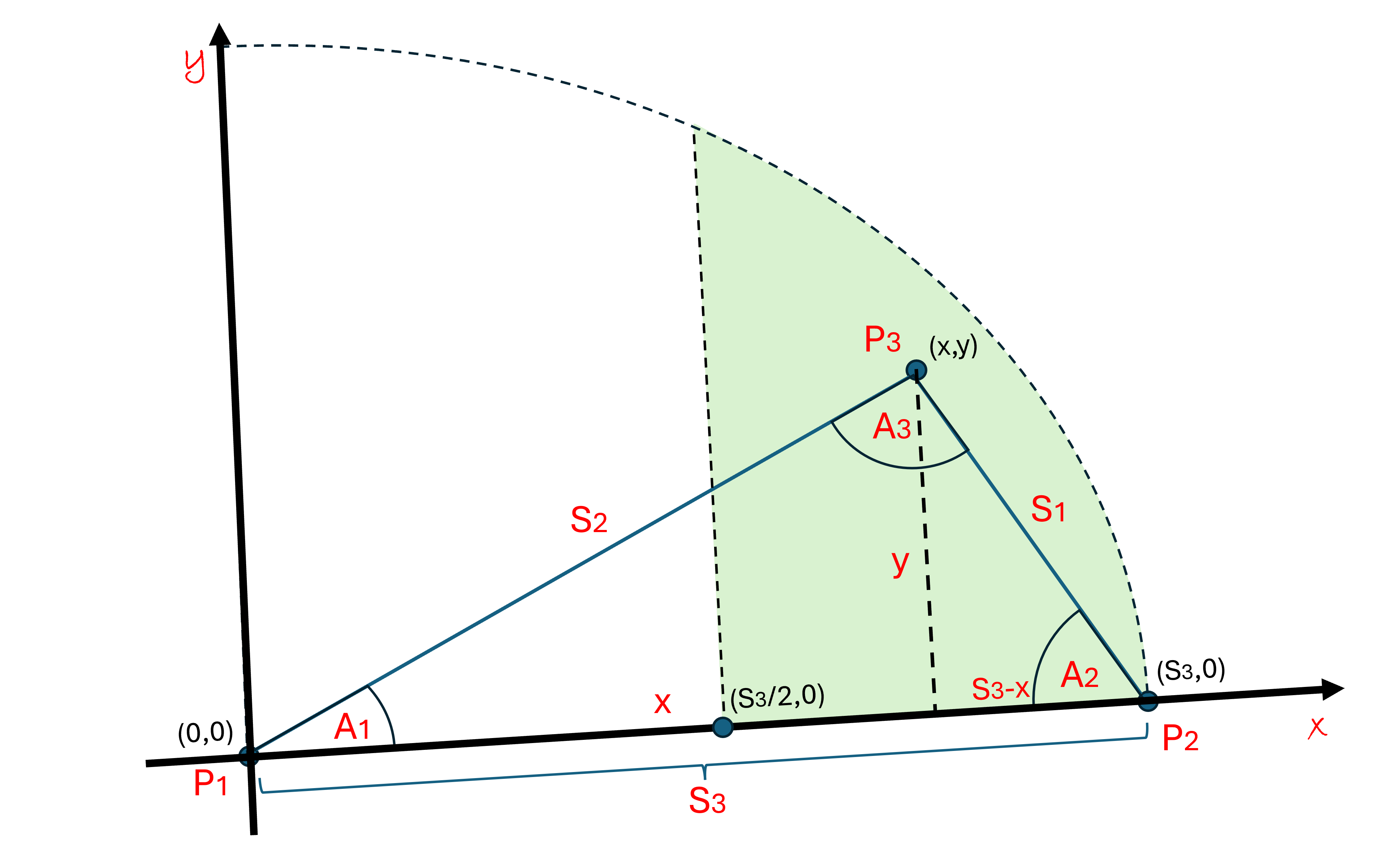
We now can see that there are some natural restrictions on where P3 can be in the above diagram, since S2 is greater than or equal to S1, then x >= ½ * S3, and since S2 is shorter than S3, P3 must be inside a circle of radius S3.  Thus, P3 is restricted to be in the shaded region shown in the diagram.  If P3 was outside this region, then S2 would be longer than S3 or shorter than S1 and we would need to re-label the points and sides accordingly and redraw our grid, then P3 would again be in the region.

We now can supply the Cartesian coordinates of the three points in this grid:

P1: (0,0)
P2: (S3,0)
P3: (x,y)

Note that this applies to all triangles in the universe, as long as we follow the labeling guidelines for the parts of the triangle and set up the grid like we have done here.

To work with the angles and find x and y, there are “trigonometric” functions on our calculators, Sin(Angle) and Cos(Angle), to find x and y from the angles, that are defined as follows:

Sin(A1) = y/S2  [or y = S2 * Sin(A1)]

Cos(A1) = x/S2 [or x = S2 * Cos(A1)]

We can also work with the angle A2 by looking at things from the P2 side:

Sin(A2) = y/S1           [or y = S1 * Sin(A2)]

Cos(A2) = (S3-x)/S1 [or x = S3 – S1 * Cos(A2)]

The angle A3 can be found because A1 + A2 + A3 = 180 degrees.

Notice that now you can find x and y if you know the angle A1 or A2, and the sides.  You can fool around with this to find the missing information.  For example, combining both expressions for x and y shown above, we get:

   x = S2 * Cos(A1) = S3 – S1 * Cos(A2)

   y = S2 * Sin(A1) = S1 * Sin(A2)    (known as the law of sines)

These relations can be used to find x and y from the angles and sides, or the angles from x and y, or the sides from combinations of each.  These are very useful in geometry.  You can explore all the possibilities by taking a trigonometry course.

A surprising and revealing fact: you can use reflection symmetry to find a point that is the same distance away from all three points P1, P2, and P3.  We call this the “center” point, C, and thus you can draw a circle that connects all three points. This means that if you randomly choose any 3 non-linear points, you can find a unique circle that connects these points.

To show this, we start by recalling the wonders of reflection symmetry.  The midpoint of S3 between P1 and P2 is the same distance from both these end points. We can find all the points that are the same distance away from P1 and P2 by drawing a perpendicular line of reflection through the midpoint of S3.  We saw that this is the line where x = ½ * S3.  Any point on this vertical line is the same distance away from P1 as it is from P2.  This is shown by the vertical dashed line in the diagram above.  In the same fashion, the points that are the same distance from P1 as they are from P3 are found to be along the line of reflection that cuts the segment S2 in half, as is shown by the other dashed line on the diagram.  These two midpoint lines of reflection from S3 and S2 meet at the “center point” C.  And so, we see that this point C is the same distance “r” from P1, P2, and P3.  We can draw a circle with center C and radius r that connects all three of these points, as shown in the diagram above.

Before we finish, let’s explore one other surprising universal fact about triangles. This comes from reflection symmetry of bisected angles that we have not covered yet.  Any angle made from two lines can be cut in half, this forms a line of reflection symmetry.  For example, in the diagram above, there is a dotted line that divides the angle A1 in half.

Through this line of reflection, you can reflect the line passing through P1 and P3 onto the line passing through P1 and P2. It might take a minute to see it. If I draw a circle with its center on this line, then the half-circle above the line can be reflected onto the half-circle below the line.  This means that if the circle touches the line on the top, then by symmetry, it must touch the line on the bottom at exactly the same distance from P1.

Similarly, the point where the bisector lines of symmetry of A1 and A2 meet is the center of a circle that touches all three sides of the triangle.  If you connect the three points where this circle touches all three sides with line segments, then you have a smaller triangle that breaks the triangle into three triangles that have two sides of equal length.  The smaller triangle is inscribed inside a circle, and forms three other triangles with two equal sides (these are called isosceles triangles).

When you stare at the diagram, do you see the multiple symmetries here?  You can divide any triangle into 6 isosceles triangles.  Also note that the angle bisectors pass through the center of the inscribed circle and thus are perpendicular bisectors to the sides of the small triangle inside.  The distance from the center of the circle to the sides is equal to the radius of the circle.  Believe me, understanding this makes geometry and trigonometry so much more simple.  May the wonders of symmetry never cease!

Standard

Math Moments – A New Perspective

You can learn a lot about something when looking at it from a new perspective. In the diagram above we are looking at the exact same square as in the last post from a different vantage point. Again, I use my right to choose a reference point and direction. I keep the point O as my reference point, but I rotate the cartesian grid a bit clockwise.

Notice that I have not changed anything about the square, it has the same points. I have only changed the way I am looking at the square. The area of the square has not changed, it is still r2. I have just “tilted my head” a little bit. I chose an “x” direction that is not along the O O+ side of the square and the “y” direction to be perpendicular. This is certainly within my rights under the axiom of choice.

From this perspective, however, the way I measure the area of the square is a bit different, I cannot “tile” the square with the cartesian tiles in this direction without “cutting off” the corners of the tiles. From here grows the whole field of trigonometry. I need to rotate my ruler to measure distance from any point and in any direction in 2-D space.

In the diagram above, I am looking at the “bottom” line segment of the square, O O+, from this new perspective, I have also modified the grid spacing a bit for better clarity. In this diagram, I found the “coordinates” of the O+ point by finding the perpendicular distance from both the x and y axis, as is customary. The distance away from the y axis is labeled “x”, and the distance away from the x axis is labeled “y”.

It is obvious from the diagram that, by parallel sides, the respective distances from O+ form a rectangle with one side a distance “x” along the x axis and another side a distance “y” along the y axis. These distances are called the cartesian “coordinates” of the point O+. It is also obvious that the area of this rectangle is x times y, written as x*y ( we use “*” to mean “multiplied by” for clarity).

If I now choose the O+ point to be the point of reference and chose the “y” direction to be down and “x” direction to be to the left, as shown by the yellow script “x” and “y” in the diagram, I basically would have chosen to look at this same rectangle from an “upside down” perspective. By flipping the diagram upside down, you can see that the rectangle and O O+ line segment looks exactly the same from this perspective.

This shows an important symmetry of the rectangle. It also shows that the area of the triangle on the top half of the rectangle is exactly the same as the area of the triangle on the bottom half. Or to say, the segment O O+ cuts the rectangle in half. Thus, the area of both triangles is ½ * x * y. This also shows that the angles of both corresponding triangles are exactly the same. We will talk about this later.

The equivalence of areas (the real estate of 2-D), regardless of our choice of reference point and direction, gives us a way to “rotate” our ruler into any angle and direction. This relation was found by Pythagoras many millennia ago and is called the Pythagorean theorem.

Standard

Math Moments – 2-Dimensional Real Estate

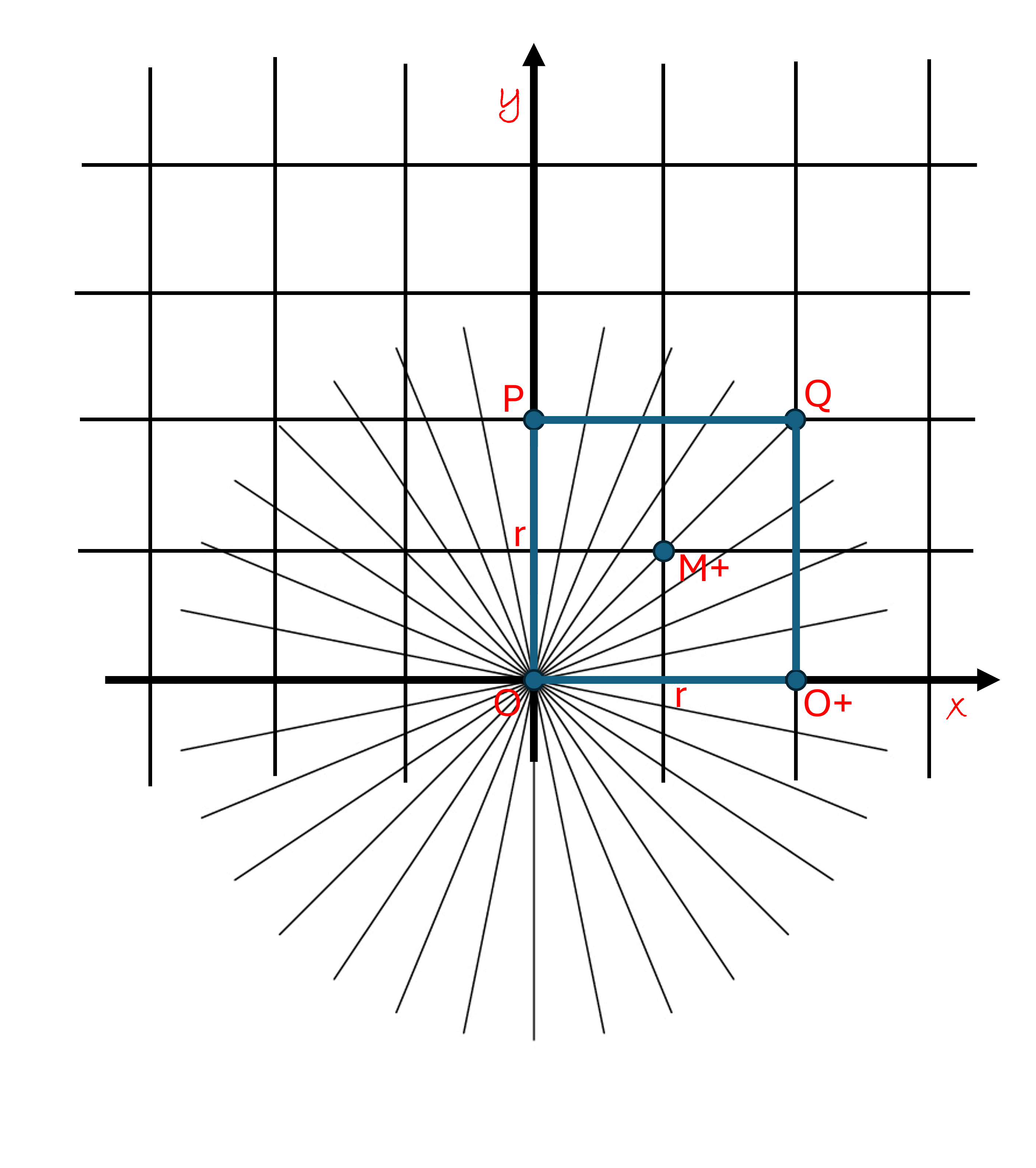
In the last post’s “cartesian grid” diagram, if you remember, the radial lines went through the point P. By reflection symmetry, I can reflect these radial lines onto any cartesian grid point I want. In the diagram above, I decided to reflect the radial lines so they now radiate from point O. I now choose point O to be the reference point.

I choose one of the “cartesian” directions to be from the reference point O to the point O+, I will call this direction the positive “x” direction, labeled by the red script “x”. I call this line the “x” axis, shown as a bold horizontal line in the diagram.

The second “cartesian” direction I choose to be from the reference point O to the point P. I call this direction the positive “y” direction (as customary), and label it with a red script “y”. This vertical line in the diagram is called the “y” axis and is bolded. There are always two perpendicular independent directions I can choose in a 2-D space. The axiom of choice allows me to choose whatever reference point I want and whatever two reference directions I want. As mentioned before, the right to choose is one of the fundamental concepts of math.

Alright, let’s talk money. In 1-D space, distance is everything, it is the most valuable asset, but in 2-D, distance alone is not worth anything. A piece of land that is 10 meters long has no value until you know how wide it is. The real estate of 2-dimensional space is called “area”. Area is measured by how many squares, or fractions of squares can fit within a given border. The number of squares determines the value.

In the diagram, we form a square by taking the segment O O+ (of length r) and the perpendicular segment O P (also of length r) and reflecting them through M+ to form the opposite sides P Q and O+ Q. Note that we found a point Q that is exactly the distance “r” from both the “x” and the “y” axis. This square (in green) now has value, it is the real estate of 2-D space.

We have seen that the whole 2-dimensional space can be “tiled” with the squares of a cartesian grid. The number of “tiles” within a boundary determines the area. For example, in the diagram above, the green r x r square has 4 cartesian tiles inside. Each side has 2 tiles and 2 x 2 = 4 tiles. Since we could shrink the size of the tiles, we could also fill the square with lots of tiny tiles. From this, it can be deducted that the area of the square is found by multiplying the length of the square by the width of the square (r x r = r2).

The area of the green square in the diagram is r2. In 2-dimensions, the “real estate” or area is always measured as a distance times a distance, like a square meter, or a square foot. In 2-D, a line segment alone has no width, and so it has no area, and thus line segments have no real value in 2-D space.

In concept, you can fit an infinite amount of parallel line segments into a square no matter how small it is. This becomes clear when we recall the same concept in 1-D space to show that an infinite number of points can fit between any two points on a line segment, no matter how small.

Standard

Math Moments – Constructing Parallel Universes

The diagram above (which looks a little like Homer Simpson) shows you how to build a 2-dimensional universe from 1-dimensional universes. There is a lot in the diagram so we will go over it a piece at a time then you can use your imagination to build another universe.

Start with the original 1-dimensional line, the one that passes through the points labeled O, and O+ on the diagram. Remember that we need only 2 points on the line, any 2 of them will generate the whole line. We then need to find another point, labeled P, that is not on the original line. The lines radiating out of the point P represent all the lines connecting P with all the points on the original line “O”.

Each one of the line segments between point P with a point on the line spans a different distance. We find a line of symmetry with respect to P by finding the segment with the shortest distance. This segment goes to the point labeled O. Point O is an important point of reflection, a point of symmetry on the line with respect to P, any point on the positive side of O and its reflection on the negative side of O has the same distance to Point P.

We use the label “r” to refer to the distance between point P and point O. In math language, the symbol “r” reminds us of a “radial” distance from the point P. This r distance is referred to as the “distance” between P and the line. If we put together all the points (on the radial lines) that are a distance r from point P, we form a circle of radius r around P. Notice that since r is the shortest distance between P and the line, this circle only touches the line at point O and cannot reach the line anywhere else. Can you find this circle in the diagram?

The line passing through O and P is a special line of symmetry in this case. It is often called the “normal” of the line that passes through point P. It is also called the perpendicular to the line passing through P. Any set of points on the “positive” side of a line can be reflected onto the “negative” side by finding the perpendiculars passing through the points and then reflecting the points along their perpendicular lines the same distance on the “negative” side of the line. In this diagram, this symmetry is obvious, every point on the right (+) side of the perpendicular (O P) is a reflection of points the left (-) side and vice versa.

In the diagram, we show the point O+ on the positive side of the original line at a distance r from the point O. Its reflection on the negative side is labeled O-. We can easily see that the line (O O+) is also the perpendicular of the line (O P). If we wanted to, we could reflect this whole diagram through the original line and we would get the diagram flipped upside down on the bottom half. For clarity’s sake, I didn’t do this in the diagram.

You might be starting to see the amazing symmetries represented in this diagram. It gets even more obvious when you look at the midpoint between O+ and P. This is labeled M+. Its reflection is labeled M-. If we draw a line segment between M+ and M-, as shown in the diagram, notice that it is also perpendicular to the line of symmetry. To show this better I drew a circle around point M+ and M- that touches the perpendicular line at one point. It also becomes obvious that M+ and M- are the same distance from the original line O O+, by symmetry. All distances are preserved upon reflection.

Alright, now we use our imagination to see what would happen if we drew another perpendicular to the original line through point M+ and another through M-. We can use the small circles drawn to visualize where the circle touches the line to draw these perpendiculars. We can now reflect everything in the middle of these perpendiculars on either side. Like two mirrors facing each other, the reflections go on forever in both directions.
From these symmetries, the line M- M+ can be shown to always be the same distance away from the original line forever in both directions. These lines will never cross.

We have finally found two parallel 1-dimensional spaces that do not intersect each other. Do you think you could find an infinite number of parallel lines in the vertical direction by using reflections?

This is a concept utilized by the mathematician Rene Descartes. He built what is known as the Cartesian plane, composed of infinitesimally close parallel vertical and horizontal lines all normal to each other. These concepts give us many ways to look at 2-dimensional space. One of the most important qualities of this space is that it is assumed to be exactly the same in all directions. Very flat indeed.

Standard

Math Moments – Expanding into Parallel Universes

Alright, this is where it starts getting really interesting. We started out saying that we can use the language of math to build universes, at least in our imagination. We started out with (1) one point in the whole universe. Since a point has no size, the whole universe was simply a 0-dimensional space (a bit mind blowing).

After thinking about nothing for a while, we then thought about having (2) two points in the universe. We argued the concept of distance between these two points. We imagined two distinct completely identical points separated by a distance, this is the origin of the concept of the number 2. We then discussed a way to build a whole 1-dimensional space of points, a line between the two points.

We said that we could fill in the points on a line between these two points by first creating a midpoint a distance half-way between these points then, including the midpoint, use the same concept to create more new points in the middle of these points, and so on forever filling in the gaps (a bit more mind blowing).

We realized that there are an infinite number of points that can fit between our original 2 points, each of them described by the distance and direction they are from the midpoint. We started finding other points to fill in all the gaps between points.

We introduced the concept of symmetry; for every point on the line, everything must look exactly the same in both directions. This symmetry concept required that every point on the line has the same arrangement of points in either direction. If we ever found a point where the line ends, we could just add another segment onto the empty direction and keep doing this forever. This complete infinite 1-dimensional space of points is called a “line” (oh, the things we can think).

We named the two directions in this 1-dimensional space to be “negative” and “positive”. We can now choose any of the points to be a reference point and describe the position of any point in this space by its distance and direction from the reference point. We have thus introduced the number line.

I hope you enjoyed this line of reasoning so far. We can now use the same line of reasoning we used to expand 0-dimensional space into 1-dimensional space in order to expand a 1-dimensional space into a 2-dimensional space.
As before, we only need to take the points we have in a 1-D space, on the line, and introduce another new point that is not in that space, not on the line. With this new point, we can now define another line by using this new point and any of the points on the original line to create a new line going in a different direction.

Since we can now create a distinct new line through the new point for every point on the original line, we have created an infinite array of new lines (1-D spaces) going off in different directions. Since the points on the original line can be infinitesimally close together, so are the lines. We include all the points on all these lines as part of a new 2-D space. We now have lots of points to connect together to form new lines. All these lines are said to live in this new 2-D space. An ancient mathematician, Euclid, studied these spaces, in honor of him, these “flat” spaces, of straight and parallel lines are called Euclidean spaces.

There are still some gaps. For example, there is a line that passes through the new point that is not connected to the original line, this line is said to be “parallel” to the original line, and since it never can cross the original line, it does not contain any of the points of the original line. As it turns out, building parallel lines using the tools we have requires a bit of doing.

Standard

Math Moments – Extending Spaces into New Dimensions

So far, we have been exploring a 1-dimensional “space” of points along an infinitesimally thin line. Mathematicians call this a 1-dimentional space. The concept of symmetry implies that the line looks exactly the same in both directions. Therefore, this line must extend on forever in both directions, there is no point on the line where it ends. The line looks exactly the same on both sides of every point.

The concept of point symmetry in 1-dimensional space also means that if you were to reverse the direction of the “ruler” that measures the distance between any two points in this space, you will still measure the same distance between the points. This concept of invariance of direction is one of the most important characteristics of space. Of course, we need a lot more than just one line to describe all the space around us.

In order to expand the dimensions of space beyond this 1-dimensional space, we must assume that there is some point that is not in this space, a point that is not on the line. When we find a point that is not on the line, we can create a new line between any point on the line and the new point. This defines a new 1-dimensional space (a line) for every point on the original line, all of these new lines pass through the new point.

Since there are an infinite number of points on the original line, we see that there are an infinite number of 1-dimensional lines that can be drawn through the new point all in different directions. The space formed by this infinite number of lines is called a 2-dimensional space. It is called 2-dimensional due to the “language” necessary to describe the location of any point in this space. To locate any point, we must choose a reference point, then first (1) we need to choose one of the lines passing through the reference point, and second (2) we use the methods we have already discussed to determine the location of a point along this reference line. Thus, the location of a point thus requires 2 numbers, one (1) to locate the reference line, and the other (2) to determine the location of the point along this line.

The concept of point symmetry in 2-dimensional spaces also comes into play. It means that measuring distances is the same in every direction. This invariance of direction means that if we have a “ruler” that measures a distance along any of the lines in this space, and we change the direction of the ruler, the length of the ruler does not change.

Imagine how the world would look if measuring lengths in one direction were different than lengths in another direction. If the invariance of direction was not true, then when we changed direction, the distance between things would shorten or lengthen, depending on which direction we faced. This is not what we experience in real life.

We can use the same concepts that we used to extend 1-dimensional space to 2-dimensional space to extend into spaces into any number of dimensions. How many distinct points do you need to generate a 3-dimensional space? Think about it. We will discuss how it can be done later.

Standard

Math Moments – The power of symmetry

If we were to consider any two points in the universe (A and C) and draw an imaginary line segment between these two points, there would be only one singular point on that line segment that preserves symmetry (under reflection). This is the midpoint (B) on the line segment which is exactly the same distance from each of the endpoints. You can reflect (flip) either one of the endpoints through the midpoint and it would fall exactly on the other endpoint. Such symmetry applies to all points on the line segment that are the same distance from this midpoint.

If you were to pick the midpoint as the reference point and the positive direction pointing toward one of the endpoints, then from the midpoint, the line segment in the positive direction looks exactly the same as the line segment in the negative direction. You could conceptually switch the positive direction with the negative direction, and nothing would change. This is called reflection symmetry, for obvious reasons.

If you have reflection symmetry, then anything that exists at a certain distance along the positive direction, also exists at that same distance in the negative direction; just like looking at things through a mirror. We use such symmetries in atomic physics all the time to make things easier.

For example, the electric field between two identical electrons, as observed from the midpoint between them, looks exactly the same when you are facing one electron as it does when you are facing the other. From the midpoint, everything is exactly the same in both directions, you cannot tell the difference between the electrons nor any of their physical properties from this perspective. To tell the difference, you would need to “break the symmetry” by introducing something else that is not symmetric to the midpoint.

So, once you have seen what exists on one side of the “mirror” we also know what will exist on the other side. It makes the math (and the diagrams) so much easier. We always should seek out these points of symmetry when we are doing the math, it makes everything so much more…symmetric.

Standard

Math Moments – How many Points are on a Line Segment?

If you have fun with the concept of being able to zoom in to a single Point forever, always getting closer and closer but never arriving, you are one step closer to understanding the concepts of advanced math and calculus.
You saw that with any two points you could always find a point that is exactly in the middle. You can then take this midpoint as a new end point and find another point that is in the middle of it. Since points have no size, you can keep on cutting these line segments in half forever.


No matter how close two points are together, you can still find a point in the middle. Thus, there are an infinite number of points in any line segment, no matter how short it is. This is an example of the concept of a countably infinite set of points. It is possible to write out list the location of these points as their distance from the reference point: 1/2, 1/4, 1/8, 1/16, … and so on forever.


You could just as well cut the segments into thirds, with the location list of points: 1/3, 1/9, 1/27, … and so on forever. Notice that this list of points does not have any of the same points as the one in the last paragraph. So, it appears like you could go on forever filling in all the gaps by dividing the segments up evenly and still never fill in all the gaps. So how many points can fit into the line segment between any two endpoints, no matter how short? Can we ever find a way to fill in all the gaps between points? To fill in all the points between any two points, we would need what is called an uncountably infinite number of points. This is a concept that mathematicians have not yet resolved.

Standard

Math Moments – The Number Line

Let’s imagine that you have a universe with only two points in it. You now draw a line segment between the two points and choose one of them to be the reference point. The location of any point along the line segment is now determined by the distance it is from the reference point. Now make a third point on the line segment that is exactly half-way between the two points. This new point is located at exactly half of the distance between the two end points.


Can you see the symmetry that is formed by these three points? The distance from the center point to either of the two end points is exactly the same. If you now were to choose the center point to be the reference point, then both end points would be the same distance away, but in opposite directions.


You would now need more than just the distance measurement alone to determine the location of points along the line. With three points, now direction becomes important. Again, using the axiom of choice and can choose which direction from the center point is positive, and which direction is negative.


We can then, finally, determine the location of every point on the line by specifying both a distance and a direction (positive or negative) from the center point. This arrangement of determining the locations of points on a line is called a “number line”. We call the distance and direction of each point on the line the Point’s coordinates. A Point’s coordinates uniquely determine its location on the line. Finally, we have a way of determining the location of a Point.


The center point is a special point of symmetry between the two endpoints. We can “rotate” the direction (exchange negative for positive directions) and the location (distance and direction) of the two identical endpoints would be exactly the same. This is called “rotational symmetry”. It means you can switch reference directions and the list of all the point coordinates will be the same. Remember that since you can’t tell the difference between points, the order of the list of points is not important.


Please believe me, taking the time to understand these concepts makes math so much more fun and easier later on. Learning these concepts is like learning the basic vocabulary of the math language.

Standard