
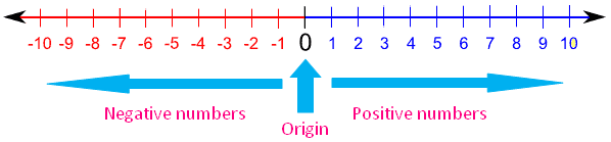
Let’s imagine that you have a universe with only two points in it. You now draw a line segment between the two points and choose one of them to be the reference point. The location of any point along the line segment is now determined by the distance it is from the reference point. Now make a third point on the line segment that is exactly half-way between the two points. This new point is located at exactly half of the distance between the two end points.
Can you see the symmetry that is formed by these three points? The distance from the center point to either of the two end points is exactly the same. If you now were to choose the center point to be the reference point, then both end points would be the same distance away, but in opposite directions.
You would now need more than just the distance measurement alone to determine the location of points along the line. With three points, now direction becomes important. Again, using the axiom of choice and can choose which direction from the center point is positive, and which direction is negative.
We can then, finally, determine the location of every point on the line by specifying both a distance and a direction (positive or negative) from the center point. This arrangement of determining the locations of points on a line is called a “number line”. We call the distance and direction of each point on the line the Point’s coordinates. A Point’s coordinates uniquely determine its location on the line. Finally, we have a way of determining the location of a Point.
The center point is a special point of symmetry between the two endpoints. We can “rotate” the direction (exchange negative for positive directions) and the location (distance and direction) of the two identical endpoints would be exactly the same. This is called “rotational symmetry”. It means you can switch reference directions and the list of all the point coordinates will be the same. Remember that since you can’t tell the difference between points, the order of the list of points is not important.
Please believe me, taking the time to understand these concepts makes math so much more fun and easier later on. Learning these concepts is like learning the basic vocabulary of the math language.

